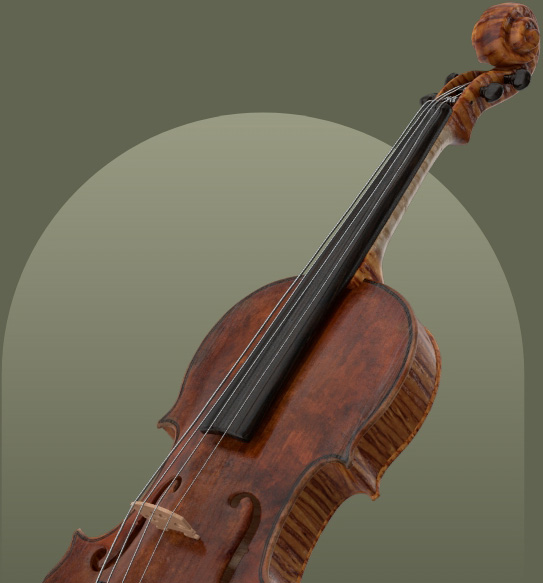
Giacomo Rivolta
Milan, 1780–1850
Giacomo RIVOLTA (1780-1850) was a Milanese luthier who worked at the sign of 'Santo Re Davide' in Contrada Santa Margherita. Active from approximately 1800 to 1834, he was known for instruments derived from Gagliano and Stradivari models, exhibiting good workmanship. His craft featured a low rounded arch, deeply fluted edges, and small, neatly cut soundholes. While materials varied, his violas, cellos, and especially his guitars were highly regarded. He received a gold medal in 1816 for Stradivari copies and was recognized for reviving the Stradivari school. A double bass by Rivolta is preserved in the Milan Conservatoire.
Auction Price History
Highest auction price
7 results
| Type | Details | Auction house | Sold | Price |
|---|---|---|---|---|
| Violin | Labelled Giacomo Rivolta fece. Milano 1830. Premiato di Medaglia d'argento, indi di ..., head later Lot 173 | Ingles & Hayday | June 2021 | £48,000est. £ 40,000-60,000 |
| Viola | 42.0 cm Milan, 1830 c. | — | October 2010 | £81,000 |
| Violin | 35.9 cm Milan, 1830 (the head later) | — | October 2010 | £42,050 |
| Violin | 35.9 cm 19th C. Ascribed to | — | October 2008 | £3,750 |
| Violin | 35.6 cm Milan, 1830 c. Probably by | — | October 2007 | £13,700 |
| Cello | Milan, 1820 | — | May 2005 | £64,504 |
| Violin | 1996 | — | March 2001 | £2,070 |
No results match those filters.
Maker Overview
Life
Giacomo RIVOLTA (1780-1850) was born in 1780 and died in 1850 in Milan, Italy. He worked at the sign of 'Santo Re Davide' in Contrada Santa Margherita. His active period is noted as approximately 1800 to 1834, with Cecie Stainer mentioning his work around 1822. Rivolta was awarded a gold medal for two violas, which were copies of instruments by Stradivari obtained from F. Mantegazza in 1816. He was also recognized with a silver medal, and subsequently a gold medal, for having revived the school of the celebrated Stradivari.
Characteristics
- Models
- Giacomo Rivolta's instruments were derived from the models of Gagliano and Stradivari, with Karel Jalovec noting very good workmanship on the patterns of Stradivari and Nicolo Gagliano. Willibald Leo Lütgendorff describes him as a skilled imitator of the Gagliani.
- Arch
- His instruments featured a low rounded arch.
- Edges
- The edges were deeply fluted.
- Soundholes
- The soundholes were rather small, neatly cut, and positioned close to the edge.
- Scrolls
- The scrolls were described as a little heavy and not deeply carved.
- Varnish
- used a fine light golden-brown varnish over a dark ground. Henri Poidras, however, describes a Neapolitan yellow varnish.
- Materials
- The quality of materials used by Rivolta was variable.
- Workmanship
- Cecie Stainer notes that his instruments show good work, and Karel Jalovec highlights his very good workmanship.
- Instruments Made
- Rivolta produced violas and cellos, which were considered very effective. He devoted more care to the building of 'celli, and his contrabasses were also of good quality. A double bass made by him is preserved in the Milan Conservatoire. He also made guitars, which, greatly contributed to his reputation. Willibald Leo Lütgendorff states that his cellos were better than his violins, and his guitars were his best instruments.
- Jacobus Rivolta
fecit Mediolani, 1817John Dilworth - Giacomo Rivolta
in Milano, 1805
all’ insegna del Santo Re Davide Giacomo Rivolta fece Milano, 1828John Dilworth - G.R.
Premiato di medaglia d’argento indi di quella d’oro
per aver fatto risorgere la scuola del celebre
Stradivari Giacomo Rivolta
Nella Contrada de Sta Margherita
all’ Insegna del Sto Re Davide
Milano 18..John Dilworth
Influence and legacy
- School/Tradition: Willibald Leo Lütgendorff suggests that Rivolta probably emerged from the Gagliani school. Henri Poidras notes that Rivolta seems to have worked with Gagliano, whose style he recalls.
- Awards: Giacomo Rivolta was awarded a gold medal for two violas, copies of Stradivari, in 1816. He also received a silver medal, followed by a gold medal, for his efforts in reviving the school of the celebrated Stradivari.
- Preserved Instruments: A double bass made by Rivolta is preserved in the Milan Conservatoire.
Further Information
- Labels: Examples of his labels include: Jacobus Rivolta / fecit Mediolani, 1817; Giacomo Rivolta / in Milano, 1805 / all' insegna del Santo Re Davide; Giacomo Rivolta fece Milano, 1828; G.R. / Premiato di medaglia d'argento indi di quella d'oro / per aver fatto risorgere la scuola del celebre / Stradivari; and Giacomo Rivolta / Nella Contrada de Sta Margherita / all' Insegna del Sto Re Davide / Milano 18..
Biographies
The overview above is drawn from the following published accounts. Read them in the original:
John Dilworth+
RIVOLTA, Giacomo Born 1780, died 1850 Milan Italy. Worked at the sign of ‘Santo Re Davide’, Contrada Santa Margherita. Gagliano and Stradivari derived models. Low rounded arch. Edges deeply fluted and soundholes rather small, but neatly cut and positioned close to the edge. Scrolls a little heavy and not deeply carved. Fine light golden-brown varnish over dark ground. Materials very variable in quality. Violas and cellos very effective. Double bass is preserved in the Milan conservatoire. Awarded gold medal for two violas, copies of Stradivari obtained from F. Mantegazza 1816. Also made guitars, etc. Jacobus Rivolta / fecit Mediolani, 1817 Giacomo Rivolta / in Milano, 1805 / all’ insegna del Santo Re Davide Giacomo Rivolta fece Milano, 1828 G.R. / Premiato di medaglia d’argento indi di quella d’oro / per aver fatto risorgere la scuola del celebre / Stradivari Giacomo Rivolta / Nella Contrada de Sta Margherita / all’ Insegna del Sto Re Davide / Milano 18..
Cecie Stainer+
A maker in Milan about 1822. His instruments show good work. A viola was dated 1806.
Willibald Leo Lütgendorff+
In der Arbeit und dem Lack ein geschickter Nachahmer der Gagliani und wahrscheinlich aus deren Schule hervorgegangen. Besser als seine Violinen sind seine Violoncelli, am besten jedoch seine Guitarren.
Henri Poidras+
This maker seems to have worked with Gagliano, whose style he recalls. Neapolitan yellow varnish. His ‘cellos are among his best instruments. His guitars greatly contributed towards making his reputation.
Karel Jalovec+
Milan. 1800—1834. Very good workmanship on the patterns of Stradivari and Nicolo Gagliano. He devoted more care to the building of ‘celli. Likewise his contrabasses are of good quality.
Sell your instrument with Amati
Get started by uploading photos of your instrument for our experts to review.
Sell your instrument with Amati
Get started by uploading photos of your instrument for our experts to review.