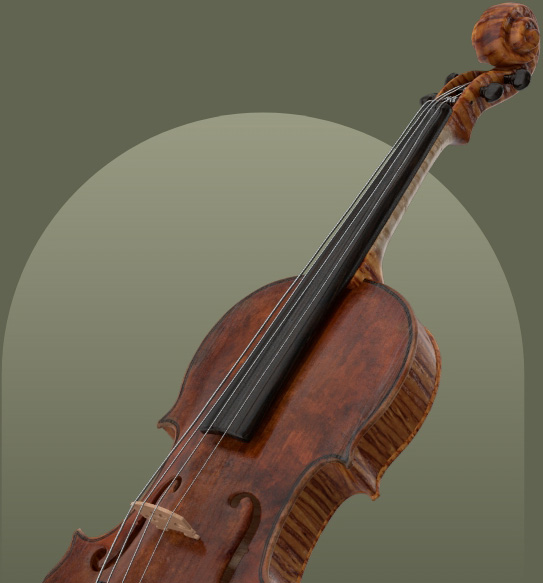
Carl Schulze
worked 1882–1908
Carl Schulze, active in Berlin circa 1882-1908, was a luthier and acoustician renowned for his scientific approach to violin making. Inspired by Helmholtz and the principles of the old Cremonese school, he developed a unique Stradivari-inspired model based on physical laws of musical intervals. Schulze conducted various experiments, including a violin without ribs, and published his findings in the book Stradivari's Geheimniss. Ein ausführliches Lehrbuch des Geigenbaus (1901). He also served as a repairer for the Royal Collection of Old Musical Instruments in Berlin, and one of his experimental violins is preserved in the Berlin Museum.
Request an expert valuation or learn how our global auctions achieve the highest prices for your instruments.
Maker Overview
Life
Carl SCHULZE (circa 1882-1908) worked in Berlin, Germany. He was a dedicated student of acoustics and geometry, drawing inspiration from the works of Helmholtz. Schulze was known for his theoretical approach to violin making, aiming to create instruments based on scientific principles rather than solely empirical methods. He also held a position repairing string and plucked instruments for the königl. Sammlung alter Musikinstrumente zu Berlin (Royal Collection of Old Musical Instruments in Berlin).
's Die Geigen- und Lautenmacher vom Mittelalter bis zur Gegenwart, Schulze announced that he made his violins "nach physikalischen Gesetzen, nach den bisher geheimen, von mir erforschten Grundsätzen der alten Cremoneser Schule" (according to physical laws, according to the hitherto secret principles of the old Cremonese school, which I have researched). He published his findings and methods in his book, Stradivari's Geheimniss. Ein ausführliches Lehrbuch des Geigenbaus (Stradivari's Secret. A Detailed Textbook of Violin Making), published in Berlin in 1901 by Fussinger's Buchhandlung.
Characteristics
- Theoretical Principles
- Carl Schulze designed his personal violin model based on strict theoretical principles, aiming to uncover the "secret principles of the old Cremonese school" through physical laws.
- Stradivari Model
- He used the works of Stradivari from the years 1700-1725 as classical prototypes, striving to develop a "gewissermaassen typisches Stradivari-Modell" (a somewhat typical Stradivari model) based on the physical laws of intervals.
- Proportional Ratios
- Schulze's model incorporated specific proportional ratios derived from musical intervals: the bridge point divided the fundamental length in a 6:5 ratio (corresponding to a minor third), the length of the upper part to the middle part was 5:4 (a major third), and the ratio of the lower part to the middle part was 3:2 (a perfect fifth). The soundpost's position divided the internal length in a 4:3 ratio (a perfect fourth), and the octave interval (2:1) was found in the division of the air volume by the soundpost.
- Experimental Construction
- He conducted various eccentric experiments, including constructing a violin without ribs, where the longitudinal and cross-sections formed ellipses. The purpose of this experiment was to determine whether elliptical arches and curves or pure circular arches were better suited for violin making. Although the tone of this experimental violin was better than expected, it ultimately showed that circular arches were more favorable than ellipses, parabolas, and hyperbolas for violin construction.
- Internal Measurements
- Schulze meticulously measured the internal parts of violins, concluding that the old masters endeavored to avoid interference of vibrations. He found that the length measurements corresponded to the ratios of consonances, while the width measurements corresponded to those of dissonances in music.
- Free Vibrating Surfaces
- In his research on the eigenfrequencies of the top and back plates, Schulze arrived at similar conclusions to Dr. Grossmann, determining the arithmetic ratios for the freely vibrating surfaces within the rib garland.
- Gef. Carl Schulze
in Berlin 18..John Dilworth
Influence and legacy
- Inspiration: Carl Schulze was notably inspired by the works of Helmholtz, a prominent figure in acoustics.
- Cremonese School: He dedicated his research to understanding and applying the "hitherto secret principles of the old Cremonese school" to his violin making.
- Published Work: Schulze authored the significant book, Stradivari's Geheimniss. Ein ausführliches Lehrbuch des Geigenbaus (Stradivari's Secret. A Detailed Textbook of Violin Making), published in Berlin in 1901, which presented his extensive investigations and new perspectives on violin construction.
- Museum Preservation: One of his experimental violins, specifically one made without ribs, is preserved in the Berlin Museum in The Brompton’s Book of Violin & Bow Makers.
Further Information
- Workshop Location: Carl Schulze worked in Berlin, Germany.
- Repair Work: He was responsible for repairing string and plucked instruments for the königl. Sammlung alter Musikinstrumente zu Berlin (Royal Collection of Old Musical Instruments in Berlin).
- Label Inscription: An example of his label reads: "Gef. Carl Schulze / in Berlin 18.. No.."
Biographies
The overview above is drawn from the following published accounts. Read them in the original:
John Dilworth+
SCHULZE, Carl Worked circa. 1882-1908 Berlin Germany. Student of acoustics and geometry, inspired by the works of Helmholtz. Designed a personal violin model on strict theoretical principles. Various eccentric experiments including a violin without ribs is preserved in the Berlin Museum. Also worked to a ‘Golden Period’ Stradivari model. Author of Stradivaris Geheimnis – ein ausführliches Lehrbuch des Geigenbaues (Berlin, 1901). Gef. Carl Schulze / in Berlin 18.. No..
Willibald Leo Lütgendorff+
Er macht seine Geigen, wie er ankündigt, »nach physikalischen Gesetzen, nach den bisher geheimen, von mir erforschten Grundsätzen der alten Cremoneser Schule«. Als classische Vorbilder dienen, wie er sagt, die Werke von Stradivari aus den Jahren 1700—1725. Er bemüht sich, auf Grund der physikalischen Gesetze der Intervalle »ein gewissermaassen typisches Stradivari-Modell« herauszubilden. Bei seinem Modell theilt der Stegpunkt die Grundlange im Verhältniss von 6:5, entsprechend dem Intervall der kleinen Terz. Die Länge des Obertheils ist zu der des Mitteltheils wie 5:4, der grossen Terz entsprechend. Das Verhältniss des Untertheils zum Mitteltheil 3:2 giebt die Quinte. Der Stand der Stimme theilt die innere Lange in zwei Theile im Verhältniss von 4:3 gleich dem Intervall der Quarte; das Intervall der Octave 2:1 findet sich in der Theilung des Luftraums durch den Stand der Stimme. Als Versuch führte er eine Geige ohne Zargen aus, deren Längen- und Querschnitte Elipsen bilden. Zweck dieses Versuchs war, festzustellen, ob sich Bögen und Wölbungen in Elipsenform oder reine Zirkelbögen besser für das Geigenmachen eignen. Der Ton der Geige war besser als man vermuthen sollte, aber es zeigte sich doch, dass die Zirkelbögen für das Geigenmachen günstiger sind als Elipsen, Parabel und Hyberbel. Seit dem Bestehen der königl. Sammlung alter Musikinstrumente zu Berlin reparirt er für diese die Streich- und Rupfinstrumente. Er schrieb das Buch: »Stradivari’s Geheimniss. Ein ausführliches Lehrbuch des Geigenbaus«. (Fussinger’s Buchhandlung. Berlin W. 35.), in welchem er auf Grund mühevoller Untersuchungen zu manchen neuen Gesichtspunkten kommt. Er maass die Theile der Geige von Innen und fand, dass die alten Meister sich bemühten, Interferenzen der Schwingungen zu vermeiden, und dass die Längenmaasse den Verhältnisszahlen der Consonanzen, die Breitenmaasse denen der Dissonanzen in der Musik entsprechen. In Bezug auf die Eigentöne von Decke und Boden kommt Schulze übrigens ungefähr zu denselben Ergebnissen, wie Dr. Grossmann. Schulze bestimmt auch hier die arithm. Verhältnisse für die frei schwingenden Flächen, als innerhalb des Zargenkranzes, während Dr. Grossmann die überstehenden Ränder und die aufgeleimten Theile ganz unberücksichtigt lässt.
Sell your instrument with Amati
Get started by uploading photos of your instrument for our experts to review.
Sell your instrument with Amati
Get started by uploading photos of your instrument for our experts to review.