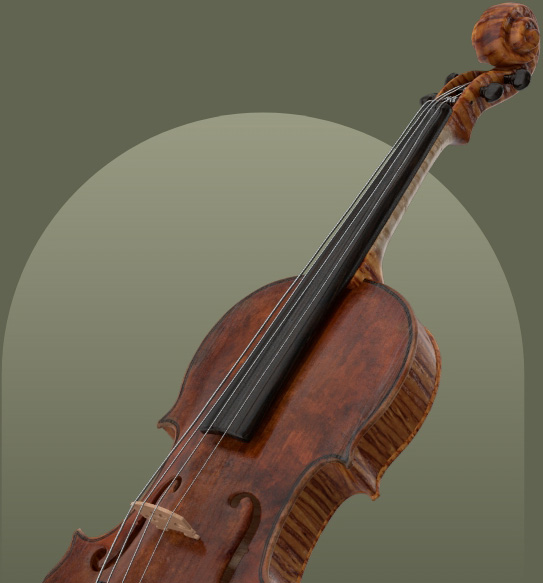
Georg Frederic Schwartz
Auction price history
Highest auction price
£14,983
| Type | Details | Sold | Price |
|---|---|---|---|
| Violin Bow | S/E 58 g. without winding | December 2010 | £4,660 |
| Violin Bow | N/E 60 g. France, mid-19th C. [Atributed to] | October 2010 | £6,875 |
| Violin Bow | S/E 60.0 g. | April 2010 | £10,998 |
| Viola Bow | S/E 58.0 g. | April 2010 | £2,137 |
| Cello | 75.5 cm Strasbourg, 1847 | May 2008 | £14,983 |
| Cello Bow | G/E 76 g. without winding (frog chevall) [Made for] | December 2007 | £4,935 |
| Violin Bow | S/E 60.0 g. | May 2007 | £7,512 |
| Cello Bow | S/E 81 g. | June 2003 | £10,738 |
| Violin Bow | G/E 59 g. | June 2001 | £920 |
| Cello Bow | S/E 79 g. | November 1989 | £4,180 |
| Violin Bow | S/E 60 g. | July 1985 | £3,520 |
Maker Overview
History
Georg Frederic SCHWARTZ (1785-1850) was born on April 7, 1785, in Strassburg, and died on December 29, 1849, in Strassburg, according to Cecie Stainer, though John Dilworth states his death year as 1850. He was the son and pupil of Bernard Schwartz.
Sources contain conflicting information regarding the continuation of the family business. According to Willibald Leo Lütgendorff and Cecie Stainer, Georg Frederic Schwartz, along with his brother Théophil Wilhelm, continued their father's business from 1821, which became known as "Freres Schwartz" after their father's death. However, John Dilworth states that Georg Frederic's workshop continued after his own death by his brother, Théophil.
Georg Frederic Schwartz specialized in bow making from approximately 1810, focusing predominantly on this craft, while his brother Théophil was chiefly concerned with instrument making within the "Freres Schwartz" partnership.
Craft
- Bow Making Style: Georg Frederic Schwartz crafted bows in the style of Tourte.
- Materials and Workmanship: His bows featured particularly fine metalwork and were constructed with pernambuco sticks, often adorned with gold, silver, and tortoiseshell mountings.
- Branding: His bows were typically branded "SCHWARTZ" on one side of the handle and "STRASBOURG" on the other, or generally marked near the nut with "Schwartz, Strasbourg."
- Instrument Production (Freres Schwartz): The partnership "Freres Schwartz" produced very good violins and violoncellos. Their first violin was dated 1824, and between 1824 and 1852, they produced approximately 80 violins and 30 violoncellos.
Influence
- Mentorship: Georg Frederic Schwartz was the son and pupil of Bernard Schwartz.
Legacy
- Reputation: Georg Frederic Schwartz gained a well-merited reputation for his bow making.
- Workshop Continuation: After his death, his brother Théophil continued to use the "SCHWARTZ" brand on German and Mirecourt bows, though these were noted by John Dilworth to be of lesser quality.
Further Information
- Partnership Label: The "Freres Schwartz" partnership used labels such as "Freres Schwartz a Strasbourg 1833 No 15" for their instruments.
- Branding Location: His bows were generally marked near the nut with "Schwartz, Strasbourg."
Summary
Georg Frederic SCHWARTZ (1785-1850) was a prominent bow maker from Strasbourg, France, and the son and pupil of Bernard Schwartz. He specialized in bow making from around 1810, crafting bows in the style of Tourte, known for their fine metalwork and use of pernambuco, gold, silver, and tortoiseshell. His bows were typically branded "SCHWARTZ, STRASBOURG." While he focused on bows, he also participated in the "Freres Schwartz" partnership with his brother Théophil, which produced violins and violoncellos. He earned a strong reputation for his bow making, though the quality of bows bearing his brand declined after his death when continued by his brother.
Biographies
John Dilworth
SCHWARTZ, Georg Frédéric Born 1785, died 1850 Strasbourg France. Bow maker. Son and pupil of Bernard Schwartz, above. Specialist bow maker from c.1810, in the style of Tourte. Particularly fine metalwork, pernambuco sticks with gold, silver and tortoiseshell mountings. Branded SCHWARTZ on one side of the handle, STRASBOURG on the other. His workshop continued after his death by his brother, Théophil, below, who continued to use the brand on German and Mirecourt bows of lesser quality.
Sell your instrument with Amati
Get started by uploading photos of your instrument for our experts to review.
Sell your instrument with Amati
Get started by uploading photos of your instrument for our experts to review.