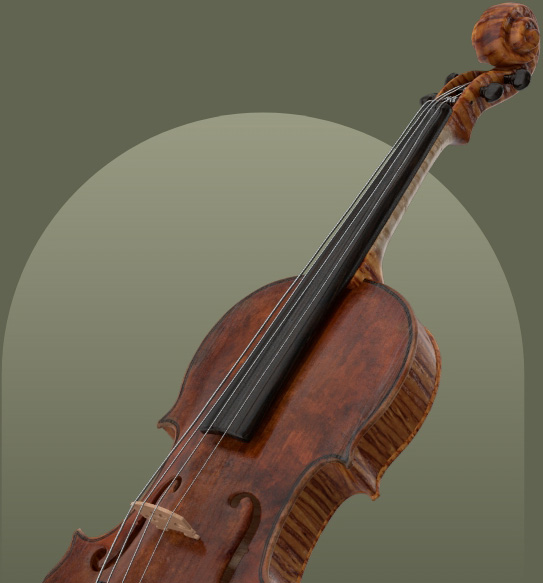
Alfred Stelzner
d. 1906
Alfred STELZNER (circa. 1891-1906) was a German luthier and innovator who studied mathematics and physics at Heidelberg University before designing radical new forms of string instruments, including the Violotta and Cellone. He based his designs on elliptical forms and conic sections, aiming to enhance the resonance of the instruments. His instruments were constructed by Wiedemann in Wiesbaden, and 330 master instruments were built and sold, with his violins fetching 300 to 500 Marks. Notable artists like Ysaye and Wilhelmj provided testimonials, and composers such as Felix Draeseke wrote pieces for his unique instruments, which were also integrated into operas by Max Schillings and Stelzner himself.
Auction Price History
Highest auction price
2 results
| Type | Details | Auction house | Sold | Price |
|---|---|---|---|---|
| Cello | Bearing the maker's label n. 106 and brand to the back Lot 102 | Vichy | June 2023 | £3,420est. € 2.000-3.000 |
| Viola | 39.7 cm 1893 | — | December 1995 | £1,808 |
No results match those filters.
Maker Overview
Life
Alfred STELZNER (circa. 1891-1906) worked in Wiesbaden and died in 1906 in Dresden, Germany. He studied mathematics and physics at Heidelberg University. Alfred Stelzner designed a radical new form of violin based on elliptical forms, which were constructed for him by Wiedemann in Wiesbaden, alongside his equally original cellone and violotta.. Stelzner stated in de Wit's Zeitschr. für Instr.-Bau on October 1, 1895, "Auf die Gefahr hin, Anstoss zu erregen — behaupte ich, künftig noch für die erste Autorität auf dem Gebiete des Streichinstrumentenbaues gewürdigt zu werden, in wörtlichem Sinne als Urheber der endgültigen Form der Resonanzkörper der Streichinstrumente". Lütgendorff observed that among the more recent attempts to reform violin making, Stelzner's were the most interesting, as he achieved results that should not be underestimated. By Stelzner's system, 330 master instruments of all types had been built and sold, with his violins achieving a price of 300 to 500 Marks.
Characteristics
- Design Philosophy
- Alfred Stelzner thoroughly studied the nature of the violin, aiming to increase the energy of the air molecules vibrating within the instrument's body.
- Outline and Arching
- This goal led him to alter the outline of violins, basing the outlines and archings on the conic sections of the ellipse and parabola, and the surfaces created by rotating these curves around their axes.
- Violotta
- Dr. Stelzner invented the Violotta, an arm violin with a body length of 42 cm, similar to a medium-sized viola, strung with four strings tuned in fifths, an octave lower than the violin, and notated in a new G-clef, the inverted violin clef.
- Violotta's Role
- The Violotta was designed to fill a gap in the string quartet between the viola and cello, representing the tenor voice, a need felt by composers such as Händel, Gretry, and Spohr.
- Cellone
- He also invented the Cellone, a knee violin only 2 cm longer in body than the violoncello, with four strings tuned in fifths, an octave lower than the Violotta, and thus two octaves lower than the violin, notated in the bass clef as the notes sound.
- Proposed String Family
- . Stelzner, the future string instrument family, besides the double bass, should consist of three G-violins (violin, Violotta, and Cellone), each differing by an octave in tuning, and the existing two C-violins (viola and violoncello) positioned between them.
- No 330 Dresden 1899
Dr. Alfred StelznerJohn Dilworth
Influence and legacy
- Academic Background: Alfred Stelzner's ability to formulate serious theories about violin making was supported by his thorough study of the violin's essence and his background in mathematics and physics from Heidelberg University.
- Artist Testimonials: Artists such as Ysaye, Wilhelmj, and Massenet provided glowing testimonials about Stelzner's instruments.
- Composers and Literature: A. E. Gerspacher wrote a string quartet for violin, viola, Violotta, and cello; Felix Draeseke composed a string quintet with Violotta; and Arnold Krug, Fd. Behm, and Otto Kaletzsch, among others, wrote string sextets featuring Violotta and Cellone.
- Orchestral Use: Max Schillings was the first to use the Violotta in an orchestra, specifically as a solo instrument in his opera Der Pfeifertag.
- Operatic Integration: In two of Stelzner's own operatic works, Rübezahl (premiered at the Dresden Hoftheater in 1902) and the music drama Swatowit's Ende (premiered at the Hoftheater in Cassel in 1903), the Violotta and Cellone were consistently notated as "gleichberechtigt und gleichbepflichtet" (equally entitled and equally obligated) with the other string instruments and were successfully used in multiple settings.
- Future Evaluation: The definitive decision regarding the value of Stelzner's theory remains reserved for the future.
Further Information
- Working Locations: Alfred Stelzner worked in Wiesbaden and later died in Dresden, Germany.
- Instruments Produced: A total of 330 master instruments of all types were built according to his system.
- Violin Pricing: His violins achieved prices ranging from 300 to 500 Marks.
- Violotta Dimensions: The Violotta has a body length of 42 cm.
- Cellone Dimensions: The Cellone is barely noticeably larger than a violoncello, being only 2 cm longer in body.
Biographies
The overview above is drawn from the following published accounts. Read them in the original:
John Dilworth+
STELZNER, Alfred Worked circa. 1891, Worked Wiesbaden, died 1906 Dresden Germany. Studied at Heidelberg University in mathematics and physics. Designed a radical new form of violin on elliptical forms which were constructed for him by Wiedemann in Wiesbaden, alongside his equally original cellone and violotta. No 330 Dresden 1899 / Dr. Alfred Stelzner
Willibald Leo Lütgendorff+
»Auf die Gefahr hin, Anstoss zu erregen« — schreibt Dr. Stelzner in de Wit’s Zeitschr. für Instr.-Bau am 1. October 1895 — , »behaupte ich, künftig noch für die erste Autorität auf dem Gebiete des Streichinstrumentenbaues gewürdigt zu werden, in wörtlichem Sinne als Urheber der endgültigen Form der Resonanzkörper der Streichinstrumente«. — Es lässt sich nicht leugnen, dass unter den neueren Versuchen, das Geigenmachen zu reformiren, die Stelzner’s die interessantesten sind, weil er immerhin zu nicht zu unterschätzenden Resultaten gelangt ist. Er hat das Wesen der Geige gründlich studirt und brachte alle Vorbedingungen mit, die ihn dazu befähigten, ernst zu nehmende Theorien aufzustellen. Sein Bestreben ist darauf gerichtet, die Energie der im Geigenkörper schwingenden Luftmoleküle zu erhöhen, was ihn zu einer Änderung der Umrisslinien der Geigen veranlasste. Er führt die Umrisslinien und Wölbungen zurück auf die Kegelschnitte der Ellipse und Parabel und die Flächen, die sich ergeben, wenn man diese Curven sich um ihre Axen gedreht denkt. Die Folgerungen, die er daraus zieht, sind geistreich, und die nach seiner Theorie gemachten Geigen haben manches Bestechende für sich, soweit ich dies nach solchen, die mir kurze Zeit zur Verfügung standen, beurtheilen kann. Künstler wie Ysaye, Wilhelmj, Massenet u. v. A. haben über die Stelzner-Instrumente glänzende Zeugnisse ausgestellt. Nach Stelzner’s System sind bisher 330 Meisterinstrumente aller Art gebaut und verkauft worden. Die Violinen erzielten einen Preis von 3 bis 500 M. Eine glückliche Schöpfung Dr. Stelzner’s ist jedenfalls die Violotta, eine Armgeige von der Länge (42 cm Corpuslänge) und Mensur einer mittelgrossen Bratsche mit vier Saiten in Quinten gestimmt, eine Octave tiefer stehend als die Violine und in einem neuen G-Schlüssel, dem umgekehrten Violin-Schlüssel notirt. In der bisherigen Besetzung des Streichquartetts sind die vier verschiedenen Stimmen nur durch drei verschiedene Tonwerkzeuge vertreten. Die Violotta füllt nach Tonumfang und Klangfarbe diese bereits von Händel, Gretry, Spohr und Anderen empfundene Lücke zwischen Viola und Cello und ist Repräsentant der Tenorstimme. Auch ein Cellone hat Dr. Stelzner erfunden, eine Kniegeige, kaum merklich grösser (nur 2 cm länger im Corpus) als das Violencell, mit vier Saiten in Quinten, und zwar eine Octave tiefer als die Violotta, also zwei Octaven tiefer als die Violine gestimmt und im Bassschlüssel notirt, wie die Töne klingen. Die Streichinstrumentenfamilie soll also künftighin nach Dr. Stelzner ausser dem Contrabass, dem mächtigen, unersetzbaren Fundament des Orchesters, bestehen aus drei G-Geigen, der Violine, der Violotta und dem Cellone, je um eine Octave in der Stimmung verschieden und den dazwischen stehenden, bisherigen zwei C-Geigen, der Viola und dem Violoncell. Es giebt bereits eine kleine Literatur für »Stelzner-Instrumente« U. A. schrieb A. E. Gerspacher ein Streichquartett für Violine, Viola, Violotta und Cello, Felix Draeseke ein Streichquintett mit Violotta, und Arnold Krug, Fd. Behm, Otto Kaletzsch u. A. Streichsextette mit Violotta und Cellone. Im Orchester verwendete zuerst Max Schillings die Violotta, und zwar als Soloinstrument in seiner vieler Orts aufgeführten Oper »Der Pfeifertag« und in zwei Operwerken Stelzner’s, dem im Dresdner Hoftheater 1902 zuerst aufgeführten »Rübezahl« sowie in dem Musikdrama »Swatowit’s Ende«, das seine Erstaufführung 1903 im Hoftheater zu Cassel erlebte, sind vom Verfasser die Violotta und das Cellone durchgehends als »gleichberechtigt und gleichbepflichtet« mit den übrigen Streichinstrumenten notirt und in mehrfacher Besetzung erfolgreich zur Verwendung gelangt. — Die endgültige Entscheidung über den Werth der Stelzner’schen Theorie bleibt der Zukunft vorbehalten.
Sell your instrument with Amati
Get started by uploading photos of your instrument for our experts to review.
Sell your instrument with Amati
Get started by uploading photos of your instrument for our experts to review.