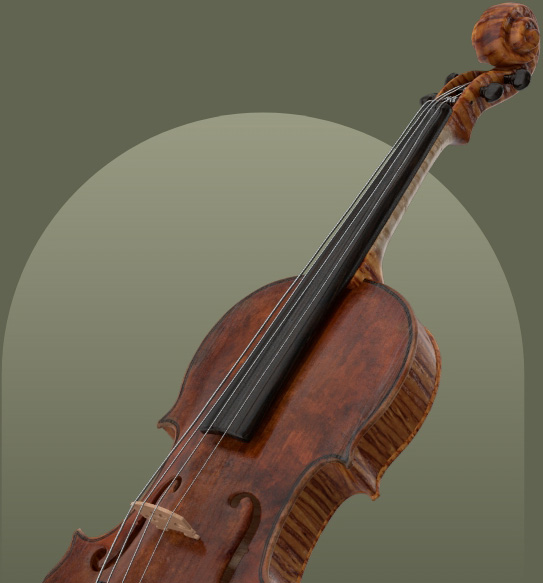
Janos Gyorgy (Johann Georg) Thir
Vienna, c.1710–1779
Janos Gyorgy (Johann Georg) THIR (circa 1710-1779) was a highly regarded Viennese violin maker known for his elegant instruments. Born in Germany, he established himself in Vienna, becoming a citizen in 1738. His violins featured a long, narrow pattern, a high Stainer-style arching (later reduced), and a distinctive varnish that evolved from dark chocolate to a transparent golden-brown. He also crafted violoncellos on a large pattern. After his death in 1779, his successor, F. Geissenhof, continued to use Thir's labels, leading to some attribution complexities for instruments dated after 1779.
Request an expert valuation or learn how our global auctions achieve the highest prices for your instruments.
Auction Price History
Highest auction price
45 results
| Type | Details | Auction house | Sold | Price |
|---|---|---|---|---|
| Violin | Labelled Johann Georg Thir, Lauten-und Geigenmacher in Wienn Anno 17... Lot 42 | — | March 2026 | £7,200est. Estimate £ 6,000-8,000 |
| Violin | Bearing the maker's label, table cracks and restorations, minor back cracks Lot 57 | — | December 2025 | £5,043est. € 3.000-4.000 |
| Violin | Labelled Johann George Thir, Lauten und Geigenmacher in Wienn, Anno 1767 Lot 132 | — | October 2020 | £6,000est. £ 6,000-9,000 |
| Violin | Restorations | — | November 2017 | £3,338est. € 3.000 |
| Viola | Labelled Joannes Georgius Thir fecit, Viennae anno 17... Lot 20 | — | October 2017 | £7,200est. £ 5,000-8,000 |
| Violin | Bearing the maker's label, lion head, some table restorations, table sound post crack Lot 324 | — | December 2014 | £8,005est. € 5.000-6.000 |
| Violin | Bearing the maker's label, some table restorations Lot 462 | — | June 2014 | £7,740est. € 3.000-4.000 |
| Violin | Bearing the maker's label, minor restorations Lot 262 | — | December 2013 | £3,484est. € 2.500-3.000 |
| Violin | Labelled Johann Georg Thir, Lauten und Geigenmacher in Wienn Anno ... Lot 153 | — | March 2013 | £7,200est. £ 3,000-5,000 |
| Violin | Bearing the maker's label, neck blemish, some table and head restorations Lot 268 | — | June 2012 | £5,823est. € 1.000-1.500 |
| Violin | 35.6 cm Vienna, 1756 | — | October 2011 | £6,000 |
| Violin | 36.0 cm Vienna, 1760 c. | — | October 2011 | £5,000 |
| Violin | 35.6 cm | — | June 2010 | £6,600 |
| Violin | 35.8 cm Vienne, 1765-1770 c. | — | June 2010 | £7,249 |
| Violin | 36.0 cm Vienna, 1770 c. | — | May 2009 | £6,988 |
| Violin | 36.0 cm Vienna, 1767 | — | October 2008 | £5,558 |
| Violin | 35.5 cm 18th C. Probably by | — | March 2008 | £2,106 |
| Cello | 75.6 cm Vienna, 1766 | — | November 2007 | £20,400 |
| Violin | 35.0 cm 1760 c. | — | March 2007 | £1,725 |
| Violin | 35.8 cm Vienna, 1770 c. Probably by | — | October 2006 | £3,678 |
| Violin | 35.6 cm Vienna 1765-1770 c. (replaced head, various restorations) | — | June 2006 | £4,856 |
| Violin | Vienna, 1762 | — | November 2005 | £2,526 |
| Violin | Vienna, 1752 | — | June 2005 | £2,012 |
| Viola | 39.1 cm 1767 | — | December 2003 | £9,895 |
| Violin | 1760 c. | — | November 2002 | £4,465 |
| Violin | 1769 | — | October 2001 | £2,270 |
| Viola | 39.1 cm 1772 | — | November 2000 | £5,760 |
| Violin | 1763 | — | November 1999 | £1,600 |
| Violin | 1791 | — | July 1998 | £2,875 |
| Violin | 1760 c. | — | November 1997 | £920 |
| Violin | 17-- | — | November 1993 | £2,453 |
| Violin | 17-- | — | November 1992 | £575 |
| Violin | 1760 | — | November 1992 | £3,520 |
| Violin | 1765 | — | September 1992 | £2,530 |
| Violin | 1760 | — | April 1991 | £1,320 |
| Violin | 1780 | — | June 1990 | £1,961 |
| Violin | 1776 | — | November 1989 | £2,860 |
| Violin | 1780 c. | — | November 1988 | £1,430 |
| Violin | 1776 | — | November 1988 | £1,650 |
| Violin | 1769 | — | March 1988 | £935 |
| Violin | 1750 c. | — | June 1987 | £2,200 |
| Violin | 1760 | — | October 1984 | £1,320 |
| Violin | 1765 | — | October 1982 | £1,812 |
| Violin | 17-- | — | February 1982 | £892 |
| Violin | 1765 | — | February 1982 | £2,735 |
No results match those filters.
Maker Overview
Life
Janos Gyorgy (Johann Georg) THIR (circa 1710-1779) was born around 1710 in Prim, Schongau, Germany, and died in 1779 in Vienna, Austria., he took the citizen's oath on September 1, 1738, and resided in the so-called Wübmer Quarter until approximately 1776, after which tax records indicate he was "behaust" (housed) in the city. He was considered one of the best Viennese violin makers. In 1781, Fr. Gaissenhof became his successor, and it appears Gaissenhof continued to use Thir's labels, leading to the existence of instruments bearing Thir's name and the year 1791. This practice by F. Geissenhof, who completed much of Thir's unfinished work and used his label with dates from 1780-1791, has led to some difficulties in attribution.
Characteristics
- Workmanship
- Thir's instruments are characterized by best quality Viennese style work as "charming and thorough."
- Violin Pattern
- His violins typically feature a long, narrow pattern and a high (Stainer-style) arching. John Dilworth notes that this high Stainer arch was somewhat reduced after 1775. The F-holes are set closely together, approximately 45 mm apart, and the ribs are 32-33 mm high. The scroll is described as large and beautiful.
- Violoncello Pattern
- For his violoncellos, he preferred a large pattern.
- Materials
- John Dilworth states that Thir generally used well-chosen materials.
- Varnish
- His varnish is noted for its color and quality. Willibald Leo Lütgendorff describes it as cherry-wood brown. John Dilworth specifies a dark semi-transparent chocolate varnish in Vienna, which changed after 1750 to a good transparent golden-brown. Henri Poidras mentions a brown-red varnish, while Cecie Stainer describes a dark yellow-brown varnish on a violoncello.
- Notable Instruments
- The Schottenstift in Vienna possesses two good violins made by him from the years 1768 and 1773.
- Johann Georg Thir, Lauten:
und Geigenmacher in Wienn
Anno 1758John Dilworth - Joannes Giorgius Thir, fecit
Viennae, Anno 1765John Dilworth
Further Information
- Labels: Examples of his labels include "Johann Georg Thir, Lauten: / und Geigenmacher in Wienn / Anno 1758" and "Joannes Giorgius Thir, fecit / Viennae, Anno 1765." Cecie Stainer also cites a label: "Johannes Georgius Thir fecit Viennae, anno 1791."
- Successor and Attribution: F. Geissenhof succeeded Thir and used his labels, sometimes with dates as late as 1791, which has created challenges in accurately attributing instruments, especially given Thir's death in 1779. Sources contain conflicting information about the latest date on a label directly attributable to Thir's own work versus those completed and labeled by his successor.
Biographies
The overview above is drawn from the following published accounts. Read them in the original:
John Dilworth+
THIR, János György (Johann Georg) Born circa. 1710 Prim, Schongau Germany, died 1779 Vienna Austria Best quality Viennese style work. High Stainer arch, somewhat reduced after 1775. Elegant long model. Dark semi-transparent chocolate varnish in Vienna. From 1750 changed his recipe to a good transparent golden-brown. Generally well-chosen materials. Succeeded by F. Geissenhof who completed a lot of his unfinished work and used his label (with dates from 1780-1791), leading to some difficulties in attribution. Johann Georg Thir, Lauten: / und Geigenmacher in Wienn / Anno 1758 Joannes Giorgius Thir, fecit / Viennae, Anno 1765 [Benedek]
Cecie Stainer+
Was working in Vienna in 1791. A violoncello of good work, made on a large pattern, had dark yellow brown varnish. Label: “Johannes Georgius Thir fecit Viennae, anno 1791″
Willibald Leo Lütgendorff+
Er legte am 1. Sept 1738 den Bürgereid ab und wohnte bis etwa 1776 im sogen. Wübmer Viertel, dann heisst es im Steuerbuch von ihm: »der Thir ist in der Stadt behaust«. Einer der besten Wiener Geigenmacher. Seine Geigen haben langes, schmales Patron und hohe (Stainer-) Wölbung. Die F-Löcher stehen enge (45 mm) beisammen; die Zargen sind 32—33 mm hoch. Die Schnecke ist gross und schön. Bei seinen Violoncelli bevorzugrt er ein grosses Patron. Sein Lack ist von weichselholz-brauner Farbe. Zwei gute Geigen von ihm aus den Jahren 1768 und 1773 besitzt das Schottenstift in Wien. Im Jahre 1781 wurde Fr. Gaissenhof sein Nachfolger, dieser scheint Thir’s Zettel weiter gebraucht zu haben, da es noch Geigen mit Thir’s Namen und der Jahreszahl 1791 giebt.
Henri Poidras+
Vienna circa 1780. Charming and thorough work. Brown-red varnish. Narrow and high instru ments. The ‘cellos are of a large pattern.
Sell your instrument with Amati
Get started by uploading photos of your instrument for our experts to review.
Sell your instrument with Amati
Get started by uploading photos of your instrument for our experts to review.