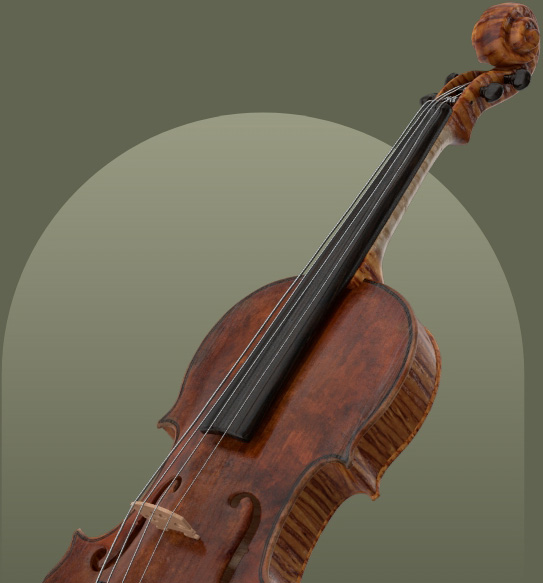
Peter (I) Wamsley
Auction price history
Highest auction price
£5,750
| Type | Details | Sold | Price |
|---|---|---|---|
| Violin | May 2014 | £5,625 | |
| Violin | 35.9 cm London, 1725 [Attributed to] | October 2009 | £2,400 |
| Violin | 36.3 cm (head later) [Attributed to] | July 2007 | £617 |
| Violin | 36.3 cm (the head later) [Attributed to] | July 2006 | £687 |
| Violin | [Attributed to] | March 2004 | £1,434 |
| Cello | 1735 c. | June 1997 | £5,750 |
| Violin | 17-- | November 1996 | £1,495 |
| Cello | 17-- | March 1994 | £3,300 |
| Cello | 1732 | November 1992 | £4,400 |
| Violin | 1730 | June 1990 | £2,200 |
| Violin | 1728 | September 1987 | £660 |
| Violin | 1730 c. | June 1987 | £770 |
| Violin | 1731 | March 1983 | £1,375 |
| Violin | 17-- | May 1980 | £715 |
Maker Overview
History
Peter (I) Wamsley (circa. 1640-1744) was born around 1640 and died in 1744 in London, UK. His establishment was variously described as 'ye Harp & Sign' in 1727, 'the Harp' in 1729, and 'the Harp & Hautboy' in 1730, but was generally referred to as 'the Golden Harp' in Piccadilly, close to the shops of Barrett, Townsend, and Cross. He was appointed violin maker to the Prince of Wales. Peter (I) Wamsley retired in 1741, although his dated labels continued up to 1748, while the shop was managed by his widow, assisted by his son Peter (II) and Thomas Smith. Later work, probably executed by Peter (II) and Thomas Smith, represents a noticeable decline in finesse and quality.
Craft
- Model: Peter (I) Wamsley produced very fine work on the Stainer model.
- Workmanship: His instruments featured delicate workmanship, though the wood was often a little thin.
- Varnish: He typically used a very fine dark red varnish of soft texture.
- Cellos: His cellos are considered very desirable as concert instruments.
- Violas: Some small violas made by him are also known.
- Double Bass: One double bass by Wamsley has been recorded.
- Later Work: Some later instruments, likely made by his son Peter (II) and Thomas Smith, were unpurfled and showed a decline in quality.
Influence
- Mentorship: From his early work, it appears possible that Peter (I) Wamsley was a pupil of Barrett.
- Successors: His shop continued under the management of his widow, assisted by his son Peter (II) and Thomas Smith, after his retirement.
Legacy
- Museum Collections: An important relic of early English bow work, a cello bow made by Wamsley, is now held in the collection of the Ashmolean Museum, Oxford.
Further Information
- Establishment Names: His establishment was known by several names, including 'ye Harp & Sign' (1727), 'the Harp' (1729), and 'the Harp & Hautboy' (1730), but was commonly referred to as 'the Golden Harp'.
- Location: The shop was located in Piccadilly, London.
- Labels: Manuscript labels read: Made Sold or Mended, by / Peter Wamsley at the Golden-Harp in Pickadilly London. Printed labels include: Made by Peter Wamsley / at ye Golden Harp in Pickadilly / London / 1727 and Peter Wamsley / Maker at the Harp / and Hautboy in Picadilly / 17 London 51.
Summary
Peter (I) Wamsley (circa. 1640-1744) was a prominent English violin maker based in London, operating his shop, generally known as 'the Golden Harp' in Piccadilly. He was appointed violin maker to the Prince of Wales and was known for his very fine work on the Stainer model, characterized by delicate workmanship and a distinctive dark red varnish. His cellos are particularly sought after as concert instruments. After his retirement in 1741, his shop continued under the management of his widow, son Peter (II), and Thomas Smith, though the quality of instruments produced subsequently saw a decline. A cello bow made by Wamsley is preserved in the Ashmolean Museum, Oxford, as an important example of early English bow making.
Biographies
John Dilworth
WAMSLEY, Peter (I) Born circa. 1640, died 1744 London UK. His establishment variously described as ‘ye Harp & Sign’ 1727, ‘the Harp’ 1729, and ‘the Harp & Hautboy’ 1730, but generally referred to as ‘the Golden Harp’ in Piccadilly (close to the shops of Barrett, Townsend,and Cross). From early work it appears possible that he was a pupil of Barrett. Appointed violin maker to the Prince of Wales. Retired 1741, although his dated labels continue up to 1748, while the shop was managed by his widow assisted by his son Peter (II) and Thomas Smith. Very fine work on Stainer model. Delicate workmanship, the wood often a little thin, but usually with very fine dark red varnish of soft texture. Cellos very desirable as concert instruments. Some small violas also known. One double bass recorded. Also one cello bow: an important relic of early English bow work and now held in the collection of the Ashmolean Museum, Oxford. Later work, probably executed by Peter (II) and Thomas Smith, represents a noticeable decline in finesse and quality. Some unpurfled. Manuscript label: Made Sold or Mended, by / Peter Wamsley at the Golden-Harp in Pickadilly London Printed labels; Made by Peter Wamsley / at ye Golden Harp in Pickadilly / London / 1727 Peter Wamsley / Maker at the Harp / and Hautboy in Picadilly / 17 London 51 [BVMA]
Sell your instrument with Amati
Get started by uploading photos of your instrument for our experts to review.
Sell your instrument with Amati
Get started by uploading photos of your instrument for our experts to review.