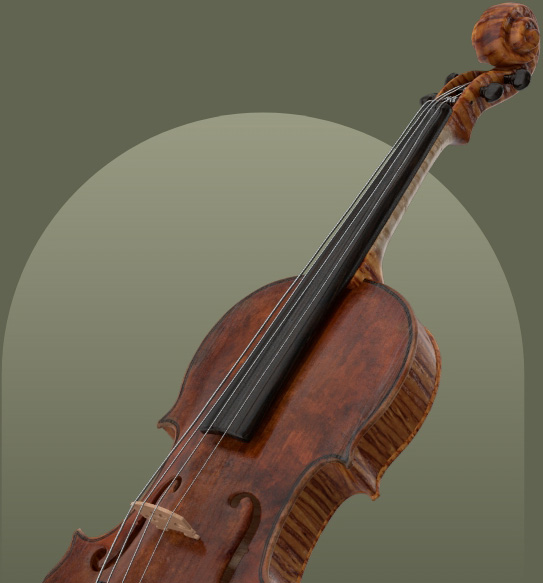
Anton Bachmann
Berlin, 1716–1800
Anton Bachmann (1716-1800) was a prolific Royal Prussian court instrument maker in Berlin, known for his violas and cellos, which are still valued by orchestra musicians for their strong tone. Despite some critical assessments of his craftsmanship and materials, he is credited with significant inventions, most notably the enduring screw mechanism for the heads of basses, introduced in 1778.
Request an expert valuation or learn how our global auctions achieve the highest prices for your instruments.
Auction Price History
Highest auction price
5 results
| Type | Details | Auction house | Sold | Price |
|---|---|---|---|---|
| Viola | Labelled Antonius Bachmann Königl. Preuss. Hofinstrumentenmacher in Berlin. 1756 Lot 124 | Ingles & Hayday | June 2021 | £19,200est. £ 7,000-10,000 |
| Cello | Labelled Antonius Bachmann Königl. Preus. Hofinstrumentenmacher in Berlin. 1767 Lot 70 | Ingles & Hayday | March 2019 | £7,800est. £ 4,000-6,000 |
| Viola | 39.5 cm Berlin, 1795 Probably by | — | October 2008 | £1,085 |
| Violin | 1899 | — | October 2003 | £1,221 |
| Cello | 1784 | — | March 1987 | £2,860 |
No results match those filters.
Maker Overview
Life
Anton Bachmann (1716-1800) was born in 1716 and died in 1800 in Berlin, Germany. He served as a repairer to the Prussian court and was a fairly prolific maker, also working as a guitar maker., he became a royal Prussian court instrument maker at the age of 30, holding a reputation that, in Lütgendorff's view, his work did not entirely justify. Lütgendorff notes that his violas and cellos are still highly valued by orchestra musicians for their strong tone, though they are described as sounding 'raw'. Bachmann reportedly never had good models or good wood, which Lütgendorff suggests was difficult to obtain in Berlin at that time. He is also noted for attempting to pass off some of his violins as copies of Stradivari, leading Lütgendorff to conclude that he had never seen a genuine Stradivari instrument. Several inventions, often attributed to his son, are believed to have originated with Anton Bachmann, including guitars with hammer action. His most enduring invention, however, was the screw mechanism for the heads of basses, which became known in 1778 and remains in use today. His second son, Friedrich Wilhelm B., reportedly learned violin making but pursued a career as a professional musician (violinist) and Kapellmeister, later engaging in the trade of musical instruments from 1797 onwards.
Characteristics
- Models: Anton Bachmann utilized Cremonese models featuring a pinched arch.
- Workmanship & Varnish: John Dilworth describes his workmanship and varnish as 'decent'. However, Willibald Leo Lütgendorff offers a contrasting view, stating that his arching was stiff, abruptly falling off towards the cheeks, and too thick in the breast. Lütgendorff also characterized his varnish as dull and of an 'ugly brown color'.
- Materials: Lütgendorff notes that Bachmann never used good models or good wood, attributing the latter difficulty to the scarcity of quality timber in Berlin during his time.
- Surviving Instruments: The royal collection of old musical instruments in Berlin preserves a Viola da Gamba from 1746, noted for its better execution (catalogue number 831). The Schwerin court chapel holds a Violoncello from 1757.
- Antonius Bachmann
Königl:Preuss Hof instrumentenmacher
in Berlin 1756John Dilworth
Influence and legacy
- Inventions: Anton Bachmann's invention of the screw mechanism for the heads of basses, which became known in 1778, has been preserved and is still in use today.
- Reputation: His violas and cellos are still highly esteemed by orchestra musicians for their powerful tone.
- Museum Holdings: A Viola da Gamba from 1746, noted for its superior craftsmanship, is preserved in the royal collection of old musical instruments in Berlin (No. 831).
- Institutional Holdings: A Violoncello from 1757 is held by the Schwerin court chapel.
Further Information
- Label: An example of his label reads: 'Antonius Bachmann / Königl:Preuss Hof instrumentenmacher / in Berlin 1756'.
- Location: He worked in Berlin, Germany.
- Inventions: Bachmann is credited with several inventions, including guitars with hammer action (though often attributed to his son) and, most notably, the screw mechanism for the heads of basses, introduced in 1778.
Biographies
The overview above is drawn from the following published accounts. Read them in the original:
John Dilworth+
BACHMANN, Anton Born 1716, died 1800 Berlin Germany. Repairer to the Prussian court. Fairly prolific maker. Cremonese models with pinched arch, decent workmanship and varnish. Also a guitar maker. Antonius Bachmann / Königl:Preuss Hof instrumentenmacher / in Berlin 1756
Willibald Leo Lütgendorff+
Er war schon mit 30 Jahren kgl. preussischer Hofinstrumentenmacher und
stand in einem Ansehen, das seine Arbeiten nicht rechtfertigen. Seine Violen
und Violoncelli werden allerdings ihres starken Tons wegen noch heute von
Orchester-Musikern sehr geschätzt, klingen aber roh. Er hat nie gute Modelle
gehabt und nie gutes Holz — das er sich zu seiner Zeit in Berlin freilich nur
schwer hatte verschaffen können — verarbeitet. Einige seiner Geigen gab er
für Copien nach Stradivari aus, er hat, nach diesen zu urtheilen, aber nie ein
echtes Instrument gesehen. Seine Wölbung ist steif, nach den Backen zu
plötzlich abfallend und in der Brust zu dick, der Lack stumpf, von hässlicher
brauner Farbe. Eine Viola da Gamba von 1746 von besserer Ausführung bewahrt
die kgl. Sammlung alter Musikinstrumente in Berlin (Nr. 831), ein
Violoncello von 1757 die Schweriner Hofkapelle. Mehrere Erfindungen, die
gewöhnlich seinem Sohne zugeschrieben werden, dürften von ihm herrühren
z. B. Guitarren mit Hammerklaviatur, aber nur seine 1778 bekannt gewordene
Erfindung des Schraubenmechanismus am Kopf der Bässe hat sich bis auf den heutigen Tag erhalten. Sein zweiter Sohn, Friedrich Wilhelm B., soll zwar auch das Geigenmachen erlernt haben, er war aber Berufsmusiker (Geiger) und Kapellmeister und soll sich von 1797 an nebenbei auch auf den Handel mit Musikinstrumenten verlegt haben. Vgl. Allg. D. Biographie,
Ledebur’s Tonkünstlerlexikon Berlins etc.
Sell your instrument with Amati
Get started by uploading photos of your instrument for our experts to review.
Sell your instrument with Amati
Get started by uploading photos of your instrument for our experts to review.