The ‘Scottish Stradivari’ Died Penniless 200 Years Ago This Week – So What’s a Matthew Hardie Worth Now?

This Sunday marks two hundred years, to the day, since Matthew Hardie died in St Cuthbert’s Poorhouse in Edinburgh. He was seventy-one. They buried him at Greyfriars in an unmarked grave.
They also called him the Scottish Stradivari which is quite a name to live up to.
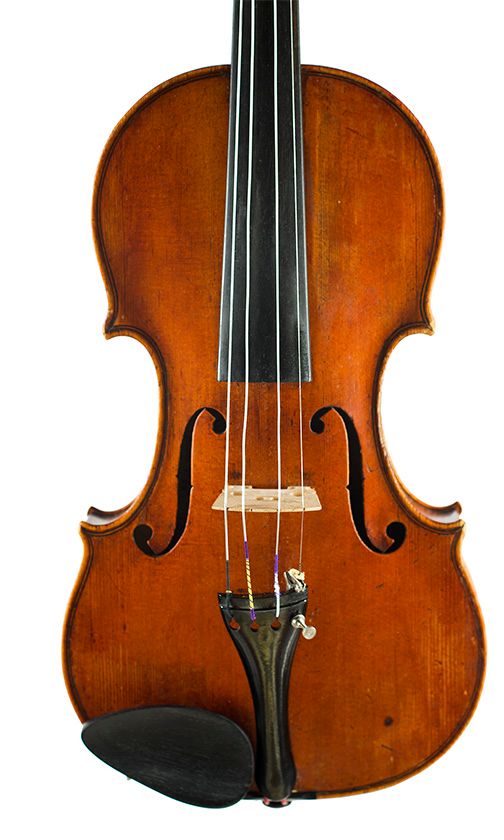
Hardie was born in Jedburgh in 1755 and took the scenic route to violins – apprenticed as a joiner, then four years in the army, then a repair bench in Edinburgh by 1784. From about 1790 he was making his own instruments in the Lawnmarket: sophisticated copies of both Stradivari and Amati, beautifully made and finely varnished, comparable with the best work Panormo was doing in London.
As is surprisingly frequently the case, although the making went beautifully, the business did not. He was imprisoned for debt in 1795. He was imprisoned for debt again in 1825. The story goes that he made some of his best violins while locked up; perhaps he had more time to work in peace, perhaps he worked harder in order to discharge his debt.
He was poor enough, at times, that instruments survive built from second-hand wood with the nail marks still in it. And a year after the second stretch in prison he died.
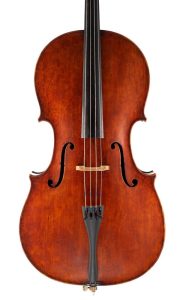
So, after such a bumpy life and a pauper’s death – what is an instrument by Hardie worth now in 2026? Our archive holds eighty-three auction results for Hardie across half a century, running from a solitary £1 (auctions are honest to a fault) up to £28,800 for a cello of 1823. And the good ones have been climbing: a violin labelled Made by Mat. Hardie & Son made £11,400 at Ingles & Hayday in 2023, a remarkably preserved example £8,400 at Brompton’s in 2019, and an 1823 Hardie & Son viola £23,600 in 2018. Good examples surface rarely – and scarcity, as any auctioneer will tell you with a completely straight face, is exactly what makes the next one interesting.
Scotland is full of old violins and I love going back to meet clients. Hardie was, in part, responsible as he was a fine teacher. His son Thomas joined the bench from 1822, and a whole coterie of Edinburgh makers caught the fever from him. I like to think that a great many Scottish attics contain a violin that has always been spoken of, a little reverently, as “the good one”.
We would love to look at it. We’re bringing the valuation table to Hardie’s home turf in November – St Andrews on Thursday the 12th, Edinburgh on Friday the 13th, Glasgow on Saturday the 14th. An appointment is free and takes about fifteen minutes: https://amati.com/book.
Most attic fiddles turn out to be honest German work from about 1900, which will still find a happy home in one of our sales. Some turn out to be rather more. That is the whole fun of it.
JKB
P.S. Hardie’s page in our Makers Archive – Dilworth’s biography, the auction history, all of it – is here: https://amati.com/maker/hardie-matthew/. After two hundred years on, it feels like slightly more recognition than he got at his death.
Share this: