Carlo (I) Bergonzi
Cremona, 1683–1747
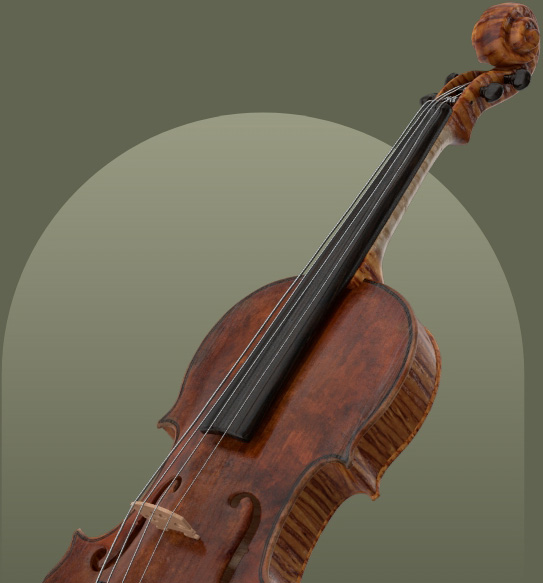
Carlo (I) Bergonzi (1683-1747) was a highly esteemed Cremonese master luthier, known for instruments that combined the finest qualities of Stradivari and Guarneri del Gesù. Initially associated with the Rugeri family, he later became a pupil and assistant in the Stradivari workshop, eventually taking over the Casa Stradivari after Antonio's death. His instruments are characterized by distinct flat archings, unique scrolls, and a rich golden-red varnish, and are highly prized for their sonorous tone and robust construction, making them some of the most sought-after and valuable in the market.
Request an expert valuation or learn how our global auctions achieve the highest prices for your instruments.
Auction Price History
Highest auction price
5 results
| Type | Details | Auction house | Sold | Price |
|---|---|---|---|---|
| Violin | 35.3 cm 1800 c. Attributed to | — | October 2009 | £21,600 |
| Violin | 35.2 cm Cremona, 1870 c. Probably by "Nicole" | — | June 2009 | £36,000 |
| Violin | Cremona, 1720 c. ex 'Paganini' & 'Vuillaume' with Prov. | — | November 2005 | £568,000 |
| Violin | 1739 | — | October 1984 | £105,600 |
| Violin | 1715 | — | June 1983 | £28,571 |
No results match those filters.
Maker Overview
Life
Carlo (I) Bergonzi (1683-1747) was born in Cremona, Italy, and is considered one of the most rarely encountered of the great Cremonese masters. His early associations were likely with the Rugeri family, who were close neighbors, and Carlo's mother was godmother to Vincenzo Rugeri's son. Stylistic and technical elements in Bergonzi's earliest instruments reflect Vincenzo Rugeri's work, and his own label began to appear with comparative regularity only after Vincenzo's death in 1719. His most characteristic works date from approximately 1720 to 1739.
By 1727, Bergonzi was assisting in the Stradivari workshop, and his hand is strongly evident in the Stradivari 'Fruh' cello of that year. This participation may have been a result of the early death of Antonio Stradivari's youngest son, Giovanni Battista, also in 1727. Despite this, Bergonzi remained independent, producing instruments with his own label, though not in great numbers, throughout this period. The death of Antonio Stradivari in 1737 was followed by the deaths of his violin-making sons, Omobono in 1742 and Francesco in 1743. In 1745, the surviving Stradivari family invited Carlo Bergonzi to take over the workshop and finish the remaining instruments for sale. The Bergonzi family subsequently moved into the Casa Stradivari, and some instruments, such as the 'Hart' viola, show signs of being fabricated from parts left unfinished at Stradivari's death. Carlo Bergonzi enjoyed this situation for only a few years, as he died in 1747.
Sources contain conflicting information about Carlo Bergonzi's early training. While some, like George Hart, state that he was undoubtedly a pupil of Antonio Stradivari, evidenced by the model, thicknesses, scroll, and general treatment of his instruments, others, such as Willibald Leo Lütgendorff and Cecie Stainer, suggest he may have first been apprenticed to Amati before joining Stradivari as an assistant., as cited by George Hart, Carlo Bergonzi worked by himself from 1716 to 1746, based on a list of names and dates collected by Count Cozio.
Characteristics
- Archings
- His instruments feature flat archings, with a slightly square upper bout.
- Bouts & Ribs
- They have an extended stop length, long corners, and parallel (untapered) ribs. The center bouts are set at a greater angle than customary, and increased breadth is given to the lower portion of the instrument.
- Scroll
- Bergonzi's scrolls are very individual, with widely projecting eyes, cut with great accuracy to give the effect of a single dowel passing through the center of the volute. They are flatter than usual, boldly cut, and distinct from Stradivari's, possessing an originality and a prominent ear that stands forth in bold relief.
- Sound-holes
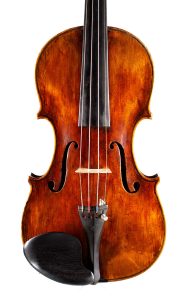
- The sound-holes are placed slightly lower than in the Stradivari model and nearer the edge than in instruments by Stradivari or Guarneri. They are longer and more open than Stradivari's and can be described as an adaptation of characteristics from both Stradivari and Guarneri, inclining more to the former.
- Varnish
- The varnish is of great quality, variable in texture and consistency, always of a rich golden-red hue. It is often red-brown or amber, sometimes thick, sometimes sparingly laid on, and can be deep red, pale red, or rich amber. While sometimes thick or showing clots, age has toned it down, resulting in a good effect.
- Wood
- He consistently used the best and healthiest wood, which was always very fine and well chosen.
- Construction
- His instruments are very strongly and massively built, contributing to their long lifespan.
- Tone
- The tone is described as great and noble, sonorous and penetrating, characterized by a peculiarly penetrating sonorous tone. It is seen as a just and exact combination of the qualities of both Stradivari and Guarneri del Gesù.
- Models
- His violins are generally made on a flat model, similar to early Stradivari instruments, with the pattern enlarged later. He also made at least one viola, known as the 'Hart', and one cello, the 'Spanish', both from around 1739. His violoncellos and double-basses are especially good, with the latter being considered some of the finest known, though many have been cut down from their original large pattern.
- Anno 1733John Dilworth
- Carlo Bergonzi
fece in CremonaJohn Dilworth
Influence and legacy
- Early Associations: Carlo Bergonzi's early associations were likely with the Rugeri family, particularly Vincenzo Rugeri, whose work influenced his earliest instruments.
- Mentorship: He is widely considered a pupil of Antonio Stradivari, with his instruments clearly tracing the teachings of the master in model, thicknesses, scroll, and general treatment. Sources, however, contain conflicting information, with some suggesting he may have first been apprenticed to Nicola Amati before becoming an assistant to Stradivari.
- Workshop Collaboration: By 1727, Bergonzi was assisting in the Stradivari workshop, and his hand is strongly evident in the Stradivari 'Fruh' cello of that year. He was also a fellow-workman with Stradivari's sons.
- Workshop Succession: In 1745, after the deaths of Antonio Stradivari and his violin-making sons, the surviving Stradivari family invited Carlo Bergonzi to take over the workshop, and he moved into the Casa Stradivari in 1746.
- Rarity: Carlo Bergonzi is noted as the most rarely encountered of the great Cremonese masters.
- Appreciation & Value: His instruments are justly celebrated for both beauty of form and tone, rapidly gaining the appreciation of artists and amateurs. Commercially, their value has risen rapidly, increasing fourfold within twenty years, particularly in England, and their price has at least sextupled in the last 50 years.
- Notable Instruments & Collections: In the collection of Count Cozio di Salabue, there were two violins by Bergonzi, dated 1731 and 1733, and a violoncello dated 1746. A perfect and unique Double Bass, purchased by Vuillaume from the executors of Luigi Tarisio, is now in the possession of Mr. John Sears of Boston, U.S.
- Attribution Issues: The work of Bergonzi has often been attributed to others, with many of his instruments mistakenly dubbed "Joseph Guarneri," primarily due to a slight resemblance in the upper and lower portions of the sound-hole.
Further Information
- Workshop Location: Carlo Bergonzi worked in Cremona, Italy. He lived next door to Stradivari and later, in 1746, moved into Antonio Stradivari's old dwelling in the Piazza San Domenico.
- Label Inscription: An example of his label reads: "Anno 1733, Carlo Bergonzi / fece in Cremona."
- Working Period: According to a list collected by Count Cozio, Carlo Bergonzi worked by himself from 1716 to 1746.
Biographies
The overview above is drawn from the following published accounts. Read them in the original:
John Dilworth+
BERGONZI, Carlo (I) Born 1683, died 1747 Cremona Italy. The most rarely encountered of the great Cremonese masters. Early associations were probably with the Rugeri, the two families being close neighbours; Carlo’s mother was god-mother to the son of Vincenzo Rugeri. Stylistic and technical touches in Bergonzi’s earliest instruments certainly reflect Vincenzo’s work, and his own, albeit rare, label appears with comparative regularity only after Vincenzo’s death in 1719. His most characteristic works date from c.1720 – 1739. They are quite distinct from other Cremonese instruments: flat-arched with a slightly square upper bout, extended stop length, long corners, parallel (untapered) ribs, and a very individual scroll form with widely projecting eyes, cut with great accuracy to give the effect of a single dowel passing through the centre of the volute. The varnish is of great quality, variable in texture and consistency, but always of rich golden-red hue. Alongside the violins are at least one viola, known as the ‘Hart’, and one cello, the ‘Spanish’, both of c.1739 period. By 1727 Bergonzi was assisting in the Stradivari workshop. His hand is strongly evident in the Stradivari ‘Fruh’ cello of that year, and his participation may have been the result of the early death of Antonio Stradivari’s youngest son Giovanni Battista, also in that year. Nevertheless, Bergonzi was still evidently independent, and producing instruments with his own label, although not in any great numbers, throughout this period. The death of Antonio himself in 1737 was closely followed by that of his other violin-making sons: Omobono in 1742 and Francesco in 1743. In 1745 Carlo Bergonzi was invited by the surviving Stradivari family to take over the workshop and finish the instruments remaining there for sale. The Bergonzi family duly moved into the Casa Stradivari, and some instruments (such as the ‘Hart’ viola referred to above) show signs of having been fabricated from parts left unfinished at Stradivari’s death. Carlo himself enjoyed this situation for only a few years, however, as he died in 1747. Anno 1733, Carlo Bergonzi / fece in Cremona [Cremona Triennale Cat. II]
George Hart+
Pupil, of Antonio Stradivari. That he was educated in Violin-making by the greatest master of his art art is evidenced beyond doubt. In his instruments may be clearly traced the” teachings of Stradivari.The model, the thicknesses, and the scroll, together with the general treatment, all agree in betokening that master’s influence. Giuseppe Guarneri del Gesu here stands in strong contrast with Bergonzi. All writers on the subject of Violins assume that Guarneri was instructed by Stradivari, a statement based upon no reasons (for none have ever been adduced), and apparently a mere repetition x of some one’s first guess or error. As before remarked, Carlo Bergonzi, in his work, and in the way in which he carries out his ideas, satisfactorily shows the source whence his early instructions were derived, and may be said to have inscribed the name of his great master, not in print, but in the entire “body” of every instrument which he made. This cannot be said of Giuseppe Guarneri. On the contrary, there is not a point throughout his work that can be said to bear any resemblance to the sign manual of Stradivari. As this interesting subject is considered at length in the notice of Giuseppe Guarneri, it is unnecessary to make further comment in this place. The instruments of Carlo Bergonzi are justly celebrated both for beauty of form and tone, and are rapidly gaining the appreciation of artistes and amateurs/ Commercially, no instruments have risen more rapidly than those of this maker; their value has increased within the past twenty years fourfold, more particularly in England, where their merits were earliest acknowledged—a fact which certainly reflects much credit’ upon our connoiseurs. In France they had a good character years ago, and have been gaining rapidly upon their old reputation, and now our neighbours regard them with as much favour as we do.They possess tone of rare quality, are for the most part extremely handsome, and last and most important of all, their massive construction has helped them, by fair usage and age, to become instruments of the first order. The model of Bergonzi’s Violins is flat, and the outline of his early efforts is of the Stradivari type; but later in life, he, in common with other great Italian makers, marked out a pattern for himself from which to construct. The essential difference between these two forms lies in the angularity of the latter. It would be very difficult to describe accurately the several points of deviation unless the reader could handle the specimens for himself and have ocular demonstration; the upper portion from the curve of the centre bouts is increased, and, in consequence, the sound-holes are placed slightly lower than in the Stradivari model. Bergonzi was peculiar in this arrangement, and he seldom deviated from it. Again, increased breadth is given to the lower portion of the instrument, and in consequence the centre bouts are set at a greater angle than is customary. The sound-hole may be described as an adaptation of the characteristics of both Stradivari and Guarneri, inclining certainly more to those of the former. As a further peculiarity, it is to be noticed that the sound-holes are set nearer the edge than is the case in the instruments of either of the makers named. Taken as a whole, Bergonzi’s design is rich in artistic feeling, and one which he succeeded in treating with the utmost skill. Carlo Bergonzi furnishes us with another example of the extensive research with which the great Cremonese makers pursued their art, and a refutation of the common assertion that these men worked and formed by accident rather than by judgment. The differences of the two makers mentioned above as regards form are certainly too wide to be explained away as a matter of mere accident. It is further necessary to take into consideration the kind of tone belonging to these instruments respectively. If Bergonzi’s instruments be compared with those of his master, Stradivari, or of Guarneri del Gesu, the appreciable difference to be found will amount to this, that in Bergonzi’s instruments there is a just and exact combination of the qualities of both the other two makers named. Is it not, therefore, reasonable to conclude that Carlo Bergonzi was fully alive to the merits of both Stradivari and Guarneri, and deliberately set himself to construct a model that should embrace in a measure the chief characteristics of both of them ? The scroll is deserving of particular attention. It is quite in keeping with the body of the instrument, and has been cut with a decision of purpose that could only have been possessed by a master. It is flatter than usual, if we trace it from the cheek towards the turn, and is strikingly bold. Here, again, is the portrait of the character of the maker. Although by a pupil of Antonio Stradivari, the scroll is thoroughly distinct from any known production of that maker—it lacks his fine finish and exact proportion; but, on the other hand, it has an originality about it which is quite refreshing* The prominent feature is the ear of the scroll, which being ‘made to stand forth in bold relief gives it a broad appearance when looked at from, the front. The work of Bergonzi, as has been the case with many of his class, has been attributed to others. Many of his instruments are dubbed “Joseph Guarneri,” a mistake in identification which arises chiefly from the form of the sound-hole at the upper and lower portions. There is little else that can be considered as bearing any resemblance whatever to the work of Guarneri, and even in this case the resemblance is very slight. Bergonzi’s outline is totally different from that of Guarneri,: and is so distinct and telling that it is sure to impress the eye of the experienced connoisseur when first seen. The varnish of Bergonzi is often fully as resplendent as that of Giuseppe Guarneri or Stradivari, and shows him to have been initiated in the mysteries of its manufacture. It is sometimes seen to be extremely thick, at other times but sparingly laid on; often of a deep, rich red colour, sometimes of a pale red, and again, of rich amber, so that the variation of colour to be met with in Bergonzi’s Violins is considerable. We must concede that his method of varnishing was scarcely; so painstaking as that of his (fellow-workers, if we judge from the clots here and there, particularly on the deep coloured instruments; but, nevertheless now that age has toned down the varnish, the effect is good. Carlo Bergonzi lived next door to Stradivari, and I believe the house remained in the family until three years since, when it was disposed of. Lancetti remarks : ” From want of information, we have forgotten in the second volume”—referring to his ” Biographical Dictionary,” part of which was printed in 1820—”to include an estimable maker named Carlo Bergonzi, who was pupil of Stradivari, and fellow-workman with his sons. From the list of names and dates collected by Count Cozio, it appears that Carlo Bergonzi worked by himself from 1716 to 1746. He used generally very fine foreign wood, and a varnish of the quality of that of his master.” In the collection of Count Cozio di Salabue, there were two Violins by Bergonzi, dated 1731 and 1733, and a Violoncello, 1746. We have in this country two remarkable Violoncellos of this maker, which are represented on Plate 5 and Plate 10. The perfect and unique Double Bass which Vuillaume purchased of the executors of Luigi Tarisio, is now in the possession of Mr. John Sears, of Boston, U.S.
Cecie Stainer+
Of Cremona, the first of the great Bergonzi family of makers, b. about 1680 ; d. 1747. He began to put his own name in his instruments about 1716. He was the most celebrated pupil of Antonio Stradivari, whose pattern he copied very closely. Was also said to have been a pupil of Nicola Amati.
After the death of Ombono Stradivari (d. 1742), Carlo inherited all the working materials which had belonged to Antonio Stradivari, and in 1746 he and his son Michel Angelo (then aged 24) moved into Antonio Stradivari’s old dwelling, in the Piazza San Domenico.
His violins, which are more scarce than his violoncellos, are generally made on a flat model, like the early instruments of Stradivari; he enlarged the pattern later on. The sound-holes, placed lower and nearer the edge, are longer and more open than those of Stradivari; the scrolls, flatter than usual, are boldly cut ; the arching is decided ; the wood is always very fine; the varnish, a beautiful red-brown or rich amber colour, is rather heavy, a sign of decadence, but gives the instruments a peculiar type of their own. The tone is sonorous and penetrating. The work is always beautifully finished.
His violoncellos and double-basses are especially good, the latter being some of the finest known. Unluckily he made them on too large a pattern, and many have been cut down to suit modern requirements, so that in their original state they are rarely to be met with. The work is careful, the wood well chosen; the varnish, of a red-brown colour, much altered by age, is often rather thick.
The violins, altos and violoncellos (the latter being thought to equal the work of his master, Stradivari) are all characterised by a peculiarly penetrating sonorous tone, and are much sought after, sometimes fetching high prices, from £200 to £300. A very fine violoncello was dated 1746.
the same in a violin dated 1733, and another dated 1731 ;
Bergonzi, Carlo,
Third son of Michel Angelo Worked in Cremona about 178 and died there about 1820. He made a few violins of little value, with straight, ugly sound-holes, but principally guitars and mandolines.
Willibald Leo Lütgendorff+
Einer der besten, wenn nicht der allerbeste Schüler Stradivari’s, der nach
dem Tode von Stradivari’s Söhnen Haus und Werkstatt seines Meisters erwarb.
Es wird allerdings behauptet, dass er zuerst bei Amati in der Lehre gewesen
und erst als Gehilfe zu Stradivari gekommen sei. In seiner Arbeit schliesst
er sich jedoch mehr an Stradivari an, nur verlängerte er die obere Hälfte des
Geigenkörpers und machte die untere etwas breiter, die F-Löcher setzte er
etwas höher und naher dem Rande und gab ihnen einen Schnitt, der dem von
Guarneri del Gesù nicht ganz unähnlich ist. Die Wölbung nahm er flach, auch
die Schnecke ist flacher, als bei den meisten seiner Zeitgenossen, aber sehr
sauber geschnitzt. Sein Lack ist meist rothbraun oder bernsteingelb, nur manchmal
etwas zu dick aufgetragen und deshalb rissig, hat aber durch das Alter
sehr gewonnen und sieht originell aus. Der Ton ist gross und edel, und da
Bergonzi stets das beste und gesündeste Holz nahm und seine Geigen sehr stark
baute, darf man ihnen eine lange Lebensdauer in Aussicht stellen. Sie stiegen
von Jahr zu Jahr in der Wertschätzung, und ihr Preis hat sich in den letzten
50 Jahren mindestens versechsfacht. Man charakterisiert ihn am besten, wenn
Sell your instrument with Amati
Get started by uploading photos of your instrument for our experts to review.
Sell your instrument with Amati
Get started by uploading photos of your instrument for our experts to review.