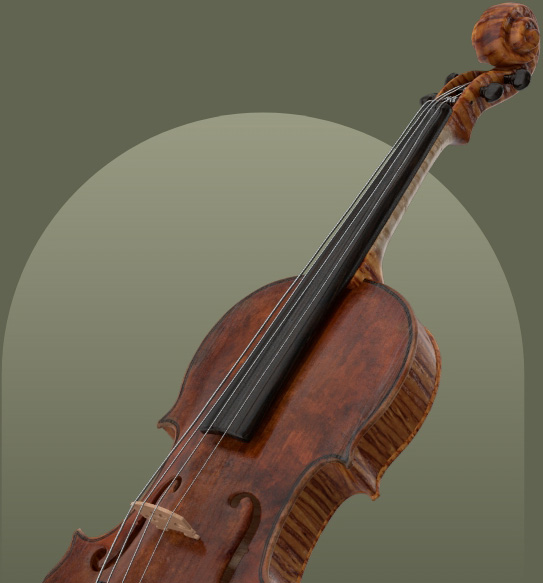
Nicolas Bertrand
Paris, 1686–1725
Nicolas Bertrand (1686-1725) was a significant Parisian viol maker, credited with pioneering the seven-string viol and holding the esteemed title of 'Faiseur d'instruments ordinaire de la muzique du Roy'. His workshop operated on a large commercial scale, producing a substantial stock of instruments, as evidenced by a detailed inventory at his death. Bertrand's craftsmanship shows a strong influence from English viol making, and his instruments are often characterized by a distinctive red varnish and the use of a brand mark. While his violins are considered rare and of lesser quality, his viols are highly regarded, with examples preserved in prominent museums worldwide.
Auction Price History
Highest auction price
1 results
| Type | Details | Auction house | Sold | Price |
|---|---|---|---|---|
| Violin | Violin Lot 77 | Giafferi | March 2012 | £161est. € 250-300 |
No results match those filters.
Maker Overview
Life
Nicolas Bertrand (1686-1725) was an important viol maker born in 1686 and died in 1725 in Paris, France. He was credited with pioneering the seven-string viol form and was appointed 'Faiseur d'instruments ordinaire de la muzique du Roy'., a significant document, the inventory of his workshop drawn up at his death by Barbey and Vauboam, reveals that his business operated on a relatively large commercial scale, producing batches of instruments for stock rather than solely to individual commission. This inventory listed well over 250 finished instruments, including 91 violins and five cellos, in addition to 20 'modern' English viols, 42 violins by Treuillot, and 10 violins by Dieulafait. Cecie Stainer notes that he worked in Paris from about 1686 to 1735. Sources contain conflicting information regarding an instrument dated 1603 mentioned in the Selhof'sche Versteigerungsverzeichniss (Haag 1759); Willibald Leo Lütgendorff suggests this date is likely a misreading for 1703 or 1693, or refers to an ancestor. Surviving violins by Bertrand are rare and, according to earlier writers, of comparatively poor quality, which has sometimes led to a diminished assessment of his status as a luthier.
Characteristics
- Innovation
- Nicolas Bertrand is credited with pioneering the seven-string viol form.
- Construction Methods
- The consistency of outline shared by several of his surviving viols strongly indicates the use of a mould in their construction.
- Workmanship & Style
- His general workmanship and style show a strong influence from 17th-century English viol making. Willibald Leo Lütgendorff describes his work as craftsmanlike, occasionally approaching the quality of Jacques Boquay.
- Varnish
- His varnish is almost always described as cracked and dull (rissig und stumpf) and commonly of a red color (rother Farbe), or as thick red varnish (Cecie Stainer) and greasy red varnish (schmierigem Lack) (Lütgendorff).
- Marking
- In addition to labels, Bertrand often used a brand mark with his name on his instruments.
- Distinctive Features
- Some of his instruments, such as a Quinton and a Bassviola (Gamba) in the Brussels Conservatorium, feature a woman's head (Frauenköpfchen) on the pegbox.
Influence and legacy
- Mentorship: Nicolas Bertrand was possibly a student of Collichon.
- Students: He may have been the teacher of Barbey and Vauboam, who later drew up the inventory of his workshop at his death.
- Extant Instruments: Among the approximately 16 extant viols dating from 1687 to 1720 are a bass viol of 1720 in the Metropolitan Museum, New York; a pardessus de viol of 1714 in the Musée de la Musique, Paris; and a 1687 instrument in the Brussels Musical Instruments Museum. Cecie Stainer also notes a bass-viol dated 1687, another with the label 'Nicolas Bertrand, Paris, 1720', a treble-viol dated 1701 in the Brussels Museum, a small five-stringed viol dated 1714 in the Paris Museum, and a bass dated 1720.
- Branding: His name is often branded on his instruments, such as the New York Bass viol branded on the upper back: 'Bertrand' Nicolas Bertrand à Paris, 17.. [Milliot].
Biographies
The overview above is drawn from the following published accounts. Read them in the original:
John Dilworth+
BERTRAND, Nicolas Born 1686, died 1725 Paris France. Important viol maker, credited with pioneering the seven string form. Appointed ‘Faiseur d’instruments ordinaire de la muzique du Roy’. Possibly a student of Collichon. May have been teacher of Barbey and Vauboam, who drew up the inventory of the workshop at his death. This significant document shows the business to have been operated on a relatively large commercial scale, making batches of instruments for stock rather than individually to commission. It lists well over 250 finished instruments, including 91 violins and five cellos, excluding 20 ‘modern’ English viols, 42 violins by Treuillot, 10 violins by Dieulafait. Consistency of outline shared by several of the surviving viols strongly indicates the use of a mould. Amongst the 16 or so extant viols dating from 1687 to 1720 are the bass viol in the Metropolitan Museum, New York of 1720, a pardessus de viol of 1714 in the Musée de la Musique, Paris, and a 1687 instrument in the Brussels Musical Instruments Museum. As well as the evidence of the 20 English viols listed in the inventory, his general workmanship and style shows the strong influence of 17th century English viol making. Surviving violins are rare and of comparatively poor quality and it is for this reason that earlier writers have tended to diminish Bertrand’s status as a luthier. New York Bass viol branded on upper back: ‘Bertrand’ Nicolas Bertrand à Paris, 17.. [Milliot]
Cecie Stainer+
A maker in Paris about 1686 to 1735. He made some violins of no great value, but is better known for various viols: a bass-viol dated 1687; another with the label ” Nicolas Bertrand, Paris, 1720,” well made, with a thick red varnish; a treble-viol dated 1701 in the Brussels Museum ; a small five-stringed viol, dated 1714 in the Paris Museum ; and a bass dated 1720. His name is often branded on his instruments.
Willibald Leo Lütgendorff+
Er arbeitete handwerksmässig; nur manchmal kam er Jacques Boquay nahe.
Sein Lack ist fast immer rissig und stumpf und gewöhnlich von rother Farbe.
Violinen scheint er nur selten gemacht zu haben, dagegen trifft man Violen,
Bässe und Quintone von ihm mehrfach. Das Selhof’sche Versteigerungsverzeichniss
(Haag 1759) führt eine Arbeit von ihm mit der Jahreszahl 1603
auf; diese kann nur 1703 oder höchstens 1693 geheissen haben, oder man
müsste einen gleichnamigen Vorfahren annehmen. Ein Quinton und eine Bassviola
(Gamba) von gewöhnlicher Arbeit, rothem, schmierigem Lack und mit
einem Frauenköpfchen am Wirbelkasten besitzt das Brüsseler Conservatorium
(No. 222 und 227). Ausser seinem Zettel verwandte er auch eine Brandmarke
mit seinem Namen.
Sell your instrument with Amati
Get started by uploading photos of your instrument for our experts to review.
Sell your instrument with Amati
Get started by uploading photos of your instrument for our experts to review.