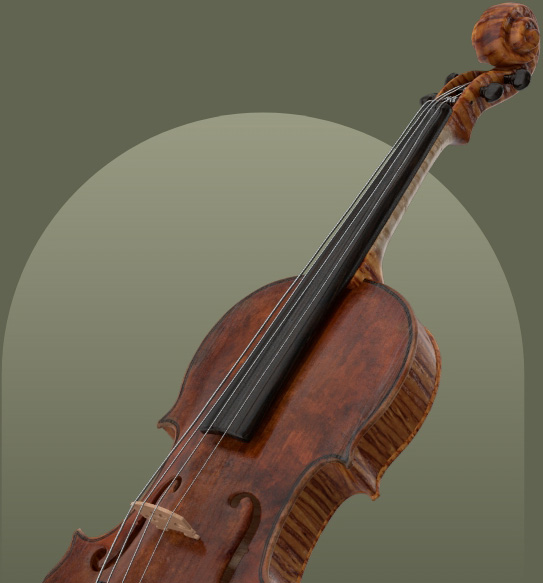
Gabriel David Buchstetter
Regensburg, Stadtamhof, worked 1730–1780
Gabriel David Buchstetter (circa 1730-1780) was a highly regarded German luthier from Stadtamhof, Regensberg, known for his individual style and fine craftsmanship. He was the son of Christoff Buchstetter and was considered one of the best German masters of his time, with even the celebrated violinist Spohr performing on his instruments. Buchstetter's work followed Stradivari-derived and Cremona patterns, featuring distinctive scrolls, fine Stradivarian soundholes, and well-regulated low arching. While his varnish was often thin and opaque, and wood selection could be inconsistent, his instruments were noted for their powerful tone, making them popular for orchestral use. His labels were frequently numbered and appeared in both Gothic and Roman type.
Auction Price History
Highest auction price
13 results
| Type | Details | Auction house | Sold | Price |
|---|---|---|---|---|
| Violin | Labelled Gabriel David Buchstetter, Lautten-und Geigenmacher, Pedeponti prope Ratisbonam. Anno ... Lot 216 | Ingles & Hayday | October 2018 | £9,000est. £ 3,000-5,000 |
| Cello | Labelled Gabriel Davids Buchstetter, Lauten-und Geigenmacher, Pedeponti prope Ratisbonam, Anno ... Lot 52 | Ingles & Hayday | October 2014 | £14,400est. £ 7,000-10,000 |
| Violin | Bearing the maker's label, German head of late 18th Century Lot 304 | Vichy | December 2013 | £2,588est. € 3.000-4.000 |
| Violin | Labelled Gabriel David Buchftetter La...teri und Geigenmacher Pedepontipio pera... bomum anno 17... Lot 242 | Brompton’s | October 2013 | £6,000est. £ 5,000-7,000 |
| Violin | 37.4 cm Rattisbonam, 1760 original neck, Baroque setup | — | March 2010 | £3,600 |
| Cello | 76.8 cm Regensburg, 1773 | — | November 2008 | £8,581 |
| Violin | 1760 c. | — | November 2000 | £1,997 |
| Violin | 1761 | — | May 1999 | £844 |
| Cello | 1760 | — | March 1996 | £8,970 |
| Violin | 1760 c. | — | March 1995 | £3,105 |
| Violin | 1775 | — | June 1988 | £1,760 |
| Violin | 1763 | — | June 1988 | £1,100 |
| Violin | 1750 | — | June 1985 | £968 |
No results match those filters.
Maker Overview
Life
Gabriel David Buchstetter (circa 1730-1780) worked in Stadtamhof, Regensberg, Germany, and was the son of Christoff Buchstetter. in The Brompton's Book of Violin & Bow Makers, he was "a very well-regarded maker of great individuality." Willibald Leo Lütgendorff, in Die Geigen- und Lautenmacher vom Mittelalter bis zur Gegenwart, noted that Buchstetter was considered one of the best German masters of his era, and the renowned violinist Spohr played a 'Buchstetter' instrument in his concerts until he acquired a 'Lupot'. Lütgendorff also described him as industrious and very wealthy. His labels were frequently numbered, with an example from 1752 being the 26th instrument made. Labels appeared in both Gothic and Roman type, with various forms such as "Gabriel David Buchstetter, Lauden und / Geigen Macher, zu Stadt am Hoff / neben Regenspurg Anno 1750", "Gabriel Buchstetter Lautten und / Geigenmacher zu Stadt am Hof / prope Ratisbonae. 1761", and "Gabriel David Buchstetter, Lautten- / und Geigenmacher, Pedeponti prope / Ratisbonam. Anno 1764".
Characteristics
- Model
- He worked on a Stradivari-derived model, also following Cremona patterns.
- Workmanship
- John Dilworth noted his "great finesse in craftsmanship," and Cecie Stainer observed that "all the details are carefully finished."
- Varnish
- Dilworth described it as "thin and opaque," while Stainer mentioned it was "dark yellow or brown colour," with one exhibited in Paris in 1878 having "very dark yellow varnish."
- Wood
- Dilworth noted "sometimes a hint of unattractive stain in the wood," and Stainer stated the "wood not always well selected."
- Scrolls
- His scrolls are "very distinctive, with a long, swan necked pegbox and deep, open throat, and a very concentric volute extending up behind the eye,".
- Soundholes
- Dilworth highlighted "Very fine Stradivarian soundholes with subtle fluting in the lower wing."
- Arching
- He employed "Well-regulated low arching," and his instruments were "not much arched."
- Materials
- Dilworth generally noted a "fine choice of materials."
- Tone
- Cecie Stainer described the tone as potentially "harsh" due to wood selection but also "powerful," making his violins "much used for orchestra playing."
- Dimensions
- Willibald Leo Lütgendorff mentioned that his best violins were "lang und schmal" (long and narrow).
- Gabriel David Buchstetter, Lauden und
Geigen Macher, zu Stadt am Hoff
neben Regenspurg Anno 1750John Dilworth - Gabriel Buchstetter Lautten und
Geigenmacher zu Stadt am Hof
prope Ratisbonae. 1761John Dilworth - Gabriel David Buchstetter, Lautten-
und Geigenmacher, Pedeponti prope
Ratisbonam. Anno 1764.John Dilworth
Influence and legacy
- Recognition: The renowned violinist Spohr played a 'Buchstetter' instrument in his concerts in Die Geigen- und Lautenmacher vom Mittelalter bis zur Gegenwart.
- Exhibitions: One of his instruments, dated 1752, was exhibited in Paris in 1878.
Further Information
- Working Locations: He worked in Stadtamhof, Regensberg, Germany, also referred to as Ratisbon, Regenspurg, and Pedeponti prope Ratisbonam.
- Labeling Practices: His labels were frequently numbered, with an instrument from 1752 being the 26th made. Labels were printed in both Gothic and Roman type.
- Label Examples: Specific label texts include "Gabriel David Buchstetter, Lauden und / Geigen Macher, zu Stadt am Hoff / neben Regenspurg Anno 1750", "Gabriel Buchstetter Lautten und / Geigenmacher zu Stadt am Hof / prope Ratisbonae. 1761", and "Gabriel David Buchstetter, Lautten- / und Geigenmacher, Pedeponti prope / Ratisbonam. Anno 1764".
Biographies
The overview above is drawn from the following published accounts. Read them in the original:
John Dilworth+
BUCHSTETTER, Gabriel David Worked circa. 1730-1780 Stadtamhof, Regensberg Germany. Son of Christoff Buchstetter, above. A very well-regarded maker of great individuality. Working on a Stradivari-derived model, he exhibits great finesse in craftsmanship, although let down by the rather thin and opaque varnish in common use in that time and place. There is sometimes a hint of unattractive stain in the wood also. The scrolls are very distinctive, with a long, swan necked pegbox and deep, open throat, and a very concentric volute extending up behind the eye. Very fine Stradivarian soundholes with subtle fluting in the lower wing. Well-regulated low arching. Generally fine choice of materials. Labels are frequently numbered, and an example of 1752 was evidently the 26th made. Labels in both Gothic and Roman type. Gabriel David Buchstetter, Lauden und / Geigen Macher, zu Stadt am Hoff / neben Regenspurg Anno 1750. Gabriel Buchstetter Lautten und / Geigenmacher zu Stadt am Hof / prope Ratisbonae. 1761. Gabriel David Buchstetter, Lautten- / und Geigenmacher, Pedeponti prope / Ratisbonam. Anno 1764.
Cecie Stainer+
A maker in Ratisbon in 1752. He followed the Cremona patterns, but his instruments are not much arched, the varnish is dark yellow or brown colour, the wood not always well selected, which renders the tone harsh; all the details are carefully finished. Owing to their powerful tone, his violins are much used for orchestra playing. One exhibited in Paris, 1878, with very dark yellow varnish, was dated 1752.
Willibald Leo Lütgendorff+
Seiner Zeit galt er für einen der besten deutschen Meister, und selbst Spohr
spielte auf seinen Concerten nur eine »Buchstetter «, bis ihm der Zufall in Münster
bei Colmar seine »Lupot« in die Hand fallen liess. Buchstetter war fleissig
und galt für sehr wohlhabend. Seine besten Geigen sind lang und schmal, haben
Sell your instrument with Amati
Get started by uploading photos of your instrument for our experts to review.
Sell your instrument with Amati
Get started by uploading photos of your instrument for our experts to review.