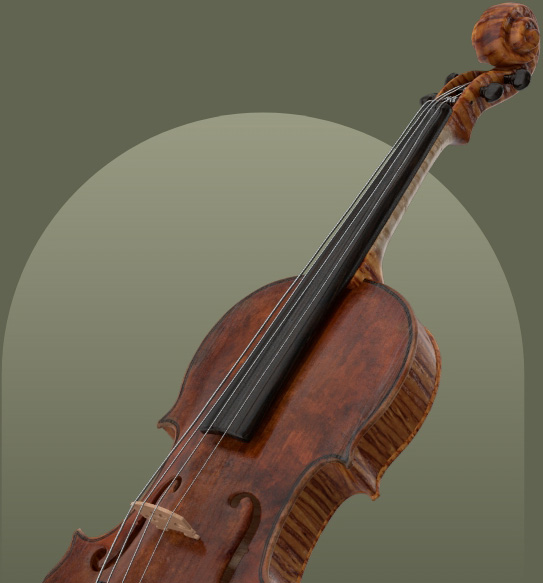
Bernardus Calcanius
Genoa, worked 1710–1750
Bernardus Calcanius (1710-1750) was a prominent luthier in Genoa, Italy, considered by John Dilworth to be the finest maker of the Genoese school. Active from 1710 to 1750, he may have been influenced by Tyrolean makers who settled in Genoa around 1700. From approximately 1740, he collaborated with Antonio Pazarini, and his success fostered the growth of several workshops in Genoa during the 18th century. His instruments are noted for their attractive and careful workmanship, fine quality materials, and distinctive golden-yellow to orange-red varnish. While sources offer conflicting views on his models, ranging from Amati and Stradivari to some attribution to the Guarneri school, his work consistently exhibits a strong and distinctive character typical of the 18th-century Italian tradition.
Auction Price History
Highest auction price
17 results
| Type | Details | Auction house | Sold | Price |
|---|---|---|---|---|
| Violin | Labelled Bernardus Calcanius fecit. Genuae Anno 1752, head later Lot 60 | Tarisio | October 2023 | £35,000est. £ 40,000-60,000 |
| Violin | 35.6 cm Genoa, 1756 | — | May 2011 | £46,128 |
| Violin | 35.7 cm Gênes 1740 c. (some restorations) | — | June 2009 | £25,929 |
| Violin | 1730 c. | — | November 2001 | £27,926 |
| Violin | 1730 | — | May 2001 | £42,908 |
| Violin | 17-- | — | November 1999 | £13,800 |
| Violin | 1754 (scroll replaced) | — | June 1998 | £17,577 |
| Cello | 1737 | — | February 1998 | £94,277 |
| Violin | 17-- | — | March 1995 | £29,900 |
| Violin | 1752 | — | December 1994 | £36,859 |
| Violin | 1732 | — | November 1991 | £13,200 |
| Violin | 1740 c. | — | November 1990 | £25,300 |
| Violin | 1751 | — | March 1990 | £28,600 |
| Violin | 1739 | — | July 1985 | £16,449 |
| Violin | 1736 | — | June 1985 | £10,560 |
| Violin | 1743 | — | November 1983 | £16,300 |
| Violin | 17-- | — | April 1983 | £11,550 |
No results match those filters.
Maker Overview
Life
Bernardus Calcanius (1710-1750) worked in Genoa, Italy, during the period of 1710 to 1750. in The Brompton's Book of Violin & Bow Makers, he was considered the best maker of the Genoese school. Dilworth suggests that Calcanius may have been introduced to the craft by Tyrolean makers such as Martinus Heel, C. Rittig, and P. Erhard, who are believed to have settled in Genoa around 1700. From about 1740, Calcanius formed a partnership with Antonio Pazarini. His success contributed to the establishment of several workshops in Genoa during the eighteenth century.
Characteristics
- Models
- Sources contain conflicting information regarding the models Bernardus Calcanius employed. John Dilworth notes his use of "Narrow waisted Amati models." However, Cecie Stainer in A Dictionary of Violin Makers and George Hart in The Violin state that his instruments were made on the model of Stradivari, with Hart specifically mentioning a "flat model, Stradivari pattern." Willibald Leo Lütgendorff in Die Geigen- und Lautenmacher vom Mittelalter bis zur Gegenwart mentions that while some experts attribute him to the Guarneri school, he increasingly adopted the flatter Stradivari model, only taking on the "hochgewölbte Modell" (highly arched model) of his partner Pazarini around 1740.
- Workmanship
- His instruments are characterized by "Very attractive workmanship", "carefully made", and "Neat workmanship".
- Materials
- John Dilworth highlights his use of "fine quality materials," a sentiment who states his "Holz ist schön" (wood is beautiful).
- Varnish
- The varnish varied in color as "golden-yellow to orange-red." Cecie Stainer notes "beautiful golden or orange-red varnish, a few with yellow varnish," while Willibald Leo Lütgendorff mentions "rothgelber oder Goldorange-Farbe" (red-yellow or gold-orange color), and George Hart simply states "orange-red varnish."
- Soundholes
- John Dilworth describes his soundholes as "Rather upright soundholes with a distinctive axe-head shape to the lower wings." Cecie Stainer and George Hart both refer to them as "well cut sound-holes."
- Scroll
- Both Cecie Stainer and George Hart note the presence of a "small scroll."
- Character
- John Dilworth observes a "Strong and distinctive character in all, typical of the eighteenth century Italian school in general." He further adds that "Although lacking the extreme refinement of the Cremonese, there is always present a balance of taste and style in the model and execution."
- Bernardus Calcanius
Gennae Anno 1750.John Dilworth
Influence and legacy
- Mentorship: John Dilworth suggests that Bernardus Calcanius "may have been introduced to the craft by one of several Tyrolean makers, Martinus Heel, C. Rittig, and P. Erhard who seem to have settled in Genoa around 1700."
- School Affiliation: While John Dilworth identifies him as part of the "Genoese school," Willibald Leo Lütgendorff notes that "verschiedenen Kennern der Schule Guarneri's zugewiesen wird" (various connoisseurs attribute him to the Guarneri school).
Further Information
- Labels: John Dilworth cites a label reading "Bernardus Calcanius / Gennae Anno 1750." Cecie Stainer provides a similar label text: "Bernardius Calcanius, fecit Genuae, 1710" and mentions "another similar label is dated 1750."
- Workshop Locations: John Dilworth indicates that his success led to the establishment of "several workshops in Genoa."
Biographies
The overview above is drawn from the following published accounts. Read them in the original:
John Dilworth+
CALCANIUS, Bernardus Worked circa. 1710-1750 Genoa Italy. The best maker of the Genoese school, he may have been introduced to the craft by one of several Tyrolean makers, Martinus Heel, C. Rittig, and P. Erhard who seem to have settled in Genoa around 1700. Formed a partnership with Antonio Pazarini from about 1740. His success led to the establishment of several workshops in Genoa in the eighteenth century. Narrow waisted Amati models. Very attractive workmanship, using fine quality materials and varnish which varies in colour from golden-yellow to orange-red. Rather upright soundholes with a distinctive axe-head shape to the lower wings. Strong and distinctive character in all, typical of the eighteenth century Italian school in general. Although lacking the extreme refinement of the Cremonese, there is always present a balance of taste and style in the model and execution. Bernardus Calcanius / Gennae Anno 1750.
George Hart+
Neat workmanship, small scroll, flat model, well-cut sound-holes, Stradivari pattern, orange-red varnish.
Cecie Stainer+
A maker in Genoa, 1710-50. His instruments are carefully made, on the model of Stradivari, with beautiful golden or orange-red varnish, a few with yellow varnish, with small scroll and well cut sound-holes.
Label : ” Bernardius Calcanius, fecit Genuae, 1710″ ;
another similar label is dated 1750.
Willibald Leo Lütgendorff+
Ein geschickter Meister, der von verschiedenen Kennern der Schule Guarneri’s
zugewiesen wird. Wenn er auch zeitweise das Guarneri-Modell nachahmte,
so nähert er sich mehr und mehr dem flachen Modelle Stradivari’s; nur
um 1740, da er mit Pazarini verbunden war, scheint er das hochgewölbte Modell
seines Genossen angenommen zu
haben. Sein Holz ist schön und
der Lack von rothgelber oder
Goldorange-Farbe. Ein Ferdinando
Calcanius, den Manche
erwähnen, hat in Genua nicht
gelebt.
Sell your instrument with Amati
Get started by uploading photos of your instrument for our experts to review.
Sell your instrument with Amati
Get started by uploading photos of your instrument for our experts to review.