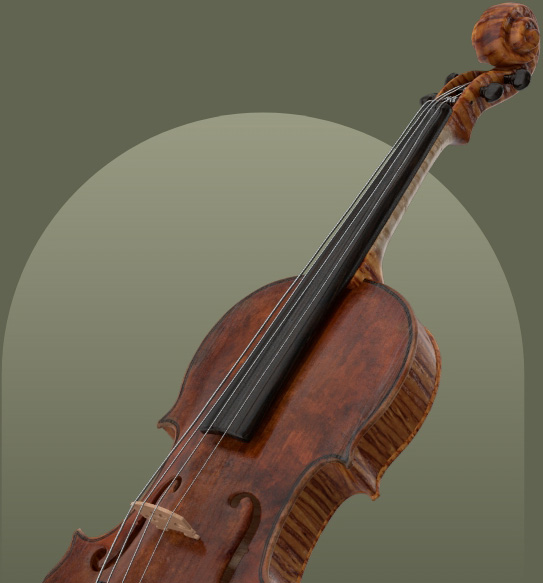
Enrico Catenar
Turin, c.1621–1701
Enrico Catenar (c. 1621-1701), born in Franconia, Germany, and active in Turin from around 1650, is widely regarded as the founder of the Turin school of violin making and an influence on G. Cappa. Succeeding Hans Angerer, Catenar's instruments are characterized by a loosely Amatisé model with a distinct Flemish appearance, featuring long slanted soundholes, extended corners, a full arch, and a unique head design. He often used plain materials, with varnish ranging from excellent golden-orange to pale golden-brown, and employed a distinctive construction method where ribs were set into a back slot and reinforced with fabric. A notable example of his work, a 1661 viola, is preserved in the Royal College of Music, London.
Auction Price History
Highest auction price
| Type | Details | Auction house | Sold | Price |
|---|---|---|---|---|
| Violin | 34.4 cm Turin, 1680 c. Possibly by | — | October 2009 | £8,898 |
| Violin | 34.4 cm Turin, 1680 c. (scroll by another hand) Possibly by | — | March 2009 | £10,530 |
No results match those filters.
Maker Overview
Life
Enrico Catenar (c. 1621-1701) was born around 1621 in Franconia, Germany, and died in 1701 in Turin, Italy. He became active in Turin from approximately 1650, succeeding Hans Angerer (also known as Johann Angerer or Giovanni Angerero), whose widow he married. Catenar is commonly considered the founder of the Turin school of violin making and an influence on G. Cappa. Sources contain conflicting information about his active period; while John Dilworth places him in Turin from c. 1650 to 1701, Cecie Stainer's A Dictionary of Violin Makers mentions a maker in Piedmont about 1785-90, which likely refers to a different individual or a later period. Willibald Leo Lütgendorff notes that the spelling of his name varies, including Catenar and Gattinari. Lütgendorff also suggests he may have been the father or brother of Francesco Catenar, and possibly related to a Catenari in Pavia. The assertion that he was a student of Cappa cannot be substantiated.
Characteristics
- Craftsmanship
- Enrico Catenar's work exhibits fine craftsmanship.
- Model
- His instruments are described as being on a loosely Amatisé model, featuring rather long centre bouts. However, Lütgendorff notes that his work is close to that of Stradivari imitators (Stradivarinachahmern nahe), indicating a potential stylistic evolution or differing interpretations.
- Varnish
- Examples of his work feature excellent golden-orange varnish, though other descriptions mention plain materials with a pale golden-brown varnish.
- Appearance
- His instruments are very Flemish in appearance, characterized by long, slanted soundholes, very long corners, a full arch, and a characteristic head with an extended last turn behind the eye.
- Construction
- The ribs are set into a slot cut in the inner edge of the back, and these are reinforced internally with fabric rather than traditional wooden linings.
- Materials
- He often used plain materials.
- Henricus Catenar
Fecit Taurini Anno 1661John Dilworth
Influence and legacy
- School Founder: Enrico Catenar is commonly considered the founder of the Turin school of violin making.
- Influence: He was an influence on G. Cappa.
- Succession: He succeeded Hans Angerer (Johann Angerer, Giovanni Angerero) in Turin.
- Mentorship Claims: The claim that he was a student of G. Cappa cannot be substantiated.
- Notable Examples: An excellent example of his work, a viola dated 1661, is preserved in the Royal College of Music, London.
Further Information
- Workshop Location: He was active in Turin from approximately 1650.
- Labels: Known labels include "Henricus Catenar / Fecit Taurini Anno 1661 [Wells]" and "Henricus Catenar, fecit Taurini anno 167—".
- Name Variations: The spelling of his name varies, with Catenar and Gattinari being common forms.
Biographies
The overview above is drawn from the following published accounts. Read them in the original:
John Dilworth+
CATENAR, Enricus Born circa. 1621 Franconia Germany, died 1701 Turin Italy. Active in Turin from c.1650, successor of Hans Angerer (Johann Angerer, Giovanni Angerero), whose widow he married. Commonly considered the founder of the Turin school and an influence on G. Cappa. Fine craftsmanship on a loosely Amatisé model, with rather long centre bouts. Excellent golden-orange varnish. Excellent example in the Royal College of Music, London; viola dated 1661. Very Flemish in appearance with long, slanted soundholes and very long corners, full arch and characteristic head with extended last turn behind the eye. Ribs set into a slot cut in the inner edge of the back, reinforced internally with fabric rather than wooden linings. Plain materials, pale golden-brown varnish. Henricus Catenar / Fecit Taurini Anno 1661 [Wells]
George Hart+
Henricus Catenar, fecit Taurini anno 167—
Cecie Stainer+
A maker in Piedmont about 1785-90.
Willibald Leo Lütgendorff+
Die Schreibweise des Namens schwankt; man findet Catenar, Gattinari etc.
angegeben. Er soll der Vater, nach Anderen ein Bruder des Francesco gewesen
sein und war vielleicht auch mit Catenari in Pavia verwandt. Die Behauptung,
dass er ein Schüler von Cappa gewesen sei, kann nicht begründet werden, in seiner Arbeit steht er den Stradivarinachahmern nahe. Vidal theilt folgenden Zettel mit:
Sell your instrument with Amati
Get started by uploading photos of your instrument for our experts to review.
Sell your instrument with Amati
Get started by uploading photos of your instrument for our experts to review.