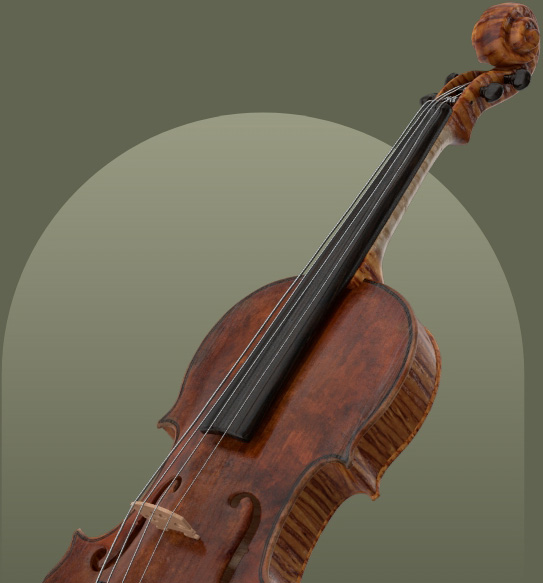
Francois Chanot
Mirecourt, Paris, 1788–1825
Francois Chanot (1787-1828) was a French naval engineer and scientist who applied his mathematical and scientific acumen to violin design. Trained by his father Joseph in Mirecourt, he developed a unique cornerless violin with a simplified, less arched form and straighter sound-holes, aiming to improve acoustics by preserving wood-fibre length. His innovative design, which was manufactured by Lété with assistance from J. B. Vuillaume, earned him a silver medal in 1819 after favorable judgment by the Académie des Sciences and Académie des Beaux-Arts. Although initially praised, his instruments are now generally considered to have poor tonal longevity, and the design has not endured over time.
Auction Price History
Highest auction price
15 results
| Type | Details | Auction house | Sold | Price |
|---|---|---|---|---|
| Violin | Rounded body shape without pronounced corners, branded to the scroll with a putto playing a pan flute Lot 2734 | Hargesheim. | March 2026 | £318est. Estimate € 900 |
| Violin | Guitar-shaped violin, labelled Chanot p.B. d'inv. ... janv 1818 Paris et Mirecourt C.I.D. No 25 Lot 175 | Ingles & Hayday | October 2019 | £2,160est. £ 1,500-2,000 |
| Cello | Follow in the French innovative tradition seen in the works of François Chanot in the 19th c., unlabelled Lot 74 | Ingles & Hayday | March 2019 | £3,600est. £ 5,000-7,000 |
| Violin | Millant collection, violin guitar, illustrated in Jean Baptiste Vuillaume sa vie son oeuvre Lot 181 | Vichy | December 2018 | £3,870est. € 1.000-1.500 |
| Viola | Spruce table Lot 24 | Vichy | April 2018 | £1,998est. € 1.200 |
| Violin | Inscribed to the label Chanot du 21 janvier 1818 N° 241 à Paris, spruce table Lot 26 | Vichy | April 2018 | £1,554est. € 800 |
| Small Cello | Guitar-shaped cello, labelled Chanot p B.d inv. 21 janv 1818 Paris CID No 69, abbreviated from ... Lot 53 | Ingles & Hayday | March 2018 | £3,360est. £ 3,000-5,000 |
| Violin | Guitar-shaped model, labelled Chanot p. B. d'inst 21 Janvier 1818, ... C.I.D. no 158 Lot 45 | Tarisio | March 2018 | £900est. £ 700-1,000 |
| Viola | Guitar-shaped viola, unlabelled Lot 72 | Ingles & Hayday | October 2016 | £2,640est. £ 2,000-3,000 |
| Violin | Lot 51 | Bonhams | May 2014 | £1,250 |
| Violin | Lot 53 | Bonhams | May 2014 | £1,250 |
| Violin | Guitar shaped, one-piece back, varnish of a golden brown colour Lot 134 | Apollium | March 2014 | £664est. € 700-800 |
| Cello | 1818 c. | — | November 2000 | £2,990 |
| Viola | 38.0 cm 1818 c. | — | November 2000 | £997 |
| Violin | 1819 c. | — | March 1990 | £1,045 |
No results match those filters.
Maker Overview
Life
Francois Chanot (1787-1828), born in Mirecourt, was the son of a musical instrument maker. Sources contain conflicting information regarding his birth year, with John Dilworth stating 1788 and Cecie Stainer stating 1787. Similarly, his death year is cited as 1825 by Dilworth and 1828 by Stainer, both occurring in Rochefort, France. A gifted mathematician and scientist, Chanot attended the Ecole polytechnique and subsequently entered the French navy as an engineer. During an absence from the navy between 1816 and 1818, caused by an injury, he returned to Mirecourt and began to apply scientific principles to violin construction. He submitted a violin of his new design to the Académie des Beaux-Arts and the Académie des Sciences in 1817, which, after three trials, was favorably judged for its superior tonal quality. He was awarded a silver medal in 1819. In 1824, he was recalled to active service and was soon promoted to the higher grade of an engineer of the first class.
Characteristics
- Design Philosophy
- Francois Chanot's violin making activities were subservient to his career as a naval engineer, but he sought to construct violins on more scientific principles.
- Innovation
- He designed a simplified and acoustically improved form of cornerless violin. His models were only slightly arched, featured sound-holes that were nearly straight, and had sides less curved, resembling those of a guitar. The underlying idea was to keep the wood-fibres as long as possible, believing this would enhance vibration.
- Manufacture
- Although Chanot designed these instruments, their manufacture was passed to the company of Lété in Mirecourt. J. B. Vuillaume was hired to assist with this work.
- Notable Instruments
- A violin made by Chanot in 1818 for Viotti and a violoncello are preserved in the Paris Conservatoire collection.
- Chanot 1818
rue St Honoré, Passage des Maures
Paris C.I.D. No. 268John Dilworth
Influence and legacy
- Training: Francois Chanot trained with his father, Joseph, in Mirecourt.
- Education: His background included studies at the Ecole polytechnique, which informed his scientific approach to instrument design.
- Recognition: Chanot was awarded a silver medal in 1819 for his innovative violin design.
- Museum Collections: A violin he made in 1818 for Viotti and a violoncello are part of the Paris Conservatoire collection.
- Enduring Quality: Despite initial favorable judgments, Cecie Stainer notes that violins on his model are now of poor quality, and their tone, though excellent when first made, does not last. John Dilworth similarly states that the Francois Chanot violin, while probably the best thought-out of many alternative patent designs, has not stood the test of time.
Further Information
- Label Inscription: An example of his label reads: "Chanot 1818 / rue St Honoré, Passage des Maures / Paris C.I.D. No. 268".
- C.I.D. Meaning: The letters C.I.D. on his label are the initials of his title, "Capitaine, Ingenieur, Deuxieme classe".
- Label Poem: Willibald Leo Lütgendorff notes a label with the verses: "À mes essais daigne sourire! / Fais résonner ce nouveau violon: / Et l'on dira que d'Apollon / J'ai retrouvé l'armonieuse lyre."
Biographies
The overview above is drawn from the following published accounts. Read them in the original:
John Dilworth+
CHANOT, François Born 1788 Mirecourt, died 1825 Rochefort France. A gifted mathematician and scientist, his violin making activities were subservient to his career as a naval engineer. He trained with his father Joseph in Mirecourt, and, during an absence from the navy in 1816-1818 caused by an injury, designed a simplified and acoustically improved form of cornerless violin. Found to be tonally satisfactory, development continued after he rejoined the navy in 1818. Manufacture was passed to the company of Lété in Mirecourt, for whom J. B. Vuillaume was hired to assist with the work. Although probably the best thought-out of many alternative patent designs for the violin throughout modern history, the François Chanot violin has not stood the test of time. Chanot 1818 / rue St Honoré, Passage des Maures / Paris C.I.D. No. 268
Cecie Stainer+
Son of a musical instrument maker in Mirecourt, b. 1787. Mirecourt; d. 1828, Rochefort. After being in the Ecole polytechnique, he entered the French navy as engineer; being retired on half-pay owing to some satirically-written political verses, he went back to Mirecourt, and in the workshops of his father came to the conclusion that violins might be constructed on more scientific principles. He made one, only slightly arched, with the sound-holes nearly straight, and the sides less curved in, more like the sides of a guitar, the idea being to keep the wood-fibres as long as possible, as being better for vibration. A violin of this pattern was submitted to the Academie des Beaux-Arts and the Academic des Sciences in 1817 ; after three trials it was favourably judged, the tone being of superior quality. He was awarded a silver medal in 1819. Unfortunately, violins on this model are now of poor quality ; the tone, though excellent when they are first made, does not last.
In 1824, he was recalled to active service and was shortly afterwards promoted to the higher grade of an engineer of the first class. The letters C.I.D. on his label are the initials of his title, ” Capitaine, Ingenieur, Deuxieme classe.”
A violin which he made in 1818 for Viotti and a violoncello are in the Paris Conservatoire collection.
Willibald Leo Lütgendorff+
Zettel mit den Versen:
»À mes essais daigne sourire!
Fais résonner ce nouveau violon:
Et l‘on dira que d’Apollon
J’ai retrouvé l’armonieuse lyre.«
Sell your instrument with Amati
Get started by uploading photos of your instrument for our experts to review.
Sell your instrument with Amati
Get started by uploading photos of your instrument for our experts to review.