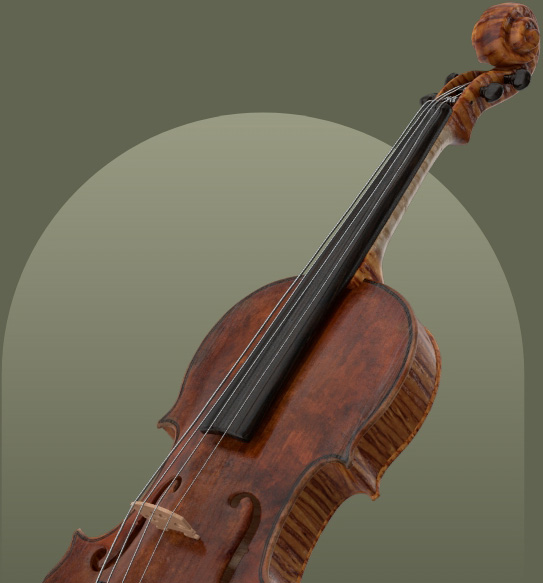
Pietro Antonio Dalla Costa
Alba, Treviso, worked 1720
Pietro Antonio Dalla Costa, born in Alba, was a notable violin maker of the Venetian school, active in Treviso from approximately 1720 to 1768, though specific dates vary between historical accounts. He was known for his "Amatisé" work, delicate forms, and generally low arching, following the patterns of the Amati brothers and also Stradivari. Uniquely, he explicitly acknowledged the Amati brothers on his labels. While sources laud his clean workmanship, there are conflicting descriptions of his varnish color (red, reddish-brown, or yellow). His historical standing is further complicated by the frequent misuse of his name by forgers. A significant detail of his legacy is that a Dalla Costa violin was once owned by Wolfgang Amadeus Mozart.
Auction Price History
Highest auction price
6 results
| Type | Details | Auction house | Sold | Price |
|---|---|---|---|---|
| Violin | Illustrated in Violin Lute Makers of Venice; Four Centuries of Violin Making, head possibly not original Lot 62 | Tarisio | March 2024 | £156,000est. £ 100,000-150,000 |
| Violin | Labelled Pietro Antonio dalla Costa fece in Treviso Anno 1748 Lot 284 | Ingles & Hayday | October 2023 | £45,600est. £ 40,000-60,000 |
| Violin | Labelled Pietro Antonio dalla Costa fece in Treviso Anno 1736 Lot 146 | Ingles & Hayday | October 2018 | £78,000est. £ 60,000-80,000 |
| Violin | Labelled Petrus Antonius a Costa fecit ad similitudinem illorum quos fecerunt. Antonius & Hieronymus ... Lot 27 | Ingles & Hayday | November 2015 | £48,000est. £ 35,000-50,000 |
| Violin | Lot 22 | Bonhams | March 2012 | £61,250 |
| Violin | After Andrea Amati, labelled Pietro Antonio dalla Costa fece ..., of an orange brown colour Lot 22 | Bonhams | March 2012 | £61,250est. £ 50,000-70,000 |
No results match those filters.
Maker Overview
Life
Pietro Antonio Dalla Costa (circa 1720-1768) was born in Alba and worked primarily in Treviso, Italy. in The Brompton’s Book of Violin & Bow Makers, he worked circa 1720-1768. However, Cecie Stainer in A Dictionary of Violin Makers states he worked in Treviso about 1740-1765. Willibald Leo Lütgendorff, in Die Geigen- und Lautenmacher vom Mittelalter bis zur Gegenwart, notes that his name is also read as Dalla Caesta. Lütgendorff also suggests that he may have temporarily worked in Mantua and Venice, possibly before 1720 or after 1757. His name was frequently misused by forgers, which may account for the wide variation in dates associated with his work. Notably, Dilworth records that Wolfgang Amadeus Mozart himself owned a Dalla Costa violin.
Characteristics
- Innovation
- Unusually for makers of his time, Pietro Antonio Dalla Costa explicitly acknowledged the Amati Brothers on his labels. These labels stated that the instrument was either a copy of their work or made using their example, rather than implying he was a pupil, as other makers often did (Dilworth).
- Methods
- A fine maker of the Venetian school, Dalla Costa produced Amatisé work, though Dilworth noted it was not as disciplined or highly finished as its Amati inspiration. His instruments were delicate in form and generally featured a low arch (Dilworth). He worked quite cleanly ("recht sauber"). Cecie Stainer further notes his adherence to the patterns of Antonio and Gerolamo Amati.
- Varnish
- Sources present conflicting information regarding his varnish. Dilworth describes it as typical Venetian red varnish, applied fairly thinly. Lütgendorff praises his "magnificent reddish-brown varnish." In contrast, Cecie Stainer states he used yellow varnish of good quality.
- Other makers tended to imply that they were pupils of the Amati. Pietro Antonio dalla Costa
fece in Treviso Anno 17..John Dilworth - Petrus Antonius a Costa fecit ad
similitudinem illorum quod fecerunt:
Antonius & Hieronymus Fratres Amati
Cremonenses, filii Andreae. Tarvisii, anno 1755John Dilworth - Pietro Antonio dalla Costa fece
in Treviso. Anno 1760
Ad examplar Antonii & Hieronymus Amati Cremonensis Petrus Antonius a Costa
fecit Tarvisii. anno 1760John Dilworth
Influence and legacy
- Schools/Tradition: Pietro Antonio Dalla Costa is identified as a fine maker of the Venetian school (Dilworth). He was an imitator of the Amati brothers, a fact he openly emphasized (Lütgendorff), and also of Stradivari (Lütgendorff).
- Notable Associations: Among his notable associations, Wolfgang Amadeus Mozart famously owned a Dalla Costa violin (Dilworth).
- Famous Owners: The illustrious composer Wolfgang Amadeus Mozart is a documented owner of a Dalla Costa violin (Dilworth).
- Modern Recognition: The frequent misuse of his name by forgers has significantly contributed to the wide-ranging and often contradictory dates found associated with his instruments, complicating precise historical timelines (Lütgendorff).
Further Information
- Technical Characteristics: Characteristic of his craft, Dalla Costa's instruments exhibited Amatisé features, distinguished by their delicate form and typically low arch (Dilworth). Lütgendorff also highlighted his notably clean workmanship.
- Historical Uncertainties: There are conflicting accounts of his working dates, with Dilworth stating circa 1720-1768, and Stainer giving about 1740-1765. The exact color of his varnish is also subject to differing descriptions: typical Venetian red (Dilworth), magnificent reddish-brown (Lütgendorff), and yellow of good quality (Stainer). His potential work in Mantua and Venice is noted as possibly temporary or outside his main working period (Lütgendorff). The misuse of his name by forgers further complicates the establishment of precise historical timelines (Lütgendorff).
- Notable Quotes: Examples of his labels, as recorded by John Dilworth:
- "Pietro Antonio dalla Costa / fece in Treviso Anno 17.."
- "Petrus Antonius a Costa fecit ad / similitudinem illorum quod fecerunt: / Antonius & Hieronymus Fratres Amati / Cremonenses, filii Andreae. Tarvisii, anno 1755" [Petrus Antonius a Costa made it in Treviso in the year 1755, in the likeness of those made by Antonius & Hieronymus Amati, Cremonese Brothers, sons of Andrea.]
- "Pietro Antonio dalla Costa fece / in Treviso. Anno 1760 / Ad examplar Antonii & Hieronymus Amati Cremonensis" [Pietro Antonio Dalla Costa made this in Treviso in the year 1760, after the example of Antonius & Hieronymus Amati of Cremona]
- "Petrus Antonius a Costa / fecit Tarvisii. anno 1760" [Petrus Antonius a Costa made this in Treviso in the year 1760]
Biographies
The overview above is drawn from the following published accounts. Read them in the original:
John Dilworth+
DALLA COSTA, Pietro Antonio Worked circa. 1720-68 Treviso Italy. Born in Alba. Fine maker of the Venetian school. Very Amatisé work, although not as disciplined and highly finished as their inspiration. Delicate in form and generally with a low arch. Typical Venetian red varnish, although applied fairly thinly. (Mozart owned a Dalla Costa violin.) Unusually amongst makers of the time, he acknowledged the Amati Brothers on his label, stating either that the instrument was a copy of their work or using their example. Other makers tended to imply that they were pupils of the Amati. Pietro Antonio dalla Costa / fece in Treviso Anno 17.. Petrus Antonius a Costa fecit ad / similitudinem illorum quod fecerunt: / Antonius & Hieronymus Fratres Amati / Cremonenses, filii Andreae. Tarvisii, anno 1755 Pietro Antonio dalla Costa fece / in Treviso. Anno 1760 / Ad examplar Antonii & Hieronymus Amati Cremonensis Petrus Antonius a Costa / fecit Tarvisii. anno 1760
Cecie Stainer+
Worked in Treviso about 1740-65. He made some fairly good violins, following the patterns of Ant. and Gir. Amati; he used yellow varnish of good quality.
Willibald Leo Lütgendorff+
Der Name wird auch Dalla Caesta gelesen. — Er war ein Nachahmer der
Brüder Amati, was er auch ausdrücklich betont, aber auch Stradivaris, und
arbeitete recht sauber; namentlich sein prachtvoller rothbrauner Lack ist zu
loben. Er soll auch in Mantua und Venedig gearbeitet haben; das könnte allerdings
nur vorübergehend oder vor 1720 und nach 1757 gewesen sein. Sein Name wurde von Fälschern gern missbraucht, wodurch sich die ungewöhnlich weit auseinanderliegenden Jahreszahlen, die man neben seinem Namen angegeben findet, wohl einigermaassen erklären lassen.
Sell your instrument with Amati
Get started by uploading photos of your instrument for our experts to review.
Sell your instrument with Amati
Get started by uploading photos of your instrument for our experts to review.