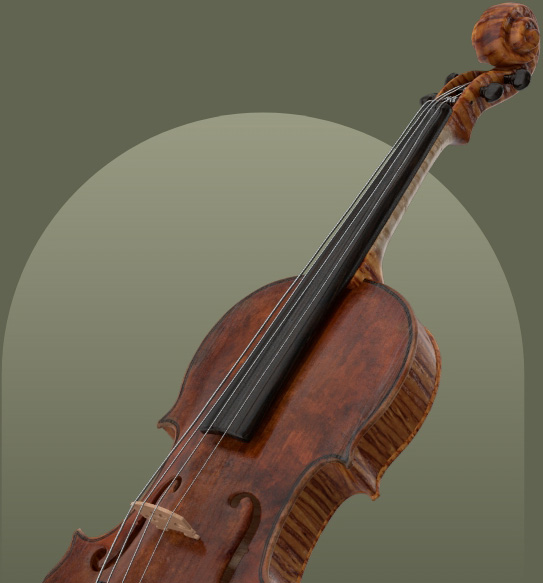
Max Grossmann
Berlin, Jastrowie, b. 1856
Max Grossmann (b. 1856) was a Polish-born acoustician who studied in Berlin and developed a significant theory of plate tuning for violins. His research proposed that the top and back plates of a violin should be in a simple vibrational relationship, specifically a pure fourth or fifth, to achieve optimal sound. He collaborated with Otto Seifert to produce 'New Cremona Violins' based on these principles and published several influential works on his findings, which were adopted by other makers.
Request an expert valuation or learn how our global auctions achieve the highest prices for your instruments.
Auction Price History
Highest auction price
7 results
| Type | Details | Auction house | Sold | Price |
|---|---|---|---|---|
| Violin | Labelled Neu-Cremona, Kunstinstrumentenbau-R ... Lot 180 | Brompton’s | March 2018 | £2,640est. £ 1,500-2,000 |
| Violin | Labelled Neu-Cremona, Kunstinstrumentenbau-Gesellschaft m. b. H. Berlin 1907, N. ... Lot 243 | Brompton’s | October 2016 | £3,840est. £ 800-1,200 |
| Violin | Bearing an original label dated 1908, signed on the label Lot 221 | Brompton’s | June 2013 | £1,020est. £ 1,000-1,500 |
| Violin | 35.6 cm 1910 | — | March 2010 | £4,800 |
| Cello | 75.5 cm Berlin,1908 | — | July 2007 | £3,360 |
| Cello | 1910 | — | June 2000 | £2,875 |
| Violin | 1908 | — | December 1989 | £1,012 |
No results match those filters.
Maker Overview
Life
Max Grossmann (b. 1856) was born in 1856 in Jastrowie, Poland. He pursued studies in acoustics in Berlin, where he developed a method for the harmonic tuning of violin plates. From 1904, Grossmann collaborated with Otto Seifert to produce 'New Cremona Violins', which also included violas and cellos, applying his acoustic principles with notable success. He published several works detailing his theories, including Es giebt doch ein Geheimniss der alten Italienischen Geigenbauer in Berlin in 1898, and Die theorie der harmonischen Abstimmung der Resonanzplatten bei der Geige und die hauptsachlichseten Einwande dagegan, also in Berlin, in 1907., three of his collected works were translated into English and published as New Cremona in London in 1908.
Characteristics
- Acoustic Theory
- Dr. Grossmann's research proposed that the back and top plates of a violin must stand in a simple vibrational relationship to each other, specifically a higher pure fourth or fifth, to achieve optimal sound.
- Material Selection
- He theorized that the choice of spruce and maple for violin construction could be explained by the fact that, at approximately equal thickness, their fundamental tones naturally exhibit this desired vibrational ratio.
- Instrument Production
- From 1904, he applied his plate tuning principles to the production of 'New Cremona Violins', as well as violas and cellos, in collaboration with Otto Seifert.
Influence and legacy
- Collaboration: Max Grossmann collaborated with Otto Seifert in the production of 'New Cremona Violins' from 1904, applying his acoustic theories.
- Adoption of Ideas: His ideas on plate tuning were adopted with success by various violin makers, including the Markneukirchen firm C. G. Schuster jun.
- Publications: Max Grossmann left a significant legacy through his published works on violin acoustics, such as Es giebt doch ein Geheimniss der alten Italienischen Geigenbauer (1898) and Die theorie der harmonischen Abstimmung der Resonanzplatten bei der Geige und die hauptsachlichseten Einwande dagegan (1907).
- Translated Works: A collection of three of his works was translated into English and published as New Cremona in London in 1908, broadening the reach of his theories.
- Instrument Line: His theoretical work was embodied in the 'New Cremona Violins' (and violas and cellos) produced from 1904, demonstrating the practical application of his research.
Biographies
The overview above is drawn from the following published accounts. Read them in the original:
John Dilworth+
GROSSMANN, Max Born 1856 Jastrowie Poland. Studied acoustics in Berlin and evolved a method of plate tuning. Working with Otto Seifert, he produced ‘New Cremona Violins’ (also violas and cellos) from 1904, using this principal with some success. Published Die theorie der harmonischen Abstimmung der Resonanzplatten bei der Geige und die hauptsachlichseten Einwande dagegan (Berlin, 1907), Es gibt doch ein Geheimnis der alten italienischer Geigenbauer (Berlin, 1898) and several other volumes. Three of these collected and translated into English as New Cremona (London, 1908).
Willibald Leo Lütgendorff+
Es ist durchaus wahrscheinlich, dass die alten Meister des Geigenbaus über
die physikalischen Gesetze besser unterrichtet waren, als man gemeiniglich
glaubt und dass die schliesslich von ihnen festgestellte Form der Geige eine
Folge wissenschaftlicher Erwägungen war. Dass wissenschaftliche Ergebnisse
in früheren Zeiten häufig als Geheimniss von den wenigen Wissenden gehütet
wurden, kann auch nicht bestritten werden und so darf man den ein Jahrhundert
alten Glauben, dass die Cremoneser ein Geheimniss besessen und mit ins Grab
genommen haben, nicht ohne weiteres von der Hand weisen. Ist es doch trotz
aller Versuche der besten Geigenmacher des 19. Jahrhunderts keinem gelungen,
Stradivari oder Guarneri auch nur zu erreichen, geschweige denn, sie zu übertreffen.
Das zu vermuthende Geheimniss zu lüften, haben sich bereits zahlreiche
Geigenmacher und Physiker bemüht und zu einem interessanten Ergebniss
ist Dr. Grossmann gekommen, der dieses in einer kleinen Schrift unter dem
Titel: »Es giebt doch ein Geheimniss der alten Italienischen Geigenbauer« veröffentliche
und das in der Forderung besteht, dass Boden und Decke in einem
einfachen Schwingungsverhältniss zu einander stehen müssen. Dieses Verhältniss
fand er in der höheren reinen Quarte oder Quinte. Bei annähernd gleicher
Stärke stehen die Eigentöne von Fichten- und Ahornholz in diesem Verhältniss,
woraus sich die Wahl gerade dieser Holzsorten zum Geigenbau erklären liesse.
Dr. Grossmann führte seine Theorie noch weiter aus in einem Aufsatz der
Berliner Mus. Instr. Ztg. vom 16. Juli (1897/98) No. 41. Auf seine Ideen
gingen verschiedene Geigenmacher mit bestem Erfolge ein, so auch die Markneukirchner
Firma C. G. Schuster jun.
Sell your instrument with Amati
Get started by uploading photos of your instrument for our experts to review.
Sell your instrument with Amati
Get started by uploading photos of your instrument for our experts to review.