The secret under the hair

Amongst all bows, Hill bows are some of the easiest to identify. They are fairly consistent in style and model; also, just to make life even easier, they are usually branded with the Hill brand. A quick check shows that since 2018 alone Amati have sold over 140 Hill bows – violin, viola and cello – so they are a pleasant constant in our working life.

So it is easy to recognise the workshop, and the shop that sold them, but the individual maker is often visible beneath the hair.
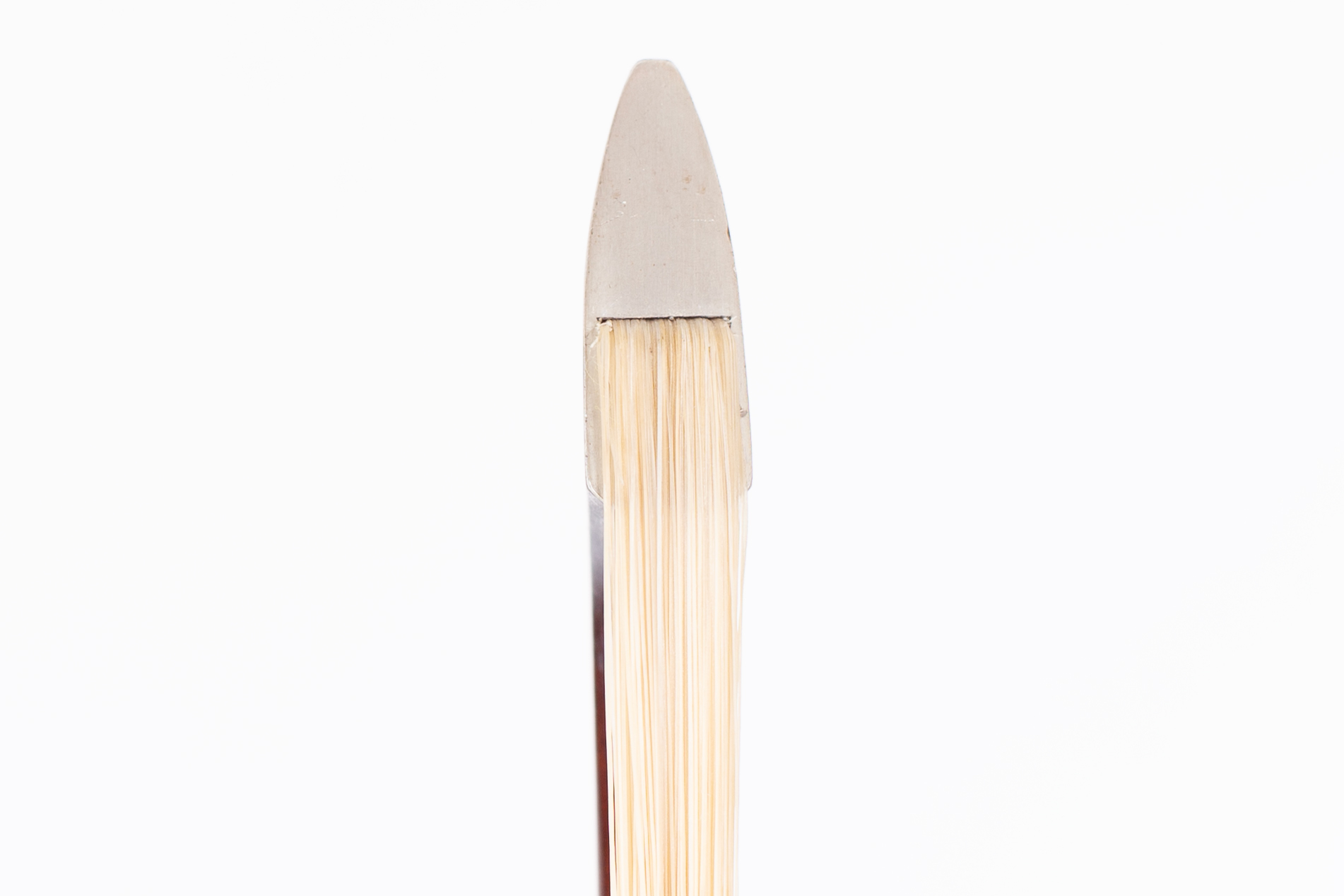
A bit of background. W. E. Hill & Sons ran from 1887 and, in a different form, continues to exist today. For most of the twentieth century their London workshop employed the best bow makers in England. What makes them unusually interesting to anyone who owns, buys or sells bows is that Hill bows are, quietly, signed – not on the stick where the Hill brand takes pre-eminence, but on the silver face at the head.

If you want chapter and verse on what they actually fetch, our W. E. Hill & Sons price history and photo archive is the place to look.
You won’t see it in normal circumstances. The mark sits under the hair. You have to release the frog and look at the faceplate to find it, which is exactly why so many owners have no idea it’s there at all.

Here’s why it matters.
A Hill bow is a Hill bow – but the individual maker moves the needle. The workshop ran on a roster of craftsmen, some of them legends in their own right, and the market absolutely knows the difference. A stick from the bench of William C. Retford is not valued the same way as an anonymous journeyman’s, even with the same brand stamped on it. The mark is the difference between “a Hill” and “a Hill by him”.
Do you own a W. E. Hill & Sons bow?
Our specialists value instruments like this every week, at free valuation days across Britain and Ireland. Fifteen minutes with an expert — free, and without obligation.
The men behind the marks
Once you start reading the marks, you start meeting the people, and they are a properly English cast of characters. A few of the notable ones:
William Napier (1848–1932) – no mark at all. A Scot, who started as a railway porter, before joining as a carpenter / packer at the piano makers Broadwood & Sons. Napier joined Hills in 1889, and lists his profession on the 1891 census as a ‘violin bow maker’. He ran the Hills workshop until 1930, and was, by all accounts, a born organiser. Watson recounts how “Retford soon became the kingpin in the bow shop and this caused a great deal of antagonism between himself and Napier… By about 1900, the animosity had to to the point where they completely stopped talking to one another.” {BVMA 2000, p.14}
His bows carry no maker’s mark, which is a nice reminder that a blank silver face isn’t necessarily a bad sign.
Sidney Yeoman (1876–1948) – a single nick in the lower mortice. Got his start in the case department of W. E. Hill & Sons in 1885 as a 14 year old boy. He moved to bows under William Napier, then enlisted in 1914 and came back from the war with severe shell-shock, later going diabetic and presumably losing an eye in consequence. He eventually took charge of the less experienced makers in 1930. This may have been in consequence of his own falling off in ability. There are accounts of Retford stepping in to help Yeoman out with his sticks in later years. A pleasing circularity, as it is likely that Yeoman originally taught William C. Retford in Hanwell.
William C. Retford (1875–1970) – the single dot, and the giant. Apprenticed to W. E. Hill & Sons at 16 in 1892 he was primarily responsible for the Hill bow as we know it – the model, the range of mounts from the simple to the fleur-de-lys. He eventually became workshop manager for the bows, holding the post for thirty years, retiring in 1957. War service interrupted his time at Hanwell when he worked in an airplane factory. A perfectionist, and widely called the greatest bow craftsman of his time.
William R. Retford (1899–1960) – two dots. “Young Bill”, son of the above, joined in 1919. A very good all-rounder who, by the family’s own account, took little joy in the work, yet whose contribution to the workshop was called “incalculable”. He’d been deafened by the guns in the First World War during his role as a first-aider. Pre-deceased his father.
Arthur Bultitude (1908–1990) – number 6, and one of the great names. He arrived at the case-making shop in 1922 aged fourteen, moved quickly to bows, built wooden aircraft during the war, and returned to Hills in 1945 before leaving in 1961 to set up on his own. Prolific under his own brand, it is thought he made more than 2000 bows, he finally retired in 1982.
William Watson (1930–2018) – number 7. Retford’s “last pupil”, and a genius at cutting out the gold fleur-de-lys inserts, a skill he had too acquire when the original jewellers who provided them closed during the Second World War. Exceptional craftsmanship, and the last man trained by the master himself. I knew him briefly from my time at Bonham’s. A fascinating man.

Garner ‘Tug’ Wilson (b. 1944) – number 12. Began at Hills in 1936, trained by Watson and Bultitude, continued after their departure by Malcolm Taylor. Leaving W. E. Hill & Sons in 1966 and setting up his own workshop in Suffolk in 1969. Highly prolific under his own brand. Less frequently seen on Hill bows.
Stephen Bristow – number 16. One of the later hands, at Hills from 1967 to 1972, afterwards working with John Clutterbuck, trading under the brand of J. S. Rameau.
These were some small biographies of the makers. As time goes by I will try and update the post to include others.

The mark of Sidney Yeoman on this Hill cello bow
The Marks
The full roster runs from single ticks and dots and leaves in the early days to a plain numbering system from around 1917 onward – Arthur Copley was 1, Edgar Bishop 2, and so on up the bench to Timothy Baker at 22. Two dozen makers, one silver face at a time.

A few practical notes
1 – The marks are small and sometimes quite subtle. Under the hair, on the faceplate.
2 – A few marks shifted over time. William Johnston’s two ticks were vertical before 1904 and horizontal after, which usefully helps date the bow as well as place the maker.
3 – The mark on its own is a strong clue, not a total attribution and at Amati, we tend to leave the cataloguing as that of Hills without specifically ascribing the maker.
Finding a number 6 doesn’t make a bow a Bultitude on its own – but it’s a very good place to start the conversation, and it’s the sort of detail that turns “I think it’s a Hill” into something a valuer can actually work with.
If you’ve a Hill bow in a case somewhere – violin, viola or cello – and you’ve never looked under the hair, it’s worth having someone (us?) take a proper look. Mostly it’s simply the small pleasure of knowing whose hands made the thing you play.
Either way – a bow that can be attributed to a named Hill maker is exactly the sort of thing that does well under the hammer, where the right two collectors can fight over what it’s really worth. If you’d like an opinion on a Hill violin bow, viola bow or cello bow – or indeed any bow, marked or otherwise – our valuations page is the place to start: https://amati.com/valuations/
JKB
List of Hill bow makers and their marks:
Symbols
Sidney Yeoman 1885 — single tick
William C. Retford 1891 — single dot
William R. Retford 1919 — two dots
William Johnston 1894 — two ticks (vertical before 1904, horizontal after)
Frank Napier 1904 — three leaves
Charles Leggatt d.1917 — two ticks in center
William Napier 1889 — no mark listed (still left out above).
Numbers
Arthur Scarbrow — number 0
Arthur Copley 1917 — number 1
Edgar Bishop 1917 — number 2
Albert Leeson 1919 — number 3
Leslie Bailey 1920 — number 4
Arthur Barnes 1919 — number 5
Arthur Bultitude 1922 — number 6
William Watson 1945 — number 7
Malcom Taylor 1947 — number 8
Ronald Harding 1949 — number 9
Arthur Brown 1946 — letter x or number 10
Allen Willis 1940 — number 11
Garner Wilson 1936 — number 12
David Taylor — number 13
John Clutterbuck — number 14
Brian Alvey 1966 — number 15
Stephen Bristow — number 16
Ian Shepherd — number 17
David Earl 1970 — number 18
Matthew Coltman — number 19
John Stagg — number 20
Derek Wilson — number 21
Timothy Baker — number 22
With thanks to the research of the Hill bow community and the BVMA’s The British Violin, on whose work any account of these marks stands.
Share this:


Related posts