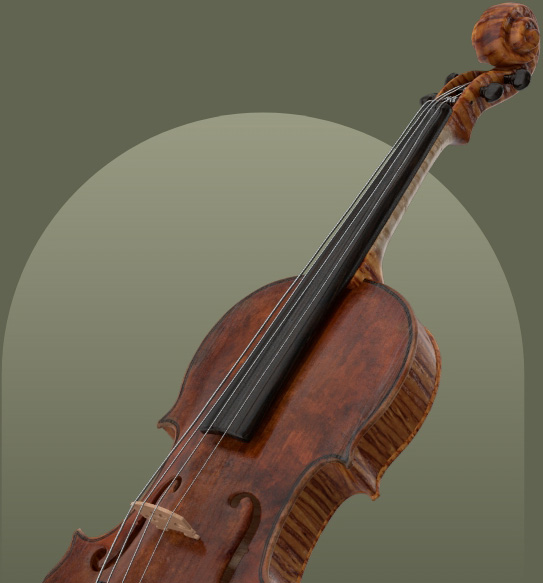
Andreas Kempter
Lechbruch, 1701–1786
Andreas Kempter (1701-1786) was a highly regarded German luthier born in Lechbruck, Allgäu, who was active in Dillingen from 1725. He was likely apprenticed in Füssen and later married and acquired citizenship in Dillingen, where he worked for over five decades. Kempter's instruments, including violins, cellos, tenor violas, and viola d'amores, followed a Stainer-derived model with high arches and broad, elegantly handled proportions. He was known for his good varnish, excellent wood, and well-executed purfling. His work is preserved in significant collections, and he was recognized in his time as an "artificiosus chelii factor."
Auction Price History
Highest auction price
2 results
| Type | Details | Auction house | Sold | Price |
|---|---|---|---|---|
| Violin | 1765 c. | — | March 1997 | £2,990 |
| Violin | 1764 | — | January 1984 | £288 |
No results match those filters.
Maker Overview
Life
Andreas Kempter (1701-1786) was born in 1701 in Lechbruck, Allgäu, and died in 1786 in Denklingen, Landsberg, Germany., his name appears in the records of Füssen, where he was likely apprenticed. Willibald Leo Lütgendorff notes that Kempter probably completed his apprenticeship in Füssen, which was near his hometown, and arrived in Dillingen around 1725. He married Jungfrau A. Maria geb. Bairin on April 13, 1732, in Dillingen, where he also acquired citizenship. Kempter practiced his art as a violin maker in Dillingen for over 50 years, celebrating his golden wedding anniversary there on June 29, 1782. Shortly thereafter, he moved to live with his son, who was a pastor in Denklingen (between Landsberg and Schongau), and spent his final years there. In church records, he was referred to as "artificiosus chelii factor" and was highly regarded as both a lute and violin maker.
Characteristics
- Model
- Andreas Kempter followed a Stainer-derived model, characterized by a high arch and broad proportions that were quite elegantly handled. Cecie Stainer states that he followed the Stainer pattern, and Willibald Leo Lütgendorff confirms that his violins, like those of most Swabian violin makers, were based on the Stainer model, though Kempter managed to express his own individuality.
- Arching
- His violins featured a high arch, while his cellos had a relatively flatter arch. Lütgendorff observed that the variety in his arching (Wölbungen) demonstrated his experimental approach.
- Proportions
- Instruments exhibited broad proportions, handled with elegance, and a strikingly broad pattern.
- Varnish
- Kempter used good varnish in various shades, sometimes yellow-brown and sometimes pale red. Lütgendorff added that his varnish, though often applied thinly, was very good.
- Materials
- He utilized excellent wood, and the purfling on his instruments was well done.
- Instruments
- Besides violins, he also made cellos, tenor violas, and viola d'amores. Several viola d'amores are noted for their finely carved lion heads, including examples in the Heyer collection and the Museum of Hamburg, and one in the Musikhistorisches Museum von Paul de Wit in Leipzig. A lute from 1747 is found in the Scheurleer collection.
- Labels and Inscriptions
- A printed label reads: "Andreas Kempter Lauten und / Geigenmacher in Dillingen, 1760". An instrument from the Heyer collection, a viola d'amore dated 1746, bears an internal inscription: "Andreas Kempter lauthen und / geigen Macher in Dillingen hat / dise grand viole d'amour 1746 / gemacht für den gesitl. Hern / Joan Anton Walther chori / vicario und caeremonario zu / Eychstätt in Dombstyft."
Influence and legacy
- Apprenticeship: Andreas Kempter likely completed his apprenticeship in Füssen, as suggested by records and noted by John Dilworth and Willibald Leo Lütgendorff.
- Stylistic Influence: He primarily followed the Stainer model, a common practice among Swabian violin makers. However, Lütgendorff emphasizes that Kempter was able to express his own individuality within this tradition.
- Family Continuity: Andreas Kempter spent his final years living with his son, who was a pastor in Denklingen.
- Museum and Collection Holdings: His instruments are preserved in notable collections, including viola d'amores in the Heyer collection and the Museum of Hamburg. A lute from 1747 is part of the Scheurleer collection, and a beautiful viola d'amore with a lion's head is housed in the Musikhistorisches Museum von Paul de Wit in Leipzig.
Biographies
The overview above is drawn from the following published accounts. Read them in the original:
John Dilworth+
KEMPTER, Andreas Born 1701 Lechbruck, Allgäu, died 1786 Denklingen, Landsberg Germany. His name appears in the records of Füssen, where he was probably apprenticed. Active in Dillingen from 1725. Died in the parish of his ordained son, Denklingen. Stainer-derived model with high arch; broad proportions quite elegantly handled. Good varnish in various shades. Cellos with relatively flatter arch; also tenor violas. Viola d’amores in the Heyer collection and the Museum of Hamburg with finely carved lion heads. The Heyer instrument dated 1746 and inscribed internally: ‘Andreas Kempter lauthen und / geigen Macher in Dillingen hat / dise grand viole d’amour 1746 / gemacht für den gesitl. Hern / Joan Anton Walther chori / vicario und caeremonario zu / Eychstätt in Dombstyft.’ Printed label: Andreas Kempter Lauten und / Geigenmacher in Dillingen, 1760
George Hart+
Stainer model. Good wood, and work well purfled.
Cecie Stainer+
A maker in Dillingen about 1725-75. He followed the Stainer pattern; his violins are arched, of a good pattern, with varnish, sometimes yellow-brown, sometimes pale red colour; the wood is excellent and the purfling well done.
Willibald Leo Lütgendorff+
Seine Lehrzeit machte er wahrscheinlich in dem seiner Heimath nahegelegenen
Füssen durch und kam um 1725 nach Dillingen, wo er sich am 13. April 1732
mit der Jungfrau A. Maria geb. Bairin verheirathete und das Bürgerrecht erwarb.
Er übte seine Kunst als Geigenmacher über 50 Jahre lang in Dillingen
aus, wo er am 29. Juni 1782 noch seine goldene Hochzeit feierte. Bald darauf
zog er dann zu seinem Sohne, der Pfarrer in Denklingen (zwischen Landsberg
und Schongau) war, und verbrachte dort seine letzten Lebensjahre. In den
Kirchenbüchern wird er »artificiosus chelii factor« genannt und stand sowohl als
Lauten- wie als Geigenmacher in grossem Ansehen. Seine Geigen gehen, wie
die der meisten schwäbischen Geigenmacher, auf das Stainermodell zurück; er
verstand es aber doch, seine eigene Individualität zum Ausdruck zu bringen.
Die Verschiedenheit der von ihm angewendeten Wölbungen beweist, dass er
Versuche anstellte: das Patron nahm er auffallend breit und ist so sorgfältig in der Arbeit wie Edlinger. Der Ton seiner gut erhaltenen Geigen ist gross und schön, auch sein (verschiedenfarbiger) Lack, der meist nur zu dünn aufgetragen erscheint, ist sehr gut. Eine Laute aus dem Jahre 1747 von ihm findet sich in der Sammlung Scheurleer, eine sehr schöne Viola d’amore mit Löwenköpfchen am Wirbelkasten und prächtigem Lack besitzt das
Musikhistorische Museum von Paul de Wit in Leipzig.
Sell your instrument with Amati
Get started by uploading photos of your instrument for our experts to review.
Sell your instrument with Amati
Get started by uploading photos of your instrument for our experts to review.