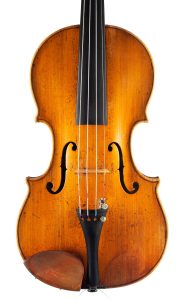
Pietro Giovanni Mantegazza
Milan, c.1730–1803
Pietro Giovanni Mantegazza (circa 1730-1803) was a prominent violin maker in Milan, Italy, known for his fine work on the Amatisé model. He worked in the Contrada dell'Aquila and Santa Margherita, and his workshop was continued by his sons Francesco and Carlo. While sources mention a brother Domenico, his confirmed involvement is debated. Mantegazza's instruments are characterized by a rich dark red varnish, though its current appearance and original quality are described differently across sources. He is also noted for his good workmanship and for producing many tenors and altos. The Mantegazza family was also involved in instrument restoration, notably lengthening violin necks to the "Paris fashion" around 1800.
Auction Price History
Highest auction price
17 results
| Type | Details | Auction house | Sold | Price |
|---|---|---|---|---|
| Viola | Rosenberg collection, labelled Nicolaus Amatius Cremonien Hieronimi filii Antoni Nepos fecit Ao 16.2 Lot 159 | Ingles & Hayday | June 2023 | £456,000est. £ 120,000-180,000 |
| Viola | Labelled Petrus Joannes Mantegatia fecit Mediolani in Via S. Margaritae 1793 Lot 62 | Tarisio | May 2016 | £245,757est. $ 220,000-300,000 |
| Viola | Slightly reduced in the upper bouts, sold with the original fingerboard, labelled Petrus Joannes ... Lot 228 | Brompton’s | June 2012 | £168,000est. £ 80,000-120,000 |
| Violin | 35.4 cm Italy, 18th C. Attributed to | — | April 2011 | £22,503 |
| Violin | 35.1 cm Milan, 1770 c. (scroll by member of the 'Guarneri' family) | — | March 2010 | £222,000 |
| Violin | 35.5 cm Milan, 1780 c. Probably by | — | March 2007 | £40,250 |
| Violin | 35.5 cm Milan, 1783 c. Ascribed to | — | November 2006 | £12,631 |
| Violin | 1790 c. | — | March 2000 | £43,300 |
| Violin | 1790 c. | — | September 1998 | £11,979 |
| Viola | 40.3 cm 1785 | — | April 1998 | £51,000 |
| Violin | 1776 | — | June 1994 | £20,700 |
| Violin | 1759 | — | May 1993 | £40,333 |
| Violin | 1750 c. | — | November 1991 | £58,300 |
| Viola | 1791 | — | March 1987 | £26,400 |
| Viola | 40.6 cm 1780 c. | — | November 1983 | £16,092 |
| Violin | 1771 | — | May 1981 | £2,430 |
| Viola | 41.3 cm 1768 | — | March 1980 | £11,733 |
No results match those filters.
Maker Overview
Life
Pietro Giovanni Mantegazza (circa 1730-1803) was born around 1730 and died in 1803 in Milan, Italy. He lived and worked in the Contrada dell'Aquila, near the contrada Santa Margherita., he was assisted by his sons Antonio, Francesco, and Carlo; Antonio pre-deceased him, but Francesco and Carlo continued the workshop after his death. Dilworth also notes that most sources mention his brother Domenico, with whom he is supposed to have worked up until 1775, but historical confirmation of this has not appeared. Sources contain conflicting information regarding the exact composition of the workshop, as Cecie Stainer refers to "Two brothers working in Milan about 1750 to 1800," and George Hart mentions "the Brothers Mantegazza." Willibald Leo Lütgendorff states that he was the best violin maker of his family. The family of Mantegazza, as violin-makers, dates back to about the middle of the eighteenth century. Lancetti states that "about 1800 the Brothers Mantegazza were restorers of instruments, and were often entrusted by French and Italian artists to lengthen the necks of their Violins after the Paris fashion, an example which was followed by amateurs and professors all over North Italy." This extract, cited by George Hart, indicates that short necks were dispensed with in Paris towards the close of the 18th century, with Viotti likely being a chief instigator of this change. Count Cozio was a patron of the Brothers Mantegazza and appears to have made notes relative to Italian Violins from information acquired from them.
Characteristics
- Model
- Pietro Giovanni Mantegazza produced fine work on an Amatisé model, characterized by a full rounded arch and a somewhat open scroll.
- Varnish
- , his instruments feature a rich dark red varnish of great quality and texture. However, Willibald Leo Lütgendorff notes that his varnish was too resinous and now appears very darkened. George Hart describes the varnish as brilliant, while Cecie Stainer states that the varnish, of fine quality, varies in color, sometimes appearing almost black.
- Wood
- Willibald Leo Lütgendorff observed that he used beautiful wood. In contrast, John Dilworth states that the materials were of only average quality. George Hart and Cecie Stainer both describe the wood as somewhat hard or rather too hard.
- Workmanship
- George Hart notes that the workmanship is good, and the modeling of the later-dated instruments is also good, though older ones are rather high.
- Petrus Ioes Fratresq
Mantegatia Mediolani
in Via S.Margarite anno
1750John Dilworth - Pietro Giov. e Fratelli Mantegazza nella
contrada di Santa Margarita in Milano
al segno dell’Angelo,1756John Dilworth - Petrus Joannes Mantegatia fecit Me-
diolani in Via S.Margaritæ 1783John Dilworth
Influence and legacy
- Stylistic Influence: Some influence of Landolphi is detectable in his work.
- Family Continuity: His sons Francesco and Carlo continued the workshop after his death, ensuring the family's legacy in violin making.
Further Information
- Workshop Location: He worked in Milan, specifically in the Contrada dell'Aquila, near the contrada Santa Margherita, and also in the contrada di Santa Margarita al segno dell'Angelo.
- Instrument Production: The Mantegazza family appears to have made many Tenors, as noted by George Hart, and Cecie Stainer specifically mentions that they made many good altos.
- Labels: Examples of his labels include "Petrus Ioes Fratresq / Mantegatia Mediolani / in Via S.Margarite anno / 1750," "Pietro Giov. e Fratelli Mantegazza nella / contrada di Santa Margarita in Milano / al segno dell'Angelo,1756," and "Petrus Joannes Mantegatia fecit Me- /diolani in Via S.Margaritæ 1783." Cecie Stainer also mentions similar labels dated 1757, 1760, 1763, 1770, and 1780.
Biographies
The overview above is drawn from the following published accounts. Read them in the original:
John Dilworth+
MANTEGAZZA (MANTEGATIA), Pietro Giovanni Born circa. 1730, died 1803 Milan Italy. Lived and worked in the Contrada dell’Aquila, near the contrada Santa Margherita. Assisted by his sons Antonio, Francesco, and Carlo. The first named pre-deceased him but the remaining two continued the workshop after his death. Most sources mention his brother Domenico with whom he is supposed to have worked up until 1775 but so far no historical confirmation of this has appeared. Fine work on Amatisé model with rich dark red varnish of great quality and texture, somewhat open scroll, and full rounded arch. Materials of only average quality. Some influence of Landolphi detectable. Petrus Ioes Fratresq / Mantegatia Mediolani / in Via S.Margarite anno / 1750 Pietro Giov. e Fratelli Mantegazza nella / contrada di Santa Margarita in Milano / al segno dell’Angelo,1756 Petrus Joannes Mantegatia fecit Me- /diolani in Via S.Margaritæ 1783
George Hart+
Lancetti states that “about 1800 the Brothers Mantegazza were restorers of instruments, and were often entrusted by French and Italian artists to lengthen the necks of their Violins after the Paris fashion, an example which was followed by amateurs and professors all over North Italy.” This extract shows that the short necks were dispensed with in Paris towards the close of the last century, and doubtless Viotti was the chief instigator with regard to the change. The family of Mantegazza, as Violin-makers, date back to about the middle of the eighteenth century. They appear to have made many Tenors. The workmanship is good, and also the modelling of the later-dated instruments. The older ones are rather high, but the varnish is brilliant. The wood is somewhat hard. Count Cozio was a patron of the Brothers Mantegazza, and appears to have made notes relative to Italian Violins, from information acquired from them.
Cecie Stainer+
Two brothers working in Milan about 1750 to 1800. They made many good altos; the varnish, of fine quality, varies in colour, sometimes is almost black, the wood is rather too hard.
Labels : ” Petrus Joes. Fratresq. Mantegatia Mediolani in Via S. Margaritae, anno 1757″ ; similar labels are dated 1760, 1763, and 1780 ;
“Pietro, Gio. e fratelli Mantegazza nella contrada di Santa Margharita in Milano al segno dell’ Angelo, 1756″ ; a similar label is dated 1770;
Willibald Leo Lütgendorff+
Der beste Geigenmacher seiner Familie. Er arbeitete Anfangs mit seinen
Brüdern zusammen und später allein. Er war recht geschickt und nahm schönes Holz; nur sein Lack war zu harzreich und erscheint jetzt sehr stark nachgedunkelt.
Sell your instrument with Amati
Get started by uploading photos of your instrument for our experts to review.
Sell your instrument with Amati
Get started by uploading photos of your instrument for our experts to review.
Family
Carlo Mantegazza Son