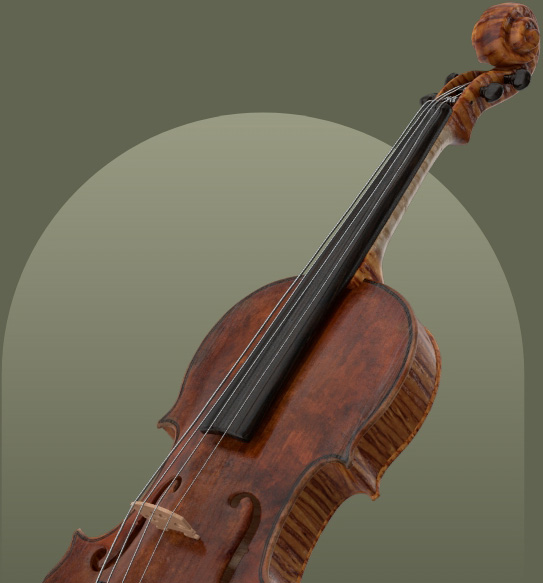
Giovanni Antonio Marchi
Bologna, 1727–1807
Moved to the city of Bologna c.1745 following the death of his father, a carpenter. Began violin making in 1755, presumably as a pupil of Alessandro Fiorini. Established his workshop at 1854 via Bertiera Scoperto (now 6 via dell’Orso), whilst living nearby at 1682 via Marsala. — John Dilworth
Auction Price History
Highest auction price
10 results
| Type | Details | Auction house | Sold | Price |
|---|---|---|---|---|
| Violin | Labelled Joannes Antonius Marchi, fecit Bononiae anno 1729 Lot 171 | Tarisio | March 2018 | £24,000est. £ 20,000-30,000 |
| Violin | 35.4 cm Bologna, 1800 c. | — | October 2009 | £6,000 |
| Violin | 35.3 cm 18th C. Attributed to | — | May 2008 | £4,191 |
| Violin | 35.3 cm 18th C. Attributed to | — | May 2007 | £5,473 |
| Violin | Italy, 1800 c. | — | February 2005 | £6,000 |
| Violin | 1798 c. | — | November 2002 | £23,900 |
| Violin | 1750 c. | — | November 1997 | £32,200 |
| Violin | 1768 | — | May 1994 | £25,226 |
| Cello | 1764 | — | June 1990 | £15,950 |
| Violin | — | November 1987 | £7,150 |
No results match those filters.
Maker Overview
Life
Giovanni Antonio Marchi (1727-1807) was born in 1727 in San Nicolo di Villola, Bologna, and died in 1807 in Bologna, Italy., he moved to the city of Bologna around 1745 following the death of his father, who was a carpenter. Marchi began violin making in 1755, presumably as a pupil of Alessandro Fiorini. He established his workshop at 1854 via Bertiera Scoperto, an address now known as 6 via dell'Orso, while residing nearby at 1682 via Marsala. He was a well-respected maker during his lifetime and served as an informant to Count Cozio di Salabue. Few of his actual violins have survived. He is perhaps best known for his Manuscript on Violin Making, published in 1786, which stands as one of the earliest reliable treatises on the craft. Sources contain conflicting information regarding his working period; while John Dilworth provides specific life dates of 1727-1807, Cecie Stainer notes a working period of approximately 1740-1795. Willibald Leo Lütgendorff also suggests the possibility of another master of the same name existing in the 18th century, citing labels with dates up to 1774.
Characteristics
- Workmanship
- His work is precise and well-finished, utilizing a personal model characterized by full arching of medium height and rather stiff, slanting soundholes. Cecie Stainer describes his violins as being of high model, while Willibald Leo Lütgendorff notes an idiosyncratic arching.
- Varnish
- The varnish is described as durable golden-yellow or orange by John Dilworth, golden-yellow by Cecie Stainer, and dark golden-yellow or reddish-brown by Willibald Leo Lütgendorff.
- Scroll
- His scroll is very well cut and accurately concentric, and powerfully curved as per Willibald Leo Lütgendorff.
- Materials
- Instruments often feature beautiful maple-wood for the back and sides, and good quality wood in general.
- Tone
- His violins, particularly his violoncellos, are noted for their broad and full tone.
- Style
- Willibald Leo Lütgendorff observes that his work sometimes recalls that of A. Gagliani.
- Labels
- Examples of his labels include "Johannes Antonius Marchi / fecit Bononiae. Anno.." and "Joannes Antonius Marchi fecit Bononiae, anno 1774", with similar labels dated 1760 and 1792.
- Johannes Antonius Marchi
fecit Bononiae. Anno..John Dilworth
Influence and legacy
- Mentorship: He is presumed to have been a pupil of Alessandro Fiorini.
- Contributions: Giovanni Antonio Marchi was an informant to Count Cozio di Salabue.
- Publications: He is best known for his Manuscript on Violin Making (1786), which is considered one of the earliest reliable treatises on the craft.
Further Information
- Workshop Location: His workshop was located at 1854 via Bertiera Scoperto, an address now known as 6 via dell'Orso.
- Residence: He lived at 1682 via Marsala.
- Label Inscriptions: His labels include "Johannes Antonius Marchi / fecit Bononiae. Anno.." and "Joannes Antonius Marchi fecit Bononiae, anno 1774", with other similar labels dated 1760 and 1792.
Biographies
The overview above is drawn from the following published accounts. Read them in the original:
John Dilworth+
MARCHI, Giovanni Antonio Born 1727 San Nicolo di Villola, Bologna, died 1807 Bologna Italy. Moved to the city of Bologna c.1745 following the death of his father, a carpenter. Began violin making in 1755, presumably as a pupil of Alessandro Fiorini. Established his workshop at 1854 via Bertiera Scoperto (now 6 via dell’Orso), whilst living nearby at 1682 via Marsala. A well-respected maker in his own time and an informant of Count Cozio di Salabue, few actual violins of his have survived. He is probably best known for his Manuscript on Violin Making (1786); one of the earliest reliable treatises on the craft. His work is precise and well-finished using a personal model with full arching of medium height, rather stiff slanting soundholes, and a durable golden-yellow or orange varnish. The scroll is very well cut and accurately concentric. Johannes Antonius Marchi / fecit Bononiae. Anno..
Cecie Stainer+
A maker in Bologna about 1740-95. His violoncellos and violins are good instruments; the latter are of high model, with very beautiful maple-wood used for the back and sides, and varnish of a golden-yellow colour.
Label : ” Joannes Antonius Marchi fecit Bononiae, anno 1774″ ; similar labels are dated 1760 and 1792.
Willibald Leo Lütgendorff+
Seine Arbeit erinnert manchmal an die A. Gaglianis. Sein Modell ist eigenartig
gewölbt, das Holz recht gut und der Lack von dunkelgoldgelber oder
röthlichbrauner Farbe. Die Schnecke ist kräftig geschwungen, und der Ton
seiner Geigen, namentlich seiner Violoncelli, ist breit und voll. Es scheint
übrigens auch im 18. Jahrhundert ein gleichnamiger Meister gelebt zu haben, denn
es giebt gleichlautende Zettel, die Jahreszahlen bis 1774 aufweisen.
Sell your instrument with Amati
Get started by uploading photos of your instrument for our experts to review.
Sell your instrument with Amati
Get started by uploading photos of your instrument for our experts to review.