(Domenico) Michele Platner
Rome, 1684–1752
Request an expert valuation or learn how our global auctions achieve the highest prices for your instruments.
Auction Price History
Highest auction price
11 results
| Type | Details | Auction house | Sold | Price |
|---|---|---|---|---|
| Violin | Labelled Michael Platner Romae Anno 1744, scroll later Lot 234 | Ingles & Hayday | March 2019 | £36,000est. £ 30,000-40,000 |
| Cello | Bearing the maker's label Lot 130 | Oger | March 2014 | £375,631est. € 100.000-150.000 |
| Violin | Labelled Michael Platner fecit Romae Anno 174* Lot 25 | Sotheby's | October 2012 | £34,850est. £ 30,000-40,000 |
| Violin | Labelled Michael Platner fecit Roma Anno 1735 Lot 292 | Brompton’s | June 2012 | £84,000est. £ 70,000-90,000 |
| Violin | 35.9 cm 1730 c. | — | November 2007 | £42,000 |
| Violin | 35.6 cm 1770 c. Ascribed to | — | October 2006 | £2,587 |
| Cello | 77.9 cm Rome, 1710 c. | — | May 2006 | £73,580 |
| Cello | 18th C. Ascribed to | — | October 2005 | £10,041 |
| Violin | Rome, 1740 c. | — | April 2004 | £30,967 |
| Violin | 1740 c. | — | November 2003 | £33,600 |
| Violin | 1735 c. | — | November 2001 | £51,862 |
No results match those filters.
Maker Overview
Life
(Domenico) Michele Platner (1684-1752) was born in 1684 and died in 1752 in Rome, Italy's The Brompton's Book of Violin & Bow Makers. He was the son, pupil, and successor of Alberto Platner, inheriting his father's workshop in the Pigna district of the city and also the appointment to the Palazzo Pamphilj. Platner was later succeeded by his pupil G. C. Gigli. While previously considered a pupil of D. Tecchler, sources note similarities in the Tyrolean style of both makers. Cecie Stainer's A Dictionary of Violin Makers suggests he was probably a Swiss and was working in Rome in 1747. Instruments bear labels such as "Michael Platner 1733" and "Michael Platner fecit / Romæ Anno 1747 [Lebet]."
Characteristics
- Workmanship
- John Dilworth notes that Platner's workmanship is a little less refined, stiffer, and less expressive compared to D. Tecchler, yet Cecie Stainer states his instruments show "very fair workmanship." George Hart's The Violin mentions that his instruments resemble those of Tecchler in both workmanship and varnish.
- Model
- Willibald Leo Lütgendorff's Die Geigen- und Lautenmacher vom Mittelalter bis zur Gegenwart indicates he sometimes worked after Andrea Guarneri, but mostly used a highly arched model. Cecie Stainer also describes his instruments as "rather arched."
- Soundholes
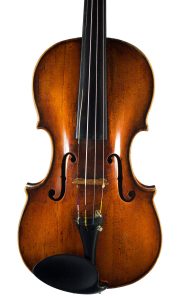
- , the soundholes are set widely, low, and upright in a very Germanic style.
- Scrolls
- John Dilworth describes the scrolls as neatly cut and concentric, featuring a deep, narrow throat. Cecie Stainer notes the scroll is "veil cut," and Lütgendorff particularly praises his scrolls as "besonders schon."
- Varnish
- John Dilworth mentions a fine golden-brown or orange varnish. Cecie Stainer describes it as a "golden-red colour," and Lütgendorff as "goldgelb."
- Michael Platner 1733John Dilworth
- Michael Platner fecit
Romæ Anno 1747John Dilworth
Influence and legacy
- Mentorship: (Domenico) Michele Platner was a pupil of his father, Alberto Platner.
- Stylistic Influence: He was previously considered a pupil of D. Tecchler, and John Dilworth notes similarities in their Tyrolean style. Willibald Leo Lütgendorff suggests he was probably a countryman of D. Tecchler, to whom he is very similar in his work.
- Model Influence: Lütgendorff also states that Platner sometimes worked after Andrea Guarneri.
Further Information
- Workshop Location: He inherited his father's workshop in the Pigna district of Rome, Italy.
- Appointments: He held an appointment to the Palazzo Pamphilj.
- Instruments Produced: His extant instruments include cellos, lutes, pochettes, and viols. His cellos, made on a small pattern, are rare but greatly appreciated.
Biographies
The overview above is drawn from the following published accounts. Read them in the original:
John Dilworth+
PLATNER, (Domenico) Michele Born 1684, died 1752 Rome Italy. Son, pupil, and successor of Alberto Platner, above. Inherited his father’s workshop in the Pigna district of the city, and also the appointment to the Palazzo Pamphilj. He was succeeded in turn by his pupil G. C. Gigli. Previously considered a pupil of D. Tecchler, there are similarities in the Tyrolean style of both makers. Platner is a little less refined, the workmanship stiffer and less expressive. Soundholes set widely; low and upright in very Germanic style. Scrolls neatly cut and concentric, with a deep narrow throat. Fine golden-brown or orange varnish. Cellos on small pattern rare but greatly appreciated. Lutes, pochettes, and viols extant. Michael Platner 1733 Michael Platner fecit / Romæ Anno 1747 [Lebet]
George Hart+
The instruments of this maker resemble those of Tecchler, both in workmanship and varnish.
Cecie Stainer+
Probably a Swiss. Was working in Rome in 1747. His instruments show very fair workmanship , they are rather arched, the scroll is veil cut, the varnish is a golden-red colour.
Willibald Leo Lütgendorff+
Vermutlich ein Landsmann D. Tecchler’s, dem er in der Arbeit sehr ähnlich ist. Er arbeitete manchmal nach Andrea Guarneri, meist aber benutzt er ein hochgewölbtes Modell. Sein Lack ist goldgelb; besonders schon aber sind seine Schnecken.
Sell your instrument with Amati
Get started by uploading photos of your instrument for our experts to review.
Sell your instrument with Amati
Get started by uploading photos of your instrument for our experts to review.