Bernhard Simon (II) Fendt
London, 1801–1852
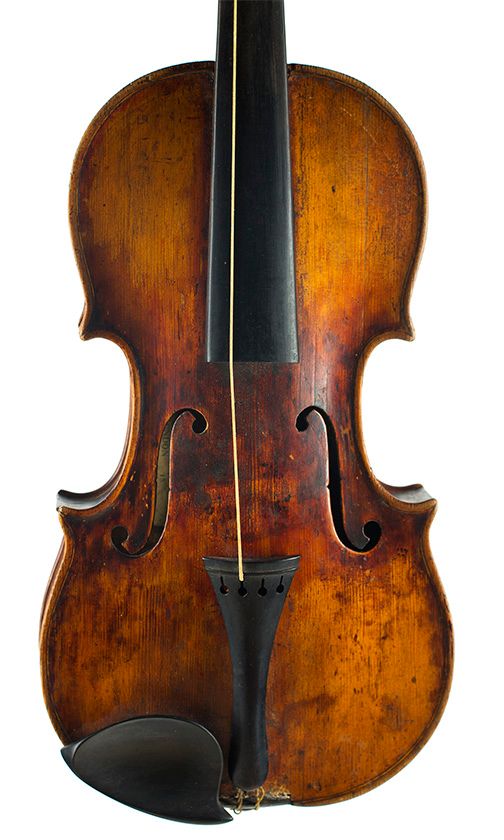
Bernhard Simon (II) Fendt (1801-1852) was a highly skilled English luthier, the eldest son and pupil of Bernhard S. Fendt (I). Trained in John Betts' workshop, he later partnered with Charles Farn and then George Purdy, operating under the name 'Purdy and Fendt' at various London addresses including Finch Lane, Oxenden Street, and Dean Street. Fendt was renowned for his ingenious craftsmanship and sensitivity to original models, producing a wide variety of instruments, particularly violins on Stradivari, Guarneri, and Amati models, and exuberant double basses on the Brescian or Gasparo da Salo form. His varnish was noted for its rich, deep red-brown hues, though descriptions vary. He contributed a quartet of instruments to the 1851 International Exhibition in London, though sources conflict on whether he received a prize. He died in 1852 from consumption.
Auction Price History
Highest auction price
38 results
| Type | Details | Auction house | Sold | Price |
|---|---|---|---|---|
| Small Cello | Unlabelled Lot 110 | Ingles & Hayday | November 2022 | £12,000est. £ 10,000-15,000 |
| Violin | 35.6 cm London, 1830 c. Probably by | — | December 2011 | £7,200 |
| Violin | 35.6 cm 1810 c. Possibly by | — | November 2011 | £16,540 |
| Violin | 35.6 cm London, 1830 c. | — | October 2011 | £11,880 |
| Viola | 38.5 cm London, 1800 c. Attributed to | — | October 2011 | £3,125 |
| Cello | 75.4 cm London, 1820 c. | — | October 2011 | £18,750 |
| Violin | 35.4 cm Probably by | — | September 2011 | £8,400 |
| Cello | 73.4 cm 1840 c. (restorations) Ascribed to | — | March 2011 | £10,560 |
| Cello | 73.3 cm 1840 c. (restorations) Attributed to | — | March 2011 | £14,400 |
| Violin | 35.2 cm London, first half of the 19th C. | — | March 2011 | £13,750 |
| Bass | London, 1830 c. string length 106.3 cm | — | June 2010 | £50,400 |
| Violin | 35.3 cm London, 1840 c. | — | October 2009 | £2,750 |
| Cello | 75.0 cm London, 1830 c. Probably by | — | November 2008 | £9,633 |
| Violin | 35.1 cm London, 1832 | — | October 2008 | £17,500 |
| Violin | 35.3 cm London, 1840 c. | — | February 2007 | £10,200 |
| Violin | 35.2 cm 1800 c. Probably by | — | October 2006 | £11,034 |
| Cello | 74 0 cm London, 1840 c. | — | February 2006 | £34,800 |
| Violin | London | — | April 2005 | £1,821 |
| Violin | London, 1840 c. | — | February 2005 | £8,400 |
| Violin | London, 1830 c. | — | July 2004 | £7,200 |
| Violin | 1830 c. | — | May 2004 | £4,973 |
| Violin | 1850 c. | — | July 2003 | £3,348 |
| Violin | 1830 | — | June 2000 | £19,550 |
| Viola | 40.3 cm 1830 | — | November 1998 | £8,313 |
| Cello | 1830 c. | — | March 1996 | £20,700 |
| Violin | 1830 c. | — | October 1995 | £10,350 |
| Cello | 1851 | — | November 1991 | £9,900 |
| Cello | 1830 c. | — | September 1991 | £14,300 |
| Cello | 1800 c. | — | September 1991 | £13,200 |
| Viola | 40.3 cm 1833 | — | June 1990 | £9,350 |
| Viola | 40.3 cm 1833 | — | November 1989 | £6,380 |
| Cello | 1800-25 | — | March 1988 | £6,380 |
| Violin | 1840 c. | — | November 1987 | £1,760 |
| Violin | 1850 | — | March 1986 | £2,160 |
| Violin | 1830 | — | June 1984 | £4,301 |
| Cello | 1840 c. | — | November 1982 | £3,240 |
| Cello | 1834 | — | November 1982 | £7,700 |
| Violin | 18-- | — | April 1982 | £1,870 |
No results match those filters.
Maker Overview
Life
Bernhard Simon (II) Fendt (1801-1852) was born in 1801 in London, UK, though Cecie Stainer notes his birth year as 1800. He was the eldest son of Bernhard S. Fendt (I) and received his training from his father in John Betts' workshop, where he remained until approximately 1823, or until Betts' death in 1823. From around 1831, he entered into a business partnership with Charles Farn, a violin dealer and former employee of his father's partner, Charles Vernon, at 72 Lombard Street. After Farn's death in 1832, Fendt joined George Purdy, a dancing and fencing teacher, forming the firm 'Purdy and Fendt'. This partnership commenced business in Finch Lane in September 1832, later moving to 3 Oxenden Street, Haymarket, and finally to 74 Dean Street from 1850. Cecie Stainer notes that in June 1843, they also opened a shop in Oxenden Street, Haymarket, and about 1850, these two shops were closed as they moved to 74 Dean Street, Soho. Bernhard Simon (II) Fendt contributed a quartet of instruments for the International Exhibition in London in 1851. He died on March 6, 1852, at 7, Smith Street, Brompton, from consumption, a fate also shared by his son, William, in the same year.
Characteristics
- Workmanship
- Bernhard Simon (II) Fendt was considered fully equal to his father as a gifted and ingenious craftsman. George Hart describes him as an excellent workman, though he notes that Fendt regrettably worked during a period when there was a "mania for obtaining supposed maturity by artificial means," which often destroyed the stamina of his instruments. Willibald Leo Lütgendorff also notes that while he was extremely diligent and skilled, he was not always particularly careful, but could demonstrate his mastery when he chose.
- Models
- His work covered a wide variety of models, generally focusing on Stradivari, Guarneri, and Amati, executed with admirable sensitivity to the virtues of the original instruments, as detailed by John Dilworth. He was one of the first makers to exploit the possibilities of the Guarneri del Gesù's style. Lütgendorff mentions his successful copies of the large Amati model. For violins, Cecie Stainer notes he made an extraordinary number, with hundreds alone on the Guarneri model.
- Double Basses
- He was equally famed for his exuberant double basses, made on the Brescian model with flat backs and double purfling. Cecie Stainer and George Hart specify that he made many very good double basses on the model of Gasparo da Salo.
- Varnish
- His instruments were varnished with rich, pliant coatings of deep red-brown colours. Cecie Stainer notes that the varnish on his violins was a bright red colour, while George Hart describes it as a glaring red colour of a hard nature. Both Stainer and Hart agree that the varnish on his double basses was superior to that on his violins. Lütgendorff mentions the varnish as "hellroth" (bright red).
- Output
- He was a most assiduous worker, producing a great number of violins, tenors, violoncellos, and double basses. George Hart suggests his reputation would have been greater had he made fewer instruments and exercised more general care.
- Labels
- Examples of his labels include "Bernard S. Fendt Junr./ London 1832" and "Bernard Fendt / London 1851."
- Bernard S. Fendt Junr.
London 1832John Dilworth - Bernard Fendt
London 1851John Dilworth
Influence and legacy
- Training: Bernhard Simon (II) Fendt was trained by his father, Bernhard S. Fendt (I), in the workshop of John Betts.
- International Exhibition 1851: He made an excellent quartet of instruments (violin, viola, violoncello, and double-bass) for the London Exhibition in 1851. Sources contain conflicting information regarding the prize awarded at this exhibition., his quartet was certainly the best contemporary instruments exhibited, but he failed to obtain the prize medal. However, Willibald Leo Lütgendorff states that in his last year of life, he received the first prize for a wonderful quartet after Guarneri at the London Exhibition of 1851.
- Family: He died of consumption in 1852, as did his son William, in the same year.
Further Information
- Workshop Locations: He worked at 72 Lombard Street, then at 20 Finch Lane, later at 3 Oxenden Street, Haymarket, and finally at 74 Dean Street from 1850.
- Death Location: He died at 7, Smith Street, Brompton.
Biographies
The overview above is drawn from the following published accounts. Read them in the original:
John Dilworth+
FENDT, Bernhard Simon (II) Born 1801, died 1852 London UK. Eldest son of Bernhard S. Fendt (I), above. Trained by his father at Betts’ until c.1823. From c.1831 joined in business with Charles Farn, a violin dealer and ex-employee of his father’s partner, Charles Vernon, at 72 Lombard Street. After Farn’s death in 1832 worked with George Purdy, a dancing and fencing teacher, under the name ‘Purdy and Fendt’ at 20 Finch Lane, later at 3 Oxenden Street, Haymarket, and finally at 74 Dean Street from 1850. Contributed a quartet of instruments for the International Exhibition, London 1851. Both he and his son William died of consumption in 1852. Fully equal to his father as a gifted and ingenious craftsman, his work covers a wide variety of models, but generally focused on Stradivari, Guarneri, and Amati, executed with a admirable sensitivity to the virtues of the original instruments, and varnished with rich pliant coatings of deep red-brown colours. One of the first makers to exploit the possibilities of the Guarneri del Gesù’s style. Equally famed for his exuberant double basses made on the Brescian model with flat backs and double purfling. Bernard S. Fendt Junr./ London 1832 Bernard Fendt / London 1851 [BVMA]
George Hart+
Son of the above. He was an excellent workman. It is to be regretted that he did not follow the example set by his father, and let time do its work without interruption upon his instruments. Had he done so they would, in many instances, have been equal to those of his parent; but, unfortunately, he worked when the mania for obtaining supposed maturity by artificial means was at its height, and shared the general infatuation, and, in consequence, very frequently destroyed all the stamina of his instruments. Subsequently he became a partner of George Purdy, and carried on a joint business at Finch Lane, in the City of London, from whence most of his best instruments date, having removed to the West End about 1843. He was a most assiduous worker. The number of Violins, Tenors, Violoncellos, and Double-Basses that he made was very great; indeed his reputation would have been greater had he been content to have made fewer instruments and have exercised more general care. His copies of Guarneri are most numerous, numbering some hundreds. They are mostly varnished with a glaring red colour, of a hard nature. He made many good Double-Basses of the Gasparo da Salo form, the varnish on which is superior to that on his Violins. He made also an excellent quartett of instruments— Violin, Viola, Violoncello, and Double-Bass, for the Exhibition of 1851. They were certainly the best contemporary instruments exhibited, but he failed to obtain the prize medal.
Cecie Stainer+
Eldest son of Bernhard. b, 1800 in London ; d. March 6, 1852, at 7, Smith Street, Brompton. He learnt his trade from his father in the workshop of John Betts, where he remained till Betts’ death (1823) : then he became either a workman for or a partner with Farn, a dealer in violins in Lombard Street. Farn dying, he joined George Purdy, ” Purdy and Fendt ” commencing business in Finch Lane in September. 1832 ; in June, 1843. they also opened a shop in Oxenden Street, Haymarket ; about 1850 these two shops were closed and they moved to 74 Dean Street, Soho.
He made many very good double-basses on the model of Gasparo da Salo, using varnish much superior to that on his violins; he made an extraordinary number of violins, those on the model of Guarneri alone numbering some hundreds ; but the work is not very carefully finished, the varnish is bright red colour. He made an excellent quartet of instruments for the London Exhibition in 1851.
Willibald Leo Lütgendorff+
Ältester Sohn und Schüler von Bernhard F. in der Werkstatt von Betts.
Nachdem er seit 1823 für die Nachfolger von Betts gearbeitet hatte, verband
er sich mit George Purdy zu der Firma Purdy and Fendt. Er war überaus
fleissig und geschickt, aber nicht sonderlich sorgfältig. Wenn er aber wollte,
konnte er seine Meisterschaft beweisen; namentlich gelangen ihm seine Copien
des grossen Amati-Modells, und noch in seinem letzten Lebensjahre erhielt er
auf der Londoner Ausstellung 1851 für ein wundervolles Quartett nach Guarneri
den ersten Preis. Seine Bässe baute er nach G. da Salò, sonst aber meist nach
Stradivari. Das Holz ist gut gewölbt und der Lack hellroth.
Sell your instrument with Amati
Get started by uploading photos of your instrument for our experts to review.
Sell your instrument with Amati
Get started by uploading photos of your instrument for our experts to review.