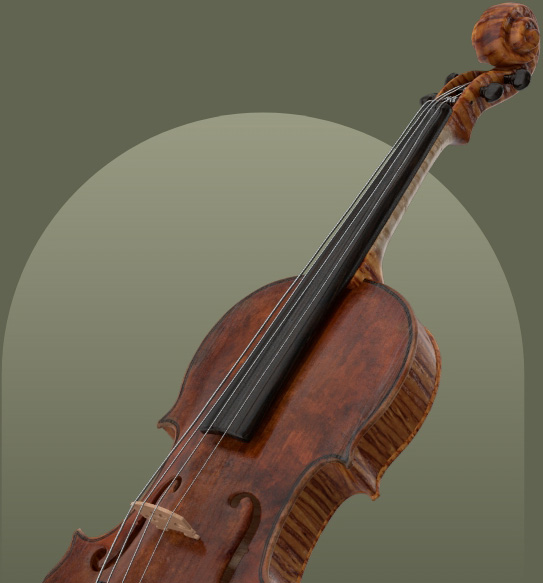
William John Acton
London, Woolwich, b. 1848
William John Acton (1848-after 1900) was a British luthier and bow maker who began his career in 1868. Trained by his father, A. W. Acton, he operated his business in Woolwich before moving to Forest Gate, London, in 1898. He crafted violins, violas, cellos, and double basses, utilizing Stainer, Stradivari, and personal models, and was known for his self-made amber oil varnish and carefully selected tonewoods. Acton also produced over 250 bows from fine pernambuco. His instruments were noted for their powerful and penetrating tone, and his workmanship, particularly the purfling and scrolls, was highly regarded. He worked independently, without assistants, and was also recognized as a skilled restorer and violinist.
Request an expert valuation or learn how our global auctions achieve the highest prices for your instruments.
Auction Price History
Highest auction price
12 results
| Type | Details | Auction house | Sold | Price |
|---|---|---|---|---|
| Violin Bow | N/E 48 g. | — | December 2002 | £757 |
| Violin Bow | N/E 53 g. | — | December 2002 | £454 |
| Violin Bow | S/E 64 g. | — | June 2002 | £956 |
| Violin Bow | S/E 59 g. | — | June 2002 | £1,812 |
| Violin Bow | S/E 62 g. | — | June 2002 | £1,812 |
| Cello | 1903 | — | November 2001 | £2,200 |
| Cello | 1909 | — | November 2000 | £4,830 |
| Cello | 1910 | — | July 1992 | £605 |
| Violin | 1895 | — | October 1987 | £220 |
| Violin | 1898 | — | June 1987 | £220 |
| Violin | 1898 | — | December 1986 | £308 |
| Violin | 1891 | — | November 1981 | £176 |
No results match those filters.
Maker Overview
Life
William John Acton (1848-after 1900) was born on December 12, 1848, in St. Mary Street, Woolwich, UK. He was the only son of A. W. Acton and was educated at Rectory Place Academy. He began his career in 1868, making his first instrument in that year. He conducted his business in Woolwich until 1898, when he relocated to 472 Katherine Road, Forest Gate, London., he was active from 1868 and died after 1900 in Forest Gate, London. Meredith Morris notes his workshop was at Gipsey Lane, Forest Gate, E.
Characteristics
- Models
- William John Acton created instruments based on Stainer and Stradivari models, in addition to his own personal designs. His model approximated that of Stradivari.
- Varnish
- He utilized an amber oil varnish of his own formulation, available in various colors including amber, ruby, and brown.
- Tonewoods
- Acton used imported tonewoods of good quality, which, while sometimes plain, were carefully selected for their acoustical properties.
- Instrument Production
- Sources contain conflicting information regarding the exact number of instruments produced., up to 1904, he completed 210 violins, 19 violas, 29 cellos, and 21 double basses. William Meredith Morris, however, states that up to the time of his writing, Acton had completed no violins, 12 violas, 19 violoncellos, and 10 double basses. Willibald Leo Lütgendorff reports over 110 violins, 12 violas, 20 violoncelli, and 10 contrabasses.
- Bows
- He also crafted over 250 bows, described as being made from fine pernambuco. His bows were noted for being strong and well-balanced, though not considered highly artistic.
- Measurements (Violin)
- His violin model featured a body length of 14 inches, upper bouts measuring 6 7/16 inches, lower bouts 8 1/16 inches, and inner bouts 4 3/8 inches. The length of the inner bouts from corner to corner was 3 1/10 inches. Sound-holes were 2 3/4 inches long, with a width of 1 3/5 inches at the top and 5 inches at the bottom. The height of the sides was 1 1/4 inches at the lower bouts and 1 3/16 inches at the upper bouts, with an arching height of 9/16 inches.
- Workmanship
- The ff holes were original and harmonized with the instrument's contour. His scrolls were considered very good, exhibiting significant character. The purfling was inlaid with taste, showing no infinitesimal chips or gaps, indicating a steady hand.
- Tone
- The tone of his instruments was described as powerful and penetrating. One instrument examined by Meredith Morris had a particularly fine G string. The tone lacked the sweetness of Amati or the bell-like clarity of Stradivari, but was considered good and expected to develop further positive qualities.
- Pricing
- His instruments were sold at prices ranging from £6 for violins up to £35 for double basses.
- William John Acton
Maker
Forest Gate London 1898John Dilworth
Influence and legacy
- Training: William John Acton received his training from his father, A. W. Acton.
- Publications: William Meredith Morris published a biography of William John Acton, including a portrait, in The Strad in January 1900.
Further Information
- Labels: He used a printed label that read: "William J. Acton, / Maker / St.Mary Street, Woolwich, 188." He also used a manuscript label: "William John Acton / Maker / Forest Gate London 1898".
- Workshop Practices: Acton employed no assistants, performing all aspects of instrument making himself.
- Skills: He was also recognized as a skilled bow maker, an extremely careful restorer, and a proficient violinist.
Biographies
The overview above is drawn from the following published accounts. Read them in the original:
John Dilworth+
ACTON, William John Born 1848 Woolwich, d. after 1900 Forest Gate, London UK. Active from 1868. Moved to 472 Katherine Road, Forest Gate, London in 1898. Stainer, Stradivari and personal models, 210 violins, 19 violas, 29 cellos and 21 double basses completed up to 1904. Amber oil varnish of his own make, in various colours. Imported tone woods of good quality. Also over 250 bows, of fine pernambuco. Printed label: William J. Acton, / Maker / St.Mary Street, Woolwich, 188. Manuscript label: William John Acton / Maker / Forest Gate London 1898 [Meredith Morris]
Willibald Leo Lütgendorff+
Sohn und Schüler A. W. A. Er begann seine Laufbahn mit einer Copie nach Stainer und hat seither über 110 Violinen, 12 Violen, 20 Violoncelli und 10 Contrabässe gebaut. Er verarbeitet vorzügliches Tonholz und bereitet sich seinen Bernstein-ÖÖllack selbst. Im Jahre 1898 verlegte er seine Werkstatt nach London. Sein Modell ist dem des Stradivari ähnlich, der Ton seiner Geigen ist edel und voll. Er gilt auch als geschickter Bogenmacher und ist äusserst sorgfältig als Wiederhersteller. Er beschäftigt keine Gehilfen und macht daher alles selbst, auch ist er ein tüchtiger Geiger. Meredith Morris veröffentlicht in »The Strad« Jan. 1900 seine Biographie mit Bildniss etc.
William Meredith Morris+
He works at Gipsey Lane, Forest Gate, E. He was born in St. Mary Street, Woolwich, on December 12, 1848, and is the only son of his father, A. W. Acton. He was educated at Rectory Place Academy. He was trained by his father, and carried on business at Woolwich till 1898, when he removed to his present address. He made his first instrument in 1868, and up to date he has completed no violins, 12 violas, 19 violon- cellos, and 10 double basses. He also makes bows. His wood is good, rather plain, but well chosen for acoustical qualities. His varnish is an amber oil one, of his own make. Colours : amber, ruby, and brown.
His model is original, approximating to that of Stradivari.
The measurements are : —
Length of body …. 14 Inches. Width of upper bouts …. 6 7/16ins,Width of lower bouts …. 8 1/16ins, Width of inner bouts . . . . 4 3/8ins, Length of inner bouts from corner to corner … 3 1/10 ins,Length of sound-holes . . . . 2 3/4ins,Width between sound-holes at top . . 1 3/5ins,Width between sound-holes at bottom … 5 ins,Height of sides at lower bouts . . . 1 1/4ins,Height of sides at upper bouts… 1 3/16ins,Height of arching … 9/16ins
The ff holes are original, and are quite in keeping with the contour of the instrument. The scroll is very good, and shows much force of character. The purfling tool is handled almost without a tremor, and the purfle is inlaid with taste. The infinitesimal chips and gaps so often observable in the purfle of some makers is conspicuous by its entire absence. Of course, this is a very small matter, and it in no way affects the acoustic qualities of the instrument, but it is well that it is not ignored at the same time.
The tone of the instruments which I have seen by this maker was powerful and penetrating. One instrument I examined had a particularly fine G string. The tone has nothing of the Amati sweetness about it, and nothing of the bell-like clearness of Stradivari, but it is a good tone, nevertheless, and ought to develop further good qualities.
He sells his instruments at prices ranging from £6 for the violins up to £35 for the double basses. His bows are strong and well-balanced, but not highly artistic.
Sell your instrument with Amati
Get started by uploading photos of your instrument for our experts to review.
Sell your instrument with Amati
Get started by uploading photos of your instrument for our experts to review.