Newsround: Hope’s prize for Europe
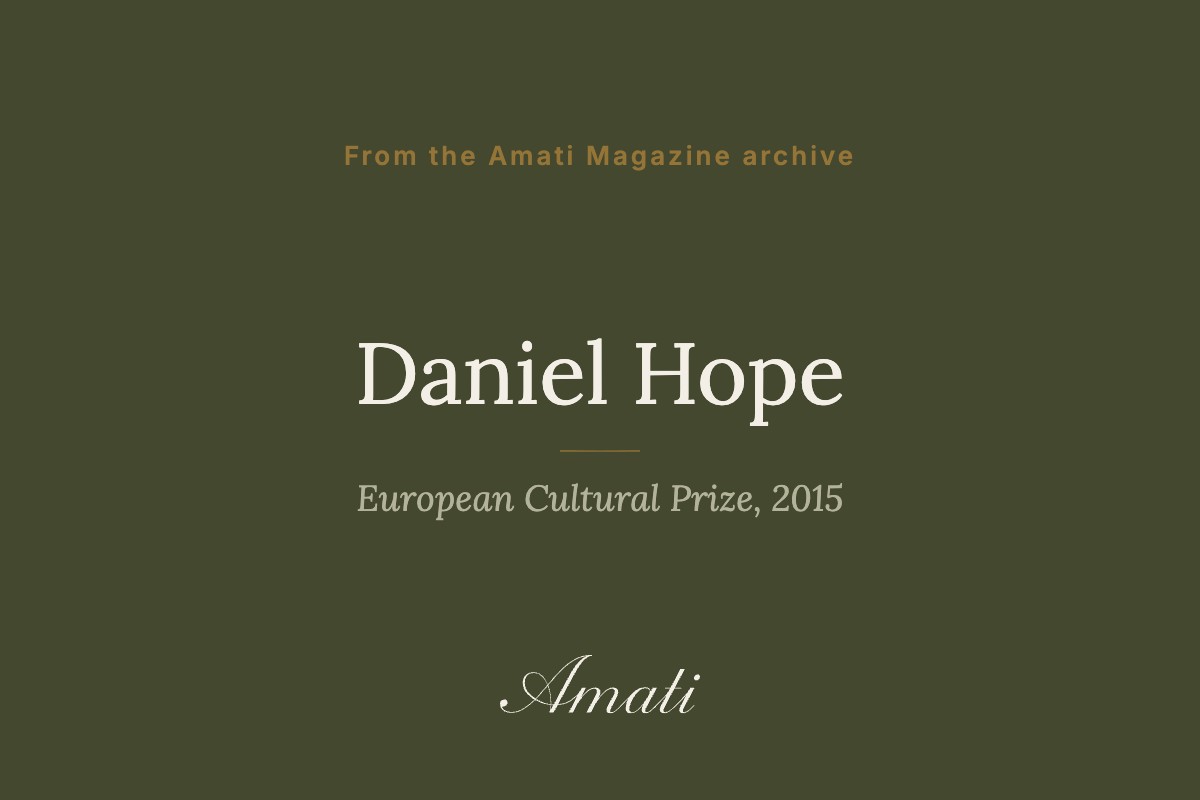
• Violinist Daniel Hope is the winner of the 2015 European Cultural Prize for Music. The award will be presented to him in Dresden in October, an event celebrating the 25th anniversary of German reunification.
‘Daniel Hope is a great artist, whose serious and refreshing approach to classical music creates generations of new listeners,’ says the President of the European Cultural Foundation, Tilo Braune. ‘He builds bridges between different musical worlds and thus stands for tolerance and openness.’
Hope says: ‘I am honoured to receive the 2015 European Cultural Prize for Music. Our cultural heritage in Europe is unique and I see it as the responsibility of every artist to protect, to celebrate and to share this heritage. I’m particularly delighted to be receiving this award in the Dresden Frauenkirche – an historical landmark in which I have been privileged to make music on several occasions, and a place which represents not only the preservation of culture but symbolises the understanding of different cultures in a unique way.’
• The Noga Quartet has won the string quartet section of the Melbourne International Chamber Music Competition, the finals of which were held this past weekend. The Berlin-based ensemble became established under the guidance of the Artemis Quartet in 2008 and its players – violinists Simon Roturier and Lauriane Verhes, violist Avishai Chameides and cellist Joan Bachs – come from France, Italy and Israel. The piano trio prize went to the London-based Linos Trio: Prach Boondiskulchok (piano), Konrad Elias-Trostmann (violin) and Vladimir Waltham (cello). A special prize awarded by Musica Viva Australia went to the Giocoso Quartet.
• The violin section of this year’s Beijing International Music Competition (BJIMC) has been cancelled. The organisation has cited ‘serious financial difficulties’ as the reason. The cello contest will go ahead as planned, 10-16 September.
• The Aurora Orchestra has been named an associate orchestra of the Southbank Centre in London. The announcement comes as the fresh and groundbreaking ensemble celebrates its tenth anniversary. In the new year it will start a series of intriguing projects at the centre including ‘The Orchestral Theatre’, a concert series in which the audience will gather on and around the stage of the Royal Festival Hall, picking up on the current rush of interest it has sparked in the idea of orchestras playing from memory. Ed Cooke, founder of memrise.com, will introduce their appearance on 7 February exploring ‘memory palace’ techniques. The orchestra will perform Beethoven’s Symphony No.5 from memory on 29 May.
• Music bursts its banks in the City of London during the weekend of 31 October and 1 November. Sound Unbound: The Barbican Classical Weekender finds the Barbican Centre opening up its many spaces to informal ‘taster’ concerts – around 50 of them in 48 different locations. The event is designed to introduce all comers to a staggering variety of music from the Renaissance to the present day, with a range of discussions, guides and debates to complement it.
Besides the centre’s resident orchestras, performers appearing include Jeremy Denk, Max Richter, Gabriel Prokofiev, Nicola Benedetti, John Adams, Matthew Barley, Joby Burgess, Maya Beiser (pictured left), Mahan Esfahani, Calder Quartet, Decoda + Manu Delago, VOCES8 and many more. Day tickets are £25, a weekend pass £40. More details here.
• A memorial concert for the eminent critic and Elgar scholar Michael Kennedy will be held on 5 October at 7.30pm in the Concert Hall of the Royal Northern College of Music, Oxford Road, Manchester M13 9RD, and will be conducted by Sir Mark Elder and Sir Andrew Davis. It will include a performance of Vaughan Williams’s Serenade to Music. Tickets, price £20 each, can be obtained from the RNCM Box Office from 29 July. Proceeds from the concert will go to a new Michael Kennedy Memorial Fund which will support RNCM students through bursaries and scholarships. RNCM Box Office telephone: 0161 907 5555.
• The sudden death of the baroque musicologist, conductor and harpsichordist Alan Curtis has shocked the musical world – not least Amati’s editor, who had interviewed him only days beforehand about an exciting new project he was preparing for an Australian tour in 2016, an event that would have found him travelling there for the first time. Curtis, who was 80, founded the orchestra Il Complesso Barocco in 1977. His career spanned both performance and teaching, with a particular specialism in the recreation and performance of Baroque opera.
First published in the Amati Magazine, July 2015.
Share this: