The Testores Cut Every Corner Except the Sound. Why Milan’s ‘Budget’ Violins Aren’t a Bargain Any More

There are two ways to run a workshop. You can do everything beautifully and charge accordingly, or you can work out which bits nobody ever hears and stop doing them.
In seventeenth-century Milan, the Grancino family took the first road. The Testore family on the same street, a few doors along, took the second, and I have always had a soft spot for them.
At the sign of the Eagle
Carlo Giuseppe Testore set up in the Contrada Larga, Milan’s violin-making street, under a shop sign of an eagle. His teacher, Giovanni Grancino, traded along the road at the sign of the Crown. Shops had signs then for the same reason pubs do now, and it made for the best addresses in the trade – “Carlo Giuseppe Testore, in the Contrada Larga of Milan, at the sign of the Eagle” is what his labels actually say.
He was born in Novara in 1660 and died in 1738 – or 1716, depending on which book you believe. Record-keeping was another thing Milan did economically.
Carlo Giuseppe was the best maker of the family, good enough that his work still gets mistaken for his teacher’s. The famous ‘Lindley Grancino’ cello spent decades as a Grancino until a repairer opened it up in 1844 and found Testore’s own label of 1690 sitting quietly inside.
How to cut corners properly
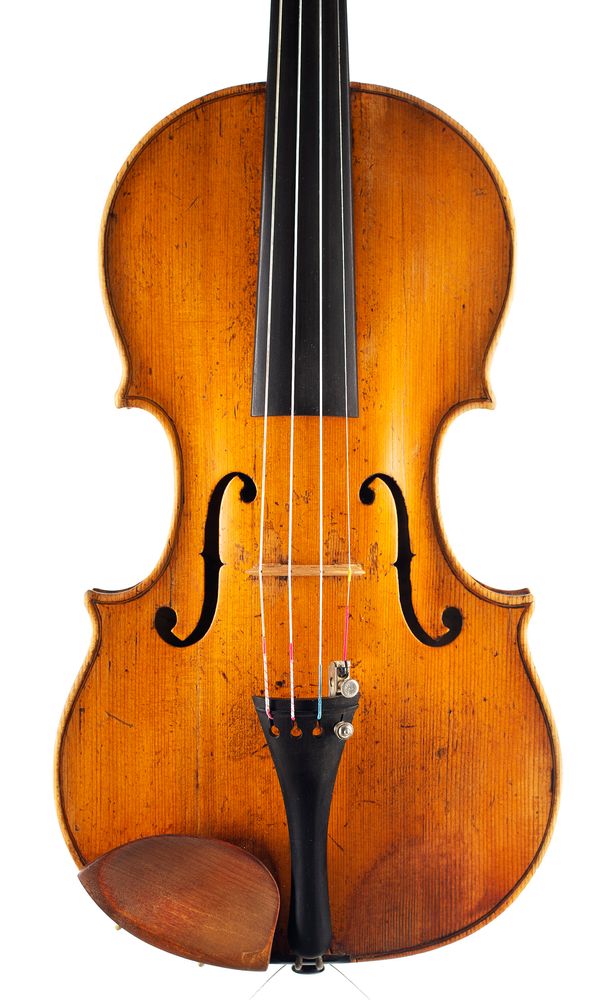
It was the next generation that turned economy into an art form. Carlo Antonio Testore (c.1693-1765), the elder son, looked hard at purfling – the elegant inlaid lines running around the edge of a violin – and concluded that since it takes hours and contributes nothing whatsoever to the sound, he could stop doing it.
Basically he mastered the art of the up-sell. If you want purfling, more effort in the scroll, more refined wood, not a problem at all but you would have to pay for it. This meant that at the top end he made beautiful instruments, at the bottom, a little less so. Very much like British Airways. Great if you are prepared to pay for it. Far more spartan if you aren’t.
1 – Purfling: often not inlaid at all, but scratched into the wood with a blade and inked in. From six feet away you cannot tell. Audiences sit further away than that.
2 – The back of the pegbox: left flat instead of carved. Nobody looks there.
3 – Wood: plain maple where flamed maple cost more, and cello backs of willow or pear, whatever was seasoned and cheap.
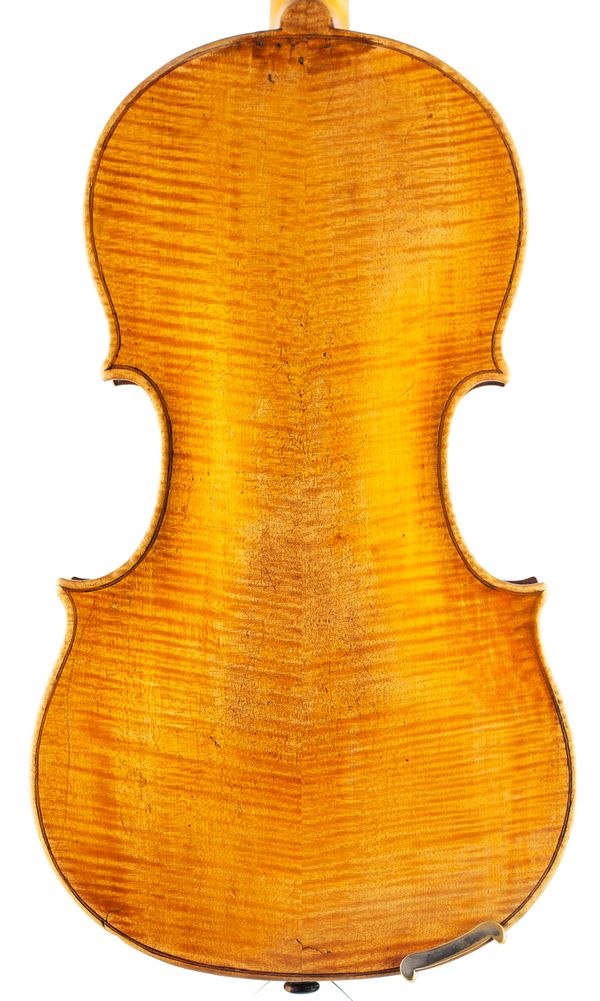
The back of a violin by Carlo Antonio Testore, Milan, circa 1725. Sold by Amati.
Every corner cut except one. The arching, the thicknesses, the acoustics were all done properly. The result is instruments that look like they left the workshop in a hurry but sound magnificent.
Three hundred years on, the shortcuts read less like laziness and more like a workshop that knew exactly what mattered.
Cellists and bass players worked this out centuries ago. Bottesini – the Paganini of the double bass – played a Testore. Amanda Forsyth plays a Carlo Giuseppe cello of 1699 today. The old books all reach for the same words about the tone, powerful, penetrating, far-carrying. Nobody has ever put down a Testore and complained about the purfling.
So what is a Testore violin worth now?
This is where the joke stops being funny, at least if your grandfather sold one in 1975.
The Carlo Giuseppe record in our Instrument Archive is £288,000, paid for a cello in November 2005. This was ‘my’ record. I sold this cello when I was running the department at Christie’s. I am still friends with the owner, one of the kindest men I know.
1 – A Carlo Giuseppe violin labelled 1697 made £205,102 in March 2021.
2 – Another, labelled 1712, made £82,026 in March 2025.
3 – In January 2024 alone, Carlo Antonio violins made £82,000 at Amati and £90,000 at Ingles & Hayday, and a cello bearing his father’s label made £144,000 against a £60,000-80,000 estimate.
And the family record belongs, pleasingly, to a viola – £172,860, back in 2011. After a Stradivari viola recently became the most expensive instrument ever sold, violas are having quite a decade.
The full price histories are on our maker pages for Carlo Giuseppe Testore and Carlo Antonio Testore – 105 auction results between them, going back to 1984.
We know these instruments first-hand. We have sold a lot of Testore instruments over the years. In fact we have one coming up in our October sale.
On a practical note, because the Testores look cheap, they can get treated cheaply. A plain-wood Italian violin with no purfling and a flat pegbox back does not photograph like money, and more than one has spent fifty years in a cupboard being called “the old rough one”.
If your family owns a plain, dark, unglamorous violin or cello with an Italian label (or no label at all) it is worth twenty minutes of your time. Send us photographs at https://amati.com/online-valuation and we will tell you what you have, for free. Or bring it to one of our free valuation days – we are always somewhere: https://amati.com/book/
The worst case is that we tell you it is what you thought it was. The best case starts at the sign of the Eagle.
JKB
P.S. Our Summer Sale is live now and ends on 2 September: https://app.amati.com/en/auction/1138-the-summer-sale-2nd-september
Share this: