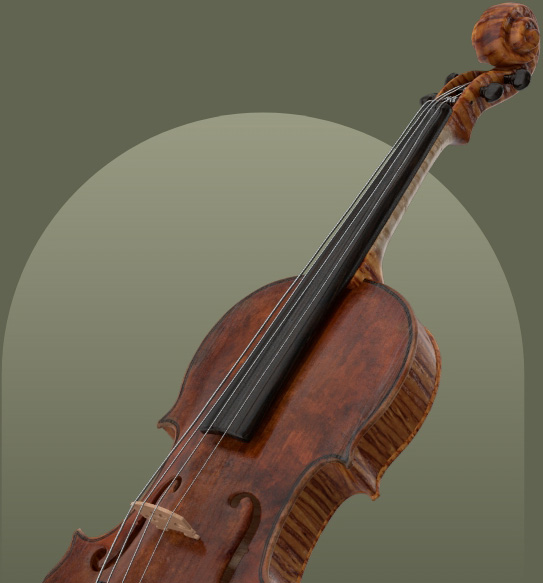
Edmund Aireton
London, c.1720–1807
Edmund Aireton (1720-1807) was a London-based luthier known for his excellent craftsmanship, particularly in copying Amati and Stainer models. Initially employed by Peter Wamsley from approximately 1735, he later worked independently in Piccadilly and Hog Lane (present-day Crown Street, Soho). While sources offer varying descriptions of his varnish, his instruments, including a notable five-string cello from 1776, are recognized for their good workmanship and fair tone. He also produced instruments for other dealers like Norris & Barnes, which means relatively few instruments bear his own label.
Request an expert valuation or learn how our global auctions achieve the highest prices for your instruments.
Auction Price History
Highest auction price
12 results
| Type | Details | Auction house | Sold | Price |
|---|---|---|---|---|
| Violin | Inscribed internally on the back Made by Ed. Aireton. 1761 Lot 289 | Ingles & Hayday | October 2023 | £8,400est. £ 8,000-12,000 |
| Violin | 35.0 cm London 1738 c. Probably by | — | March 2009 | £1,053 |
| Violin | 1770 | — | November 2001 | £3,000 |
| Violin | 1800 c. | — | March 1994 | £1,955 |
| Violin | 1757 | — | March 1994 | £1,955 |
| Cello | 1767 c. | — | July 1993 | £8,625 |
| Viola | 38.6 cm 1932 | — | March 1989 | £2,057 |
| Cello | 1790 c. | — | November 1988 | £6,380 |
| Violin | 1761 | — | November 1988 | £6,160 |
| Viola | 38.6 cm 1782 | — | October 1984 | £1,540 |
| Viola | 40.0 cm 17-- | — | June 1984 | £2,038 |
| Cello | 1757 | — | November 1982 | £3,740 |
No results match those filters.
Maker Overview
Life
Edmund Aireton (1720-1807) was born circa 1720 and died in 1807 in London, UK, at the advanced age of 80. He worked in Piccadilly and, from 1805, in Hog Lane, which is present-day Crown Street, Soho. He was initially employed by Peter Wamsley from approximately 1735. His signature or label appeared in instruments labeled and sold by several London makers and dealers, including Peter Wamsley, Norris & Barnes, and John Johnson.
Characteristics
- Models
- Edmund Aireton copied Stainer and Amati models. His best instruments were on the Amati model. He also made many violins on the Stainer model and a few, of inferior make, on the Stradivari model. William Meredith Morris notes that this suggests the Stradivari model was not highly appreciated in England at the time and not considered worthy of the best effort.
- Varnish
- Sources contain conflicting information regarding his varnish. John Dilworth describes it as rather poor yellow. Willibald Leo Lütgendorff mentions his yellow-brown varnish as dull, while William Meredith Morris states it was a spirit varnish of a lustreless yellow. George Hart describes it as a varnish of fair quality with a yellow color.
- Workmanship
- His craftsmanship is described as excellent by John Dilworth, similar to Peter Wamsley's pupil Thomas Smith. William Meredith Morris also states that the workmanship is good.
- Instruments
- An excellent five-string cello of small size is labeled and dated 1776.
- Tone
- Willibald Leo Lütgendorff describes the tone as unimportant. However, William Meredith Morris states the tone was of a fair quality.
- Made by
Edmund Aireton
London, 1755John Dilworth
Influence and legacy
- Mentorship: Edmund Aireton is considered a pupil of Peter Wamsley.
- Collaborations: He worked extensively for Norris & Barnes, which resulted in relatively few violins appearing with his own label.
- Family Connections: It has been surmised that a workman of the same name, who was working with Peter Wamsley in 1735, was his father. Willibald Leo Lütgendorff also notes that he was a relative of the church composer Edmund Ayreton (1734-1808), who served as assistant organist at Westminster Abbey under Händel.
- Exhibitions: A violin with his label from 1755 was exhibited in South Kensington in 1872.
Further Information
- Addresses: He worked in Piccadilly and later in Hog Lane (present-day Crown Street, Soho) from 1805.
- Labels: An example of his label reads: "Made by / Edmund Aireton / London, 1755."
Biographies
The overview above is drawn from the following published accounts. Read them in the original:
John Dilworth+
AIRETON, Edmund Born circa. 1720, died 1807 London UK. Worked in Piccadilly, and from 1805 in Hog Lane (present day Crown Street, Soho). Stainer or Amati model. Employed initially by Peter Wamsley from c.1735. Rather poor yellow varnish but excellent craftsmanship, similar to Wamsley’s pupil Thomas Smith. An excellent five-string cello of small size is labelled and dated 1776. His signature or label appears in instruments labelled and sold by several London makers and dealers, including Peter Wamsley, Norris & Barnes, and John Johnson. Made by / Edmund Aireton / London, 1755
Willibald Leo Lütgendorff+
Angeblich der Sohn eines gleichnamigen, schon 1735 vorkommenden Geigenmachers und ein Verwandter des Kirchenkomponisten Edmund Ayreton (1734 bis 1808), der unter Händel Hilfsorganist der Westminster-Abtei war. Edm. A. gilt als ein Schüler Peter Wamsley’s und ahmte Stainer und Amati nach. Die Arbeit ist gut, sein gelbbrauner Lack dagegen stumpf und der Ton unbedeutend. Da er viel für Norris & Barnes arbeitete, kommen verhältnissmässig selten Geigen mit seinem Zettel vor, eine solche aus dem Jahre 1755 war 1872 in South Kensington ausgestellt.
George Hart+
Was originally employed in the workshop of Peter Wamsley, at the ” Harp and Hautboy,” in Piccadilly. He made a great many excellent Violins and Violoncellos, and chiefly copied Amati. Varnish of fair quality; colour yellow. He died at the advanced age of 80, in the year 1807.
William Meredith Morris+
His best instruments are on the Amati model. He also made many violins on the Stainer model, and a few, of inferior make, on the Stradivari model — a fact which proves that the model of the great Italian was little appreciated in England and not thought worthy of the best effort at the time. The workmanship is good, and the tone of a fair quality. The varnish is a spirit one, of a lustreless yellow. It has been surmised that a workman of the same name, who was working with Peter Wamsley in 1735, was his father.
Sell your instrument with Amati
Get started by uploading photos of your instrument for our experts to review.
Sell your instrument with Amati
Get started by uploading photos of your instrument for our experts to review.