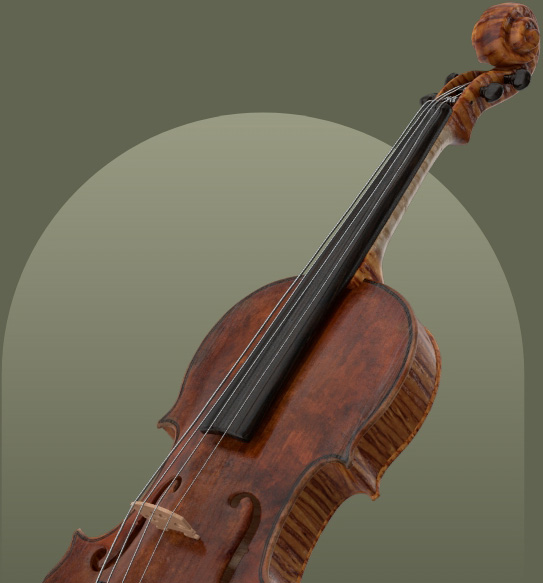
Antonio (II) Bagatella
Padua, c.1759–1829
Antonio (II) Bagatella (1759-c.1829) was an Italian violin maker, restorer, and theorist from Padua and Venice. Nephew of Antonio (I) Bagatella, he operated his own shop in Venice from 1805. While he made violins and violoncellos, often in the Cremona style and imitating Giuseppe Guarneri, his most significant contribution was his prize-winning treatise on violin construction, "Regole per la costruzione de' violini, viole, violoncelli e violoni," published in 1786. This work, which focused on the methods of old Italian masters like Amati, was widely translated and influenced later luthiers and authors such as Maugin.
Request an expert valuation or learn how our global auctions achieve the highest prices for your instruments.
Maker Overview
Life
Antonio (II) Bagatella (1759-c.1829) was born in Padua, Italy, in 1759 and died around 1829. He was the son of Gaetano B. and Catarina Coppo-Scanferla, and the nephew of Antonio (I) Bagatella. Originally, he aspired to be a violinist and was presumably a student of his relative Pietro B. in The Brompton's Book of Violin & Bow Makers, Antonio (II) established his own shop in Venice from 1805, operating under the sign of S. Michele in the Merceria S. Salvador. Dilworth notes that his work is often difficult to distinguish from that of Antonio (I), leading to many published sources conflating the two makers. Willibald Leo Lütgendorff describes him as a literary and musically educated man. Cecie Stainer, in A Dictionary of Violin Makers, states that he was a very good restorer of violins and worked for many Germans, including Prince Waldestein, Laibek, Prince of Wittemberg, and Krauss of Prague. He was married to Antonia Pelizzari, had several children, and ultimately died impoverished and blind. For a period, he also collaborated with Danieli.
Characteristics
- Instrument Production
- Antonio (II) Bagatella made both violins and violoncellos.
- Quality and Style
- George Hart notes that a few of his instruments have points of merit. However, Cecie Stainer states that he made few new instruments, and they were generally "of no great merit," though she adds that "some violins and violoncellos made on the Cremona model were good." Sources contain conflicting information regarding the overall merit of his new instruments.
- Influences
- He imitated Giuseppe Guarneri and is considered close to Joseph Rocca in style.
- Noteworthy Examples
- A violin bearing his name, described as of good workmanship with red varnish, was reportedly purchased in England for approximately 1000 Marks. Another violin offered for sale, labeled "Antonio Bagoletto in Padua, 1782," if authentic, was also likely by Bagatella.
Influence and legacy
- Mentorship: He was presumably a student of his relative, Pietro B.
- Literary Contributions: Antonio (II) Bagatella's primary significance lies less in his skill as a violin maker and more in his theoretical writings on violin construction.
- Prize-Winning Treatise: In 1782, he gained a prize from the Accademia di scienze, lettere ed arti di Padova for his work on the construction of the violin.
- Publication and Impact: This treatise was published by the Accademia in 1786 at their expense. Its full title was "Regole per la costruzione de' violini, viole, violoncelli e violoni. Memoria presentata all' Accademia di scienze, lettere ed arti di Padova, al concorso del premio dell' arti dell 'anno 1782. Dal Signor Ant. Bagatella, Padovano, E coronato dall' Accademia stessa. Padova, 1786."
- Content and Translations: The work focused less on innovations and more on practical methods for achieving a perfect imitation of instruments by great Italian makers, particularly Amati. It has been repeatedly published and translated into German, French, and English. For example, it was translated into German by Schaum as "Ueber den Bau der Violinen, Bratschen, Violoncells und Violons" (Leipzig, 1806).
- Influence on Later Works: From Bagatella's work, Maugin derived his method of tracing a fine violin model using only a rule and compass, which he included in his "Manuel du Luthier." A shortened version of this method can also be found at the end of Bishop's translation of Otto on the violin.
- Historical Significance: He is credited with preserving some of the few surviving traditions regarding the principles employed by the old Italian masters.
- Practical Application Debate: George Hart notes that he wrote a pamphlet in 1782 on a method of constructing violins by means of a graduated perpendicular line, similar to Wettengel's, but states that "no benefit has been derived from it."
Biographies
The overview above is drawn from the following published accounts. Read them in the original:
John Dilworth+
BAGATELLA, Antonio (II) Born 1759, d.c.1829 Padua Italy. Nephew of Antonio I, was also a maker, with his own shop in Venice from 1805, at the sign of S. Michele in the Merceria S. Salvador. His work is difficult to distinguish from that of Antonio (I), and most published sources conflate the two makers. [Pio]
George Hart+
Made both Violins and Violoncellos, a few of which have points of merit He wrote a pamphlet in 1782 on a method of constructing Violins by means of a graduated perpendicular line similar to Wettengel’s ; but no benefit has been derived from it.
Cecie Stainer+
b. 1755, Padua; d. 1829. Was a very good restorer of violins. Worked for many Germans— Prince Waldestein, Laibek, Prince of Wittemberg, Krauss of Prague—made few new instruments, and they were of no great merit; some violins and violoncellos made on the Cremona model were good.
Gained in 1782 a prize from the Padua Accademia for a work on the construction of the violin, which was published by the Accademia in 1786. Its full title was ” Regole per la costruzione de’ violini, viole, violoncelli e violoni. Memoria presentata all’ Accademia di scienze, lettere ed arti di Padova, al concorso del premio dell’ arti dell ‘anno 1782. Dal Signor Ant. Bagatella, Padovano, E coronato dall’ Accademia stessa. Padova, 1786.” This work touched less on innovations than on practical methods of arriving at a perfect imitation of the instruments of the great Italian makers, Amati especially; it was translated into German by Schaum under title of ” Ueber den Bau der Violinen, Bratschen, Violoncells und Violons ” (Leipzig, 1806).
It was from Bagatella’s work that Maugin, in his ” Manuel du Luthier,” took his method of tracing a fine model of a violin with only a rule and compass, which may also be seen somewhat shortened at the end of Bishop’s translation of Otto on the violin.
Willibald Leo Lütgendorff+
Sohn des Gaetano B. und der Catarina Coppo-Scanferla. Er wollte ursprünglich
Geiger werden und war vermuthlich ein Schüler seines Verwandten
Pietro B. Ein literarisch und musikalisch gebildeter Mann. Seine
Bedeutung liegt allerdings weniger in seiner Kunst als Geigenmacher, als
vielmehr darin, dass er eine Abhandlung über die Theorie des Geigenbaues
schrieb, für welche er 1782 einen von der Akademie der Wissenschaften in
Padua ausgesetzten Preis erhielt. Diese Abhandlung wurde 1786 auf Kosten
der Akademie gedruckt und ist seitdem wiederholt erschienen und sowohl mehrfach
ins Deutsche als auch ins Französische, Englische etc. übersetzt worden.
Ihm verdankt man die wenigen erhaltenen Überlieferungen der Grundsätze,
nach denen die alten italienischen Meister gearbeitet haben. Über sein Leben
ist nicht viel mehr bekannt, als was er in seiner Schrift selbst erzählt, und dass
er mit Antonia Pelizzari verheirathet war, verschiedene Kinder hatte und
gänzlich verarmt und erblindet starb. Eine Zeit lang arbeitete er mit Danieli
zusammen. Eine Geige mit seinem Namen, von guter Arbeit und rothem Lack
wurde kürzlich in England um ca. 1000 Mk. gekauft. Eine andere zum Verkauf
ausgebotene Geige von »„Antonio Bagoletto in Padua, 1782 durfte, wenn
sie echt war, gleichfalls von Bagatella gewesen sein. — Er ahmte Jos. Guarneri
nach und steht Joseph Rocca nahe.
Sell your instrument with Amati
Get started by uploading photos of your instrument for our experts to review.
Sell your instrument with Amati
Get started by uploading photos of your instrument for our experts to review.