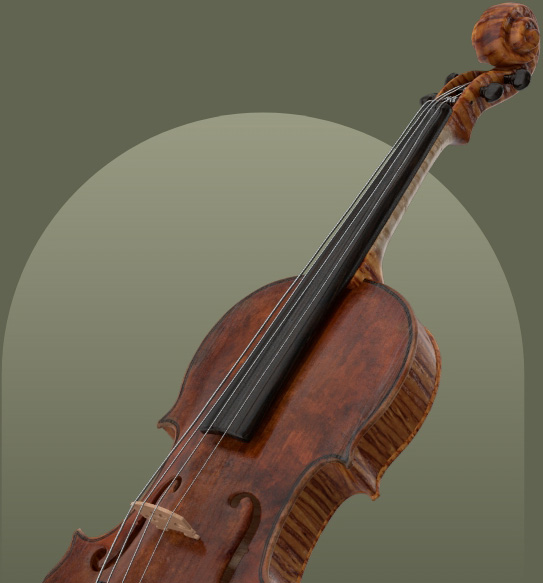
Tomasso Balestrieri
Mantua, c.1735–1790
Tomasso Balestrieri was an influential violin maker active in Cremona and Mantua during the 18th century. While he claimed Cremonese origin, records primarily place him in Mantua, where he became a leading maker. His instruments, including violins, violas, and highly sought-after violoncellos, are characterized by a bold, flat-arched Stradivarian model and a powerful, rich tone that improves with age. Although his workmanship could be rugged and less refined than his contemporaries, it possessed a vigorous style. Balestrieri used carefully selected wood for bellies and applied two distinct types of varnish, one reminiscent of Guadagnini. Sources offer conflicting accounts of his training, suggesting possible tutelage under Stradivari, Pietro Guarneri, or Camillo Camilli, through whom he gained authentic technique.
Request an expert valuation or learn how our global auctions achieve the highest prices for your instruments.
Auction Price History
Highest auction price
41 results
| Type | Details | Auction house | Sold | Price |
|---|---|---|---|---|
| Violin | Original label of this violin, dated 1792, is in all probably the one in the Emil Herrmann label collection Lot 231 | Ingles & H. | March 2025 | £240,000est. £ 200,000-300,000 |
| Violin | Labelled Thomas Balestrieri Cremonensis Fecit Mantuae Anno 1767 Lot 64 | Ingles & H. | October 2023 | £90,000est. £ 80,000-120,000 |
| Violin | Rosenberg collection, labelled Petrus Guarnerius Cremonensis Faciebat anno 1720 Lot 206 | — | June 2023 | £360,000est. £ 140,000-180,000 |
| Violin | Labelled Petrus Guarnerius Filius Joseph Cremonensis fecit Venetiis Anno 1730, head later Lot 150 | — | October 2022 | £154,316est. € 150.000-220.000 |
| Violin | Labelled Thomas Balestrieri Cremonensis fecit Mantuae anno 1747 Lot 89 | — | March 2021 | £405,719est. $ 450,000-650,000 |
| Violin | Labelled Thomas Balestrieri Cremonensis, Fecit Mantua anno ... Lot 174 | — | November 2020 | £77,017est. $ 50,000-80,000 |
| Small Violin | 3/4 size violin, labelled Joseph Guarnerius fecit Cremone anno 1711, scroll later Lot 159 | — | March 2020 | £33,600est. £ 30,000-50,000 |
| Violin | Bearing a reproduction label Thomas Balestrieri Cremonensis Fecit Mantuae, Anno 1792 Lot 185 | — | March 2017 | £204,000est. £ 180,000-250,000 |
| Violin | Bearing its original label Thomas Balestrieri Cremonensis Fecit Mantuae. Anno 1788 Lot 196 | — | October 2016 | £300,000est. £ 180,000-250,000 |
| Violin | Labelled Thomas Balestrieri Cremonensis, Fecit Mantua Anno 1774 Lot 250 | — | October 2016 | £177,222est. $ 120,000-180,000 |
| Small Violoncello | Bearing the maker's label, many restorations, back sound post crack with patch, ribs worm Lot 175 | — | June 2016 | £73,542est. € 80.000-100.000 |
| Violin | Labelled Thomas Balestrieri Cremonensis Fecit Mantuae Anno 1775 Lot 174 | — | March 2015 | £420,000est. £ 200,000-300,000 |
| Violin | 35.7 cm 1750 c. (later scroll) Ascribed to | — | October 2009 | £89,885 |
| Violin | 35.0 cm Mantua, 1760 c. | — | June 2008 | £40,800 |
| Violin | 35.4 cm Mantua, 1760 c. | — | March 2008 | £76,050 |
| Violin | 35.2 cm Mantua, 1760 c. (top probably by his pupil "Giofreddo Cappa") | — | May 2007 | £15,842 |
| Viola | 41.0 cm Mantua, 1774 | — | October 2006 | £262,196 |
| Violin | 35.1 cm Mantua, 1785 | — | February 2006 | £232,000 |
| Violin | Mantua, 1781 | — | November 2005 | £134,215 |
| Violin | Mantua, 1764 | — | November 2005 | £60,000 |
| Violin | Mantua, 1759 | — | October 2004 | £49,138 |
| Violin | 1760 c. | — | March 2003 | £89,600 |
| Violin | 1771 | — | December 2002 | £55,996 |
| Violin | 1767 | — | November 2002 | £106,192 |
| Violin | 1760 | — | May 2001 | £23,404 |
| Violin | 1767 | — | May 2000 | £66,000 |
| Violin | 1788 | — | June 1997 | £69,700 |
| Violin | 17-- | — | June 1995 | £78,500 |
| Violin | 1788 | — | November 1994 | £84,000 |
| Violin | 1765 c. | — | November 1993 | £41,100 |
| Violin | 1760 c. | — | March 1992 | £52,800 |
| Violin | 1768 | — | June 1990 | £25,300 |
| Violin | 1778 | — | March 1990 | £93,500 |
| Violin | 17-- | — | June 1989 | £66,000 |
| Violin | 1750 c. | — | November 1987 | £26,400 |
| Violin | 1761 | — | November 1985 | £30,800 |
| Violin | 1771 | — | June 1985 | £37,840 |
| Violin | 17-- | — | June 1984 | £31,693 |
| Viola | 39.7 cm 1760 c. | — | June 1984 | £22,638 |
| Violin | 1750 | — | April 1982 | £10,450 |
| Violin | 1763 | — | March 1982 | £9,167 |
No results match those filters.
Maker Overview
Life
Tomasso Balestrieri (circa 1735-circa 1790) is documented as a maker working in Cremona from about 1720 to 1757, and subsequently in Mantua until about 1772. John Dilworth, however, places his birth around 1735 and death around 1790 in Mantua, Italy. Dilworth notes that Balestrieri referred to himself as "Cremonese" on his labels, but no record of him has been found in Cremona, suggesting he may have been born in a village between Cremona and Mantua. Willibald Leo Lütgendorff also states that Balestrieri claimed to be from Cremona but was only traceable in Mantua from 1757 onwards, having supposedly lived in Cremona before that. In Mantua, he was considered the leading maker after Pietro Guarneri and Antonio Zanotti.
Characteristics
- Instruments
- Tomasso Balestrieri produced good violins, a few violas, and violoncellos of fine tone. His violoncellos are particularly sought after.
- Model
- His model is described as large and beautiful by Willibald Leo Lütgendorff. John Dilworth characterizes it as a bold, flat-arched Stradivarian model. George Hart observes that Balestrieri's instruments may be likened to those made by Stradivari during the last few years of his life, specifically between 1730 and 1737, noting a general rough resemblance in character.
- Workmanship
- Cecie Stainer notes a rough general resemblance in his work to Stradivari's late period, though with no comparison in merit. George Hart elaborates that the ruggedness found in late Stradivari instruments is present, but more marked, in Balestrieri's work. Hart also mentions that the absence of finish is compensated by a style full of vigour. Willibald Leo Lütgendorff describes his work as not very uniform. John Dilworth notes that early work has a Camilli-like rotundity and lightness, but later work adopted a slightly coarsened Cremonese style.
- Wood
- The wood used by Balestrieri varies considerably, though the wood for the bellies was carefully selected and possessed the necessary qualities for good tone.
- Varnish
- Cecie Stainer identifies two kinds of varnish: one resembling that of Guadagnini, and another softer and richer in colour. George Hart concurs with this observation. Willibald Leo Lütgendorff describes the varnish as yellowish-red or orange-yellow, also noting two distinct types, one reminiscent of Guadagnini. John Dilworth describes a slightly harder recipe, tending towards a greenish golden-brown, which substituted the great Cremonese varnish.
- Scroll
- John Dilworth notes an open scroll with a small chamfer, recalling Storioni.
- Tone
- His instruments are known for a powerful tone that becomes richer with age. George Hart describes the tone as large and very telling, acquiring a richness that is by no means common after much use.
- Labels
- Willibald Leo Lütgendorff mentions that Balestrieri used various labels, including one with an ornate border featuring a three-line text. An example provided by John Dilworth is "Thomas Balestrieri / Cremonensis / Fecit Mantuae anno 1751".
- Thomas Balestrieri
Cremonensis
Fecit Mantuae anno 1751John Dilworth
Influence and legacy
- Teachers and Schools: Sources contain conflicting information about Tomasso Balestrieri's training. Cecie Stainer and George Hart state he was said to be a pupil of Stradivari, with Hart finding this probable. Willibald Leo Lütgendorff notes that while some consider him a skilled dilettante, others, like De Piccolellis and Vidal, assign him to the Stradivari school, which Lütgendorff finds justified given Balestrieri's apparent connection to the great Cremonese maker's later works. Lütgendorff also mentions that some make him the only pupil of Pietro Guarneri. John Dilworth identifies Camillo Camilli as his presumed teacher, through whom Balestrieri acquired an authentic technique from Guarneri.
- Appreciation: Tomasso Balestrieri's instruments are more valued in Italy than in England or France, though their estimation by competent judges in the latter countries is fast rising, not solely for artistic merit but for their peculiarly telling qualities. Willibald Leo Lütgendorff adds that his violins have undoubtedly gained in tonal beauty with age, explaining their current higher appreciation, and his violoncellos are particularly sought after.
Biographies
The overview above is drawn from the following published accounts. Read them in the original:
John Dilworth+
BALESTRIERI, Tomasso Born circa. 1735, d.c.1790 Mantua Italy. Referred to himself on his labels as Cremonese, but to date no record of him has been found in the city. The likelihood is that he was born in one of the villages between Cremona and Mantua. The leading maker in Mantua, following Pietro Guarneri, Antonio Zanotti, and his presumed teacher Camillo Camilli. Early work has a Camilli-like rotundity and lightness, but through the greater part of his career worked in a slightly coarsened Cremonese style, with an authentic technique acquired through Camilli from Guarneri. A bold flat-arched Stradivarian model with a powerful sound, but substituting the great Cremonese varnish with a slightly harder recipe, tending towards a greenish golden-brown. Open scroll with small chamfer, recalling Storioni. Thomas Balestrieri / Cremonensis / Fecit Mantuae anno 1751
George Hart+
Said to have been a pupil of Stradivari, which is probable. The instruments of Balestrieri may be likened to those of Stradivari which were made during the last few years of his life, 1730—1737. The form of both is similar, and the ruggedness observable in the latter instruments is found, but in a more marked degree, in those of Balestrieri. These remarks, however, must not be considered to suggest that comparison can fairly be made between these two makers in point of merit, but merely to point out a general rough resemblance in the character of their works. The absence of finish in the instruments of Tommaso Balestrieri is in a measure compensated by the presence of a style full of vigour. The wood which he used varies very much. A few Violins are handsome, but the majority are decidedly plain. The bellies were evidently selected with judgment, and have the necessary qualities for the production of good tone. The varnish seems to have been of two kinds, one resembling that of Guadagnini, the other, softer and richer in colour. The tone may be described as large and very telling, and when the instrument has had much use there is a richness by no means common. It is singular that these instruments are more valued in Italy than they are either in England or France. They are, however, fast rising in the estimation of competent judges in the last-mentioned countries, not so much from an artistic point of view as from their peculiarly telling qualities.
Willibald Leo Lütgendorff+
Seiner Angabe nach stammt er aus Cremona und ist ein Meister, über den
die Meinungen merkwürdig auseinandergehen. Während ihn die Einen nur
als geschickten Dilettanten ansehen, machen Andere ihn zu dem einzigen Schüler
des Pietro Guarneri, und wieder Andere, wie De Piccolellis und Vidal, weisen
ihn der Schule Stradivaris zu. Das Letztere hat insoferne Berechtigung, als
Balestrieri thatsächlich an die letzten Arbeiten des grossen Cremonesers anzuknüpfen
scheint. Sein Modell ist gross und schön, die Arbeit nicht sehr gleichmässig, sein
Lack ist von gelblichrother oder orangegelber Farbe, — man kann übrigens zwei
bestimmte Lackarten bei ihm unterscheiden, von denen die eine an Guadagnini
erinnert. Seine Geigen haben zweifellos durch das Alter sehr an Tonschönheit
zugenommen, so dass es sich erklärt, dass sie jetzt wesentlich höher geschätzt
werden als früher. Besonders sind seine Violoncelli gesucht. Er soll erst von
1757 an in Mantua nachweisbar sein und vorher in Cremona gelebt haben,
mir sind jedoch nur Zettel aus Mantua bekannt geworden. Er verwendete verschiedene
Zettel, darunter auch einen mit verziertem Rand, auf welchem der Text
dreizeilig erscheint.
Cecie Stainer+
A maker in Cremona about 1720-57, then in Mantua till about 1772. Said to have been a pupil of Stradivari ; there is a rough general resemblance in his work to that done by Stradivari in the last years of his life (1730-37), but no comparison in point of merit.
He made some good violins, a few violas, and violoncellos of fine tone. The wood varies, that used for the bellies was carefully selected; the tone is powerful and becomes richer with age.
He used two kinds of varnish, one resembling that of Guadagnini, the other softer and richer in colour.
The work of his brother Pietro, in Cremona, 1725, was inferior.
Sell your instrument with Amati
Get started by uploading photos of your instrument for our experts to review.
Sell your instrument with Amati
Get started by uploading photos of your instrument for our experts to review.