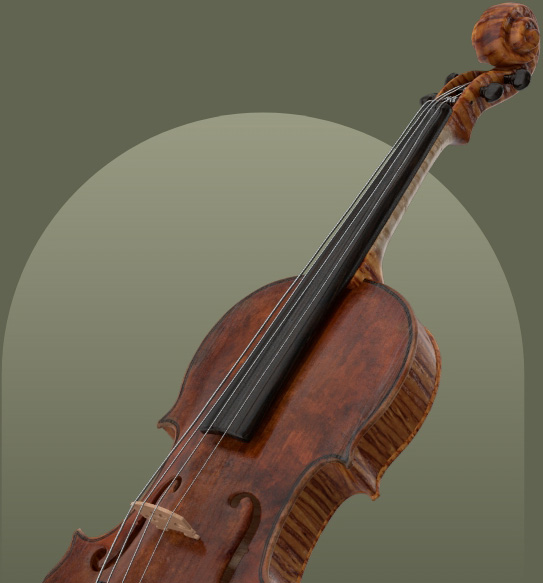
Anselmo Bellosio
Cassine, Venice, 1743–1793
Anselmo Bellosio (1743-1793) was a Venetian violin maker, born in Cassine, Piedmont. He moved to Venice around 1763, becoming active as a maker in 1770 in Giorgio Serafin's workshop, which he took over in 1779. Considered by John Dilworth as the last great maker of the classical school in Venice, his instruments are noted for their distinctive outline, full arch, and elegant edgework, though his scrolls are described as large and clumsy. While Dilworth praises his rich red-brown varnish, other sources like Lütgendorff suggest that better wood and varnish were sometimes desired. He was a pupil of Santo Serafino and taught notable makers such as M. A. Cerin and Pietro Novello.
Request an expert valuation or learn how our global auctions achieve the highest prices for your instruments.
Auction Price History
Highest auction price
5 results
| Type | Details | Auction house | Sold | Price |
|---|---|---|---|---|
| Viola | 38.4 cm Venice, 1780 c. | — | February 2005 | £33,600 |
| Violin | 1780 | — | June 2002 | £52,841 |
| Violin | 1780 | — | November 1991 | £30,800 |
| Violin | 1750 c. | — | March 1986 | £19,800 |
| Violin | 1774 | — | April 1983 | £1,980 |
No results match those filters.
Maker Overview
Life
Anselmo Bellosio (1743-1793): Born in Cassine, Piedmont, in 1743, and died in Venice, Italy, in 1793, as detailed by John Dilworth in The Brompton’s Book of Violin & Bow Makers. He hailed from a family of organ builders. Around 1763, he relocated to Venice. His career as a violin maker commenced in 1770 within the workshop of Giorgio Serafin, a workshop he subsequently took over in 1779. Pietro Novello, a fellow employee, continued as Bellosio's assistant after the transition (Dilworth). Cecie Stainer, in A Dictionary of Violin Makers, and Willibald Leo Lütgendorff, in Die Geigen- und Lautenmacher vom Mittelalter bis zur Gegenwart, identify him as a pupil of Santo Serafino.
Characteristics
- General Reputation
- John Dilworth considers him "the last great maker of the classical school in Venice." However, Cecie Stainer notes that "as a rule his instruments are not so well made as those of his master," a sentiment, who states his workmanship is "very inferior" to Santo Serafino's. Lütgendorff, while acknowledging he didn't equal his master, still regarded him as "einer der besseren Geigenbauer seiner Zeit" (one of the better violin makers of his time).
- Outline and Arching
- Instruments are "beautifully made, with a distinctive outline showing slightly pointed upper bouts" (Dilworth). The arch is described as "full" (Dilworth).
- Edgework and Purfling
- Edgework is "deep," and the purfling and corners are "elegant and strongly emphasised" (Dilworth).
- Scroll
- Characterized as "large and relatively clumsy, with an extended last turn behind a large boss" (Dilworth).
- Varnish
- John Dilworth describes the varnish as "a rich red-brown laid over a golden ground, fully compatible with the best Venetian work." In contrast, Lütgendorff suggests that "besseres Holz und schönerer Lack zu wünschen wäre" (better wood and more beautiful varnish were often desired).
- Known Instruments
- Several small-sized violas are known (Dilworth). Stainer also mentions he "made good violoncellos."
- Anselmus Bellosius fecit
Venetiis, 1776John Dilworth - Anselmij Bellosij fecit
Venetiis, 17..John Dilworth
Influence and legacy
- Training: He was a pupil of Santo Serafino. He also worked in the workshop of Giorgio Serafin (Dilworth).
- Notable Pupils: M. A. Cerin was a pupil (Stainer, Lütgendorff). Pietro Val. Novello was also a pupil and his assistant (Dilworth, Lütgendorff).
- Historical Standing: Generally regarded by John Dilworth as "the last great maker of the classical school in Venice."
- Pupil Recognition: His pupils, including Marc. Ant. Cerin and Pietro Val. Novello, frequently referred to him on their labels to enhance their own reputations (Lütgendorff).
Further Information
- Labels: Examples include "Anselmus Bellosius fecit / Venetiis, 1776" and "Anselmij Bellosij fecit / Venetiis, 17.." (Dilworth).
Biographies
The overview above is drawn from the following published accounts. Read them in the original:
John Dilworth+
BELLOSIO, Anselmo Born 1743 Cassine, Piedmont, died 1793 Venice Italy. From a family of organ builders. Moved to Venice c.1763. Active as a violin maker from 1770 in the workshop of Giorgio Serafin, which he took over in 1779. A fellow employee of Serafin’s, Pietro Novello, remained as Bellosio’s assistant in the shop. Generally seen as the last great maker of the classical school in Venice, his instruments are beautifully made, with a distinctive outline showing slightly pointed upper bouts. The arch is full, the edgework deep, the purfling and corners elegant and strongly emphasised. The scroll is large and relatively clumsy, with an extended last turn behind a large boss. The varnish is a rich red-brown laid over a golden ground, fully compatible with the best Venetian work. Several small-sized violas are known. Anselmus Bellosius fecit / Venetiis, 1776 Anselmij Bellosij fecit / Venetiis, 17..
George Hart+
Similar to Santo Serafmo in pattern, but the workmanship is very inferior.
Willibald Leo Lütgendorff+
Wahrscheinlich ein Sohn von Giovanni Bell, und Schüler von Serafino
Santo. Wenn er seinem Meister auch nicht gleichkam, so war er doch einer
der besseren Geigenbauer seiner Zeit und stand in hohem Ansehen, so dass
seine Schüler (Marc. Ant. Cerin, Pietro Val. Novello u. A.) in ihren Zetteln sich stets zu ihrer Empfehlung auf ihn beriefen. Seine Geigen klingen gut,
wenn ihnen auch oft besseres Holz und schönerer Lack zu wünschen wäre.
Cecie Stainer+
A maker in Venice about 1720-80. Pupil of Santo Serafino. He made good violoncellos, but as a rule his instruments are not so well made as those of his master. M. A. Cerin was a pupil of his.
Sell your instrument with Amati
Get started by uploading photos of your instrument for our experts to review.
Sell your instrument with Amati
Get started by uploading photos of your instrument for our experts to review.