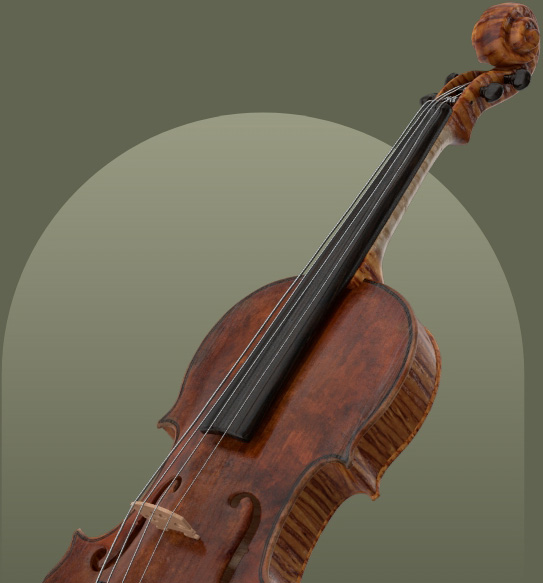
Gasparo Bertolotti
Brescia, 1540–1609
Born into a musical family in Salò, he was living in Brescia by 1563. Associated there with the Virchi family of instrument makers, also probably influenced by the viol maker Pellegrino Michelli. Gasparo was a musician also; records exist of him playing the violone in Bergamo Cathedral. — John Dilworth
Request an expert valuation or learn how our global auctions achieve the highest prices for your instruments.
Auction Price History
Highest auction price
5 results
| Type | Details | Auction house | Sold | Price |
|---|---|---|---|---|
| Viola | 44.1 cm Brescia, 1575 c. | — | April 2010 | £356,670 |
| Violin | 35.7 cm Attributed to | — | October 2007 | £3,250 |
| Viola | 39.4 cm 1580 c. | — | November 1987 | £17,600 |
| Violin | 1550-99 | — | June 1984 | £18,741 |
| Violin | 1580-99 | — | March 1980 | £4,889 |
No results match those filters.
Maker Overview
Life
Gasparo Bertolotti (1540-1609), also known as Gasparo da Salò, was born in Salò and died in Brescia, Italy. He came from a musical family; his father, Francesco B., was a painter and "Violino", and his grandfather was also an instrument maker. Bertolotti was living in Brescia by 1563 and was associated there with the Virchi family of instrument makers, likely also influenced by the viol maker Pellegrino Michelli. He was also a musician, with records indicating he played the violone in Bergamo Cathedral. Tax returns from 1568 and 1588 provide insight into his status; by 1588, his business was flourishing, he owned his house and another property, and he regularly visited France. In 1598, he took Gio.Paolo Maggini as an apprentice, who remained with him after his apprenticeship ended in 1604 and became his successor. His eldest son, Francesco (born 1565), and another worker, Jacopo Lafranchini, also assisted him. After Bertolotti's death, Francesco, Maggini, and Lafranchini continued to work together from the Bertolotti house and workshop for a short period. His work is highly important musically and historically. Tradition holds that he was the inventor of the violin, but John Dilworth notes that it is "clearly more likely to have been any one of the luthiers already active in Brescia for several generations, or Andrea Amati working in Cremona at a much more sophisticated level some years earlier." Dilworth also states that "No genuine Brescian work of this period has a precise date attached," which has led to speculation and confusion. However, Cecie Stainer mentions that a violin belonging to Dr. Forster was "said to have been dated 1613", and two other violins are "said to be dated 1566 and 1576 respectively", presenting conflicting information regarding dated labels.
Characteristics
- Instrument Types
- Gasparo Bertolotti made many types of instruments, including citterns, lire da braccio, viols, violins, tenor violas, cellos, and double basses.
- Construction Style
- His instruments are consistent in style, featuring high-vaulted archings, generally doubled ebony purfling, large soundholes with finial circles of equal size at either end, and crudely formed scrolls. The interior work is coarse, bearing strong rasp marks on all surfaces, and most instruments were probably made without linings.
- Outlines
- Outlines are similar, with small corners and short centre bouts, but there is great variation, indicating that a mould was not used.
- Varnish
- The varnish is a soft textured oil of deep oxidised golden-brown colour. Cecie Stainer notes it was sometimes rich brown, probably darkened with age, or a very clear brown-amber colour.
- Wood Selection
- His viols and citterns frequently have strongly figured softwood in the fronts, often referred to as cedar but in fact a locally grown pine. Violins and violas are made with imported mountain-grown spruce of conventional aspect. Pear wood and sycamore wood were often used, with the grain of the bellies usually very regular and even.
- Violins
- His violins tend to be large, made on a longer and more arched pattern than Cremona instruments. They feature straight, long, pointed, and widely opened sound-holes, with centre bouts often short and shallow, and a rough scroll. The workmanship is described as heavy and not highly finished.
- Tenor Violas
- His tenor violas are a significant legacy, with all but one known example being of tenor size with a back length exceeding 44cm. They are noted for their rich, dark tone and remain the most desirable instrument for concert players. The Ashmolean Museum holds a particularly fine and undisturbed example that uniquely retains its original neck.
- Cellos
- Bertolotti's cellos are a small group of compactly proportioned instruments of very manageable size. None survive with an original scroll, suggesting they may have originally been constructed as viols with five or six strings.
- Double Basses
- His basses are considered very important and, like the violas, remain definitive of the instrument and one of the most imitated models throughout the history of lutherie.
- Specific Examples
- The violin of Ole Bull, held in the Bergen Museum, Norway, is a particularly fine work, unexpectedly well finished and bearing an intricately carved head. The Paris Conservatoire Collection holds a four-stringed bass-viol and a little bass-viol of rather clumsy workmanship with very dark varnish.
- Labels
- His usual printed label, usually affixed to the centre of the back, was undated and read: "Gasparo da Salò, In Brescia".
Influence and legacy
- Early Training: Gasparo Bertolotti was probably a student of his grandfather and later of Girolamo.
- Brescian Associations: He was associated with the Virchi family of instrument makers in Brescia and was likely influenced by the viol maker Pellegrino Michelli.
- Apprentices and Assistants: His most notable apprentice was Gio.Paolo Maggini, who later became his successor. His eldest son, Francesco, and another worker, Jacopo Lafranchini, also assisted him in his workshop.
- Historical Importance: Gasparo Bertolotti's work is considered highly important musically and historically.
- Defining Instruments: His most significant legacy includes his tenor violas, a small group of compactly proportioned cellos, and double basses. His tenor violas remain the most desirable instrument for concert players, and his basses are definitive of the instrument, being among the most imitated models in lutherie history.
- Influence on Later Makers: His pattern was partially revived by Giuseppe Guarneri (1686-1745), likely due to its great tone-producing capacity.
- Modern Imitation: His name has been much used in modern altos and violins made in imitation of the early Brescian type, though many instruments with his label were actually made by G. P. Maggini.
Biographies
The overview above is drawn from the following published accounts. Read them in the original:
John Dilworth+
BERTOLOTTI, Gasparo (Gasparo da Salò) Born 1540 Salò, died 1609 Brescia Italy. Born into a musical family in Salò, he was living in Brescia by 1563. Associated there with the Virchi family of instrument makers, also probably influenced by the viol maker Pellegrino Michelli. Gasparo was a musician also; records exist of him playing the violone in Bergamo Cathedral. Two tax returns completed by Gasparo, in 1568 and 1588, are important indicators of his status. At the earlier date Gasparo was married with two baby sons, and apparently existing on his wife Isabetta’s dowry in a rented house. By 1588 he owned his house and another property which he rented out, the family had grown, and his business was flourishing. He also mentions that he was regularly visiting France, a useful indicator of the breadth of his activities, and that he owed money to his wood dealer in Venice. In 1598 he took as apprentice Gio.Paolo Maggini, who was to remain with him after the term of apprenticeship ended in 1604 and became his successor. Also assisting him was his eldest son, Francesco (Born 1565) and another worker, Jacopo Lafranchini. After Gasparo’s death, Francesco, Maggini, and Lafranchini continued to work together from the Bertollotti house and workshop for a short period. Gasparo’s work is highly important musically and historically. Tradition holds that he was the inventor of the violin, but if there is one such individual, it is clearly more likely to have been any one of the luthiers already active in Brescia for several generations, or Andrea Amati working in Cremona at a much more sophisticated level some years earlier. Unfortunately the tradition in Brescia was not to date labels. No genuine Brescian work of this period has a precise date attached, which has led to a great deal of speculation and confusion. Gasparo made many types of instrument, including citterns, lire da braccio, and viols, prime examples of which are held in the Ashmolean Museum, Oxford and elsewhere, but his violins are rare. His most significant legacy are his tenor violas, a small group of compactly proportioned cellos, and double basses. They are consistent in style, with high-vaulted archings, generally doubled ebony purfling, large soundholes with finial circles of equal size at either end, and crudely formed scrolls. The interior work is coarse, bearing strong rasp marks on all surfaces, and most instruments were probably made without linings. Outlines are similar, with small corners and short centre bouts, but there is great variation indicating that a mould was not used. Varnish is a soft textured oil of deep oxidised golden-brown colour. His viols and citterns frequently have strongly figured softwood in the fronts, often referred to as cedar, but in fact a locally grown pine. Violins and violas are made with imported mountain-grown spruce of conventional aspect. The violin of Ole Bull, held in the Bergen Museum, Norway, is a particularly fine work, unexpectedly well finished and bearing an intricately carved head in the manner of a cittern and decorated organ loft in Brescia itself made by Virchi. The violins tend to be large, as are the violas, of which all except one known example are of tenor size with a back length exceeding 44cm. Many have been ruthlessly cut-down for modern use. The Ashmolean Museum has a particularly fine and undisturbed example which uniquely retains its original neck. These violas, even when cut down, have a rich, dark tone which has come to define the instrument, and Gasparo da Salò violas remain the most desirable instrument for the concert player. His cellos are less well appreciated, but some half-dozen exist and are of very manageable size. None survive with an original scroll however, and they may have originally been constructed as viols with five or six strings. The basses are very important and, like the violas, remain definitive of the instrument and one of the most imitated models throughout the history of lutherie. Printed label, usually affixed to the centre of the back: Gasparo da Salò, In Brescia
Willibald Leo Lütgendorff+
Sohn des Francesco B. und Enkel von Santino. Sein Vater war Maler und
»Violino«, die ganze Familie war musikalisch , und der junge Gasparo wandte sich wohl schon frühzeitig dem Berufe, den auch sein Grossvater ausübte, zu.
Er war wahrscheinlich ein Schüler seines Grossvaters und später von Girolamo
Cecie Stainer+
Son of Francesco Bertolotti, b. 1542, probably in Salo, a small town in Brescia on the shores of Lake Garda ; d. April 14, 1609. One of the earliest of the great makers in Brescia, and probably among the first to give the violin the form afterwards definitely adopted by the Italian makers; he certainly assisted in the transformation of the ancient viol-form into that of the violin.
His violins have more of an historical than practical or artistic interest; the pattern is primitive, and one must realise the early date of his work to appreciate its merit in spite of its imperfections ; for it is not to be compared with that of G. P. Maggini, who came soon after him (1580-1632).
He was famed for his viols, Bass-viols, and tenor-viols; his bass-viols have generally been remounted as double-basses ; one, admirable for the equality of its tone, belonged to Dragonetti, who refused £800 for it, and bequeathed it to Venice; another, with four strings, is in the Paris Conservatoire Collection ; also a little bass-viol, of rather clumsy workmanship with very dark varnish. About 1570 this form of his work varied a good deal; the lower plate is quite flat and the upper plate arched, whilst the upper part, instead of having the round form of the violin, sinks on each side, similarly to a viol; the tone is strong.
His tenors were unquestionably his best instruments; one that was exhibited in London in 1872 was sold in 1894 for £81 ; the varnish was a beautiful golden-yellow; true four-stringed tenors, made with only two corners, a very primitive form, exist, but are very rare. The violoncello, with a head with four pegs, was made in Italy from about 1520, but the first authentic specimens date from Gasparo, and are extremely rare. Only about ten viols, viols da gamba, and other instruments are known, and of really authentic violins only six or seven, which are much prized, chiefly because of their rarity. They are made on a longer and more arched pattern than the Cremona instruments (his viols are generally on a flat model) ; the sound-hole is straight, long, pointed, and widely opened ; the centre bouts often short and shallow ; the scroll rough ; the wood well chosen (pear wood and sycamore wood are often used), the grain of the bellies usually very regular and even ; the varnish sometimes rich brown (probably darkened with age), sometimes very clear brown-amber colour ; penetrating, strong tone ; the corners not very prominent and much rounded ; the purfling generally single ; the workmanship heavy and not highly finished. This pattern was partially revived by Giuseppe Guarneri (1686-1745), owing, doubtless, to its great tone-producing capacity.
The celebrated violin that belonged to Ole Bull was made of light wood, with rich varnish, paler in colour than usual. it had a beautifully carved head. Another violin, which belonged to Dr. Forster, is said to have been dated 1613 ; it had beautiful varnish and very good tone, but had a new head and neck. Two other violins are said to be dated 1566 and 1576 respectively. Gasparo’s usual label was undated : ” Gasparo da Salo in Brescia” ; but his name has been much used in modern altos and violins made in imitation of the early Brescian type ; many instruments with his label were really made by G. P. Maggini.
Sell your instrument with Amati
Get started by uploading photos of your instrument for our experts to review.
Sell your instrument with Amati
Get started by uploading photos of your instrument for our experts to review.