John Blair
Edinburgh, worked 1790–1822
John Blair (1790-1822) was an Edinburgh-based luthier known for his distinctive personal model and use of the Stradivari model. He worked at 8, Potterow and was assisted by Robert Ballantyne. His instruments featured local woods, slender purflings, and a generally good quality golden-orange varnish. Sources offer conflicting accounts regarding his relationship with Matthew Hardie, with some suggesting he was Hardie's pupil and others that he was Hardie's teacher.
Request an expert valuation or learn how our global auctions achieve the highest prices for your instruments.
Instruments
Auction Price History
Highest auction price
| Type | Details | Auction house | Sold | Price |
|---|---|---|---|---|
| Violin | Edinburgh | — | May 2004 | £7,077 |
| Violin | 1805 c. | — | November 2001 | £8,777 |
No results match those filters.
Maker Overview
Life
John Blair (1790-1822) worked in Edinburgh, Scotland UK, established at 8, Potterow.
Sources contain conflicting information regarding his relationship with Matthew Hardie; John Dilworth states he was 'said to have been a pupil of Matthew Hardie,' while Willibald Leo Lütgendorff suggests Hardie was 'probably sein Schüler' (his pupil) and William Meredith Morris quotes a Mr. Honeyman who was 'of opinion that he was the teacher of Matthew Hardie.'
He may have been associated with William Ferguson, another Edinburgh contemporary, and was assisted by Robert Ballantyne, who succeeded to his business in 1827.
Characteristics
- Model
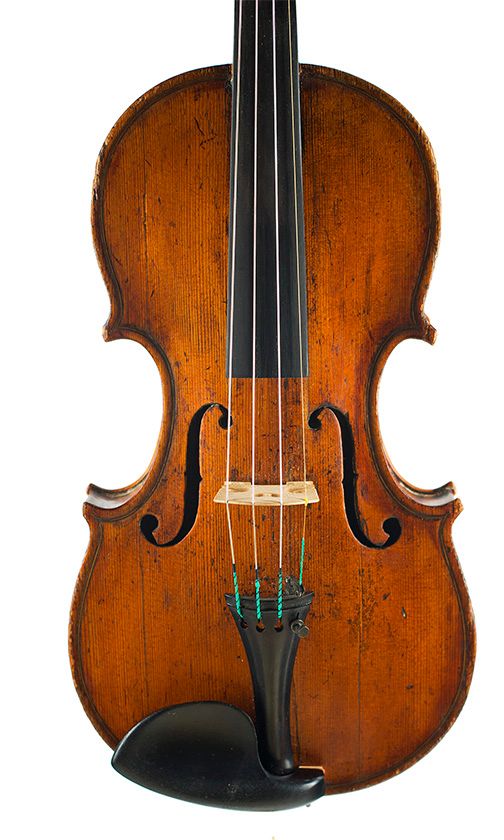
- He employed a personal model described as very distinctive, well-proportioned, and featuring a strong, low arch, small corners, and a delicate scroll, despite a slightly rustic but highly attractive finish.
- Inspiration
- He worked after the Stradivari model.
- Materials
- He used local woods, and his instruments featured slender, well-fitted purflings.
- Varnish
- The varnish was generally of very good quality and texture, golden-orange and very reflective, though some examples had a more meagre, brown-yellow spirit varnish. Willibald Leo Lütgendorff notes his spirit varnish, now appearing quite brown, was originally yellowish.
- Tone
- William Meredith Morris states that while his instruments were excellent in appearance, they were 'not so excellent in tone.'
Influence and legacy
- Mentorship: Sources contain conflicting information regarding his mentorship with Matthew Hardie. John Dilworth suggests Blair was 'said to have been a pupil of Matthew Hardie,' while Willibald Leo Lütgendorff indicates Hardie was 'probably sein Schüler' (his pupil) of Blair, and William Meredith Morris quotes a Mr. Honeyman, who believes Blair was 'the teacher of Matthew Hardie.'
- Association: He may have been associated with William Ferguson, an Edinburgh contemporary.
Biographies
The overview above is drawn from the following published accounts. Read them in the original:
John Dilworth+
BLAIR, John Worked 1790-1822 Edinburgh, Scotland UK. Established at 8, Potterow. Said to have been a pupil of Matthew Hardie but the differences in their respective techniques and styles are far greater than any similarities. In workmanship he has more in common with William Ferguson, another Edinburgh contemporary, who may have been associated in some way. Assisted by Robert Ballantyne who succeeded to his business in 1827. Personal model in very distinctive manner, although very well proportioned and with strong, low arch. Small corners and delicate scroll, slightly rustic in finish but highly attractive. Slender, well-fitted purflings. Local woods employed. Varnish of very good quality and texture, golden-orange and very reflective, although some examples fall below this standard and the varnish can be quite meagre in shades of brown-yellow. Unlabelled, but signed on the interior: ‘John Blair, maker, Edinburgh’ [Rattray]
William Meredith Morris+
He worked on the Stradivari model, and turned out excellent instruments as regards appearance, but not so excellent in tone. Mr. Honeyman is of opinion that he was the teacher of Matthew Hardie, and there is certainly a close resemblance between their work. Wood mostly good and handsome ; spirit varnish rather poor in quality. No label, but he usually wrote his name across the belly on the inside.
Cecie Stainer+
Worked in Edinburgh in 1820 with Matthew Hardie.
Willibald Leo Lütgendorff+
Anfangs arbeitete er allein, später mit Matthew Hardie zusammen, der wahrscheinlich
sein Schüler war. Blair war jedenfalls der Geschicktere von Beiden.
Zettel scheint er nicht verwendet zu haben, doch schrieb er manchmal seinen
Namen in seine Arbeiten und verwendete eine Brandmarke J. B. Sein Spirituslack,
der jetzt ziemlich braun aussieht, war ursprünglich gelblich. Er arbeitete
nach Stradivari.
Sell your instrument with Amati
Get started by uploading photos of your instrument for our experts to review.
Sell your instrument with Amati
Get started by uploading photos of your instrument for our experts to review.