Jacques Boquay
Lyon, Paris, d. 1730
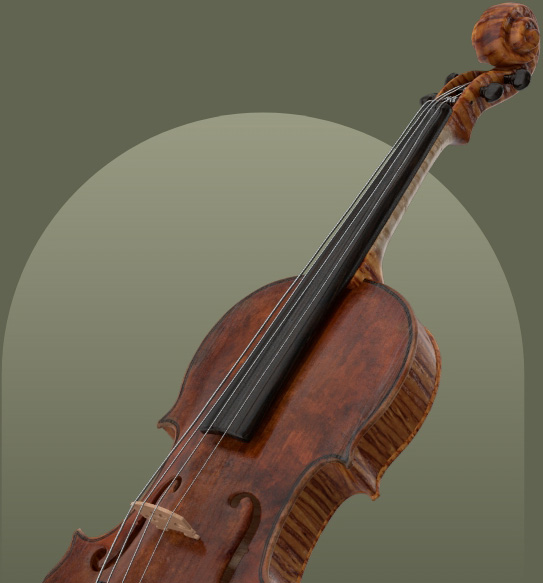
Jacques Boquay (d. 1730) was a significant luthier of the 'Vieux Paris' school, born in Lyons and active in Paris from around 1705. He is noted for his Amati model violins and cellos, characterized by high arching and a distinctive 'hip' in the outline. His workshop inventory at his death revealed a substantial commercial operation, including instruments made by his apprentice Treuillot. While some sources praise his violoncellos for their fine tone, others suggest his violins could suffer from poor tone due to inconsistent craftsmanship.
Request an expert valuation or learn how our global auctions achieve the highest prices for your instruments.
Auction Price History
Highest auction price
45 results
| Type | Details | Auction house | Sold | Price |
|---|---|---|---|---|
| Violin | Bearing the maker's label, later head, many table restorations including sound post and bass bar cracks Lot 255 | — | December 2021 | £15,831est. € 15.000-20.000 |
| Violin | Labelled Giuseppe Guarneri 1703, back and table restorations Lot 298 | — | November 2021 | £12,879est. CHF 15,000-20,000 |
| Violin | Not original head of French school in the Bocquay style, many back restorations and worm damage Lot 222 | — | December 2020 | £8,736est. € 5.000-6.000 |
| Violin | Bearing the maker's label, some table restorations, table sound post crack Lot 270 | — | December 2016 | £26,401est. € 12.000-15.000 |
| Violin | Two-piece back of faint medium curl, later head, varnish of a reddish brown colour on a golden ground Lot 58 | — | November 2015 | £14,400est. £ 12,000-15,000 |
| Violin | Two-piece back, varnish of a brown colour, neck restoration, otherwise good condition Lot 31 | — | May 2015 | £8,509est. € 12.000-15.000 |
| Violin | Labelled JACQUES BOCQUAY, PARIS, repair label CHARLES R. VOIGT, PHILADELPHIA ... Lot 123 | — | April 2015 | £899est. $ 2,200-3,800 |
| Violin | Bearing the maker's label, later head, many table cracks, table sound post and bass barre restorations Lot 305 | — | December 2014 | £7,346est. € 8.000-10.000 |
| Violin | Labelled Jacques Bocquay, Paris, 1717 Lot 299 | — | December 2013 | £16,853est. $ 4,000-6,000 |
| Violin | Labelled Jacques Boquay, rue d'Argenteuil a Paris, 1715 Lot 145 | — | October 2013 | £6,000est. £ 4,000-6,000 |
| Violin | Bearing the maker's label, not original French head of the 18th Century, many restorations Lot 356 | — | June 2013 | £16,320est. € 6.000-8.000 |
| Violin | Labelled Jacques Boquay, rue d'Argenteuil à Paris, 1720 Lot 310 | — | November 2012 | £5,992est. $ 8,000-12,000 |
| Violin | 36.4 cm Paris, 1720 c. Probably by | — | October 2011 | £3,750 |
| Violin | 35.3 cm Attributed to | — | March 2011 | £7,200 |
| Violin | 35.9 cm Paris, 1715-1720 c. | — | December 2010 | £4,142 |
| Violin | 35.7 cm Early 18th C. (back center seam open) Attributed to & possibly by | — | December 2010 | £3,230 |
| Violin | 35.9 cm Paris, 1715-1720 c. | — | December 2009 | £21,761 |
| Violin | 35.9 cm 18th C. Probably by | — | October 2009 | £8,898 |
| Violin | 35.8 cm Paris, 1715 c., without hair | — | December 2008 | £5,119 |
| Cello | 74.3 cm Paris, 1710-1715 c. (new edges) | — | June 2007 | £8,417 |
| Violin | 36.1 cm Paris, 1721 | — | June 2006 | £3,642 |
| Violin | Paris, 1710 | — | November 2005 | £9,600 |
| Violin | Paris, 1730 c. | — | May 2005 | £1,200 |
| Violin | Paris, 1710 c. | — | April 2005 | £4,699 |
| Violin | Paris, 1720 c. Probably by | — | February 2005 | £5,400 |
| Violin | 1730 c. | — | January 2005 | £968 |
| Violin | Paris, 1730 c. | — | February 2004 | £2,271 |
| Violin | 1714 | — | May 2003 | £4,416 |
| Cello | 1710 | — | November 2001 | £19,550 |
| Violin | 1720 | — | June 2001 | £1,596 |
| Violin | 1720 | — | June 1999 | £3,576 |
| Violin | 1715 | — | December 1998 | £1,844 |
| Violin | 1720 | — | June 1998 | £4,101 |
| Violin | 1720 | — | April 1998 | £10,350 |
| Violin | 1719 | — | November 1997 | £1,157 |
| Violin | 1722 | — | July 1997 | £8,000 |
| Violin | 17-- | — | March 1996 | £4,370 |
| Violin | 1724 | — | November 1994 | £1,725 |
| Violin | 1720 c. | — | March 1994 | £5,750 |
| Violin | 1725 | — | November 1992 | £2,200 |
| Violin | 1735 c. | — | March 1992 | £3,300 |
| Violin | 17-- | — | March 1992 | £1,980 |
| Violin | 1718 | — | November 1991 | £4,840 |
| Violin | 1720 | — | November 1991 | £3,850 |
| Violin | 1719 | — | April 1991 | £2,200 |
No results match those filters.
Maker Overview
Life
Jacques Boquay (d. 1730) was born in Lyons and died in 1730 in Paris, France. He was an important member of the 'Vieux Paris' school, alongside his contemporary Claude Pierray. He worked in Paris from about 1705 to 1735, residing at rue de la Juiverie in 1718 before moving to rue d'Argenteuil in 1719. The inventory of his workshop at his death revealed a large stock of instruments and materials, indicative of a significant commercial enterprise. Sources contain conflicting information regarding the quality of his output; while some suggest he made too many instruments to finish them with care, resulting in a generally poor tone due to badly calculated thicknesses, others describe his violins as good and his violoncellos as handsome instruments with a fine tone.
Characteristics
- Models
- Jacques Boquay's output included small and 'Grand' Amati model violins.
- Archings
- His instruments featured well-sculpted high arching.
- Outline
- A noticeable quirk of his technique was an abrupt change from the outward curve of the lower bouts to the inward curve of the corner, creating a distinct 'hip' in the outline.
- Varnish
- The varnish on his instruments is described as very transparent, appearing red-brown or sometimes yellow in color.
- Workshop Inventory
- At his death, his workshop inventory included 18 violins, some unvarnished, made by his apprentice Treuillot, along with many violins, cellos, vieilles, and scores of bows.
- Specific Instruments
- An alto dated 1709 is known, as is a violin dated 1718 in the Paris Conservatoire collection. A violoncello dated 1719 and a violin dated 1730 are also documented.
- Violin dated 1718 used by Baillot, and also a cello, are currently held in the Musée de la Musique, Paris. Jacques Boquay
rue de la Juiverie
A Paris, 1709Brumpton Import - Jacques Boquay
rue d’Argenteuil
A Paris, 1719Brumpton Import - Jacques Bouquey Luthier
rue du Coq no. 15 à ParisBrumpton Import
Influence and legacy
- School: Jacques Boquay was an important member of the 'Vieux Paris' school.
- Contemporaries: He worked alongside his contemporary Claude Pierray, and it is presumed by Willibald Leo Lütgendorff that he was a fellow student of Pierray.
- Collections: A violin dated 1718 made by Boquay is part of the Paris Conservatoire collection, and was notably used by Baillot for teaching.
Further Information
- Working Period: Jacques Boquay worked in Paris from approximately 1705 to 1735.
- Addresses: He was living at rue de la Juiverie in 1718 and moved to rue d'Argenteuil in 1719.
- Workshop Scale: The inventory of his workshop at his death in 1730 indicated a large commercial enterprise, including a substantial stock of instruments and materials.
Biographies
The overview above is drawn from the following published accounts. Read them in the original:
John Dilworth+
BOCQUAY (BOQUAY), Jacques b. Lyons, died 1730 Paris France. Important member of the ‘Vieux Paris’ school alongside his contemporary Claude Pierray. The inventory of his workshop at his death reveals a large stock of instruments and materials appropriate to a major commercial enterprise. Amongst many violin, cellos, vieilles, and scores of bows are 18 violins, some unvarnished, made by his apprentice Treuillot. His output includes small and ‘Grand’ Amati model violins. Well-sculpted high arching. An obvious quirk of his technique is the rather abrupt change from the outward curve of the lower bouts to the inward curve of the corner, giving a noticeable ‘hip’ in the outline. Finish a littl
Cecie Stainer+
b. at Lyons. Worked in Paris about 1705-35, was living rue de la Juiverie, 1718, but went to rue d’Argenteuil, 1719. Made too many instruments to finish them with care. His violins are good, though inferior to those of Pierray, his contemporary. He followed the Amati pattern his instruments are small, slightly arched, the tone generally poor owing to the thicknesses being badly calculated; the varnish, very transparent, is red-brown, sometimes yellow colour.
His violoncellos are handsome instruments and have a fine tone.
An alto was dated 1709, a violin dated 1718 in the Paris Conservatoire collection was one on which Baillot used to play when teaching. A violoncello dated 1719 and a violin dated 1730 are also known.
Willibald Leo Lütgendorff+
Vermuthlich ein Mitschüler von Pierray, dem er in seiner Arbeit zwar nicht
Sell your instrument with Amati
Get started by uploading photos of your instrument for our experts to review.
Sell your instrument with Amati
Get started by uploading photos of your instrument for our experts to review.