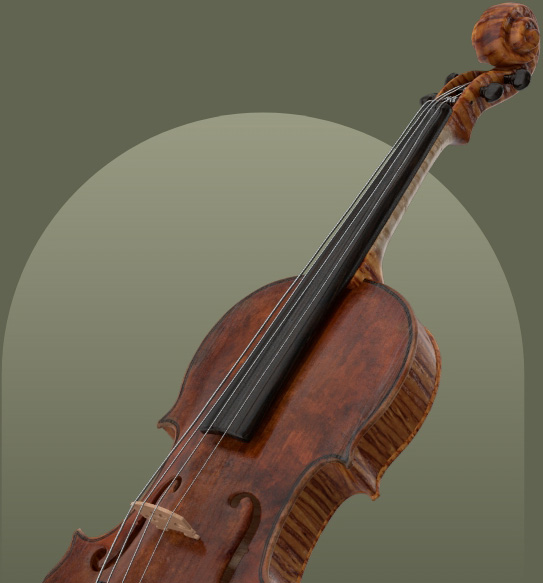
Nathaniel Cross
Auction price history
Highest auction price
£21,780
| Type | Details | Sold | Price |
|---|---|---|---|
| Violin | Faintly labelled Sold by Eliz: Miller at the sign of the violin on London Bridge ... | October 2024 | £8,400 |
| Cello | 71.5 cm London, 1733 [Probably by] | October 2010 | £9,764 |
| Violin | 35.6 cm London , 1740 c. [Attributed to] | October 2010 | £3,600 |
| Violin | 1740 c. | July 1997 | £1,150 |
| Viola | 41.1 cm 1732 | June 1994 | £21,780 |
| Violin | 1743 | January 1992 | £3,080 |
| Violin | 1725 | June 1991 | £3,080 |
| Cello | 1733 | June 1990 | £9,900 |
| Viola | 41.4 cm 1740 c. | April 1987 | £4,400 |
| Cello | 1700-50 | January 1984 | £2,444 |
Biographies
John Dilworth
CROSS, Nathaniel Born 1686, died 1751 London UK. In partnership with Barak Norman from c.1713: Norman viol of that date is inscribed ‘Nathaniel Cross wrought my back and belly’. In 1724 Cross’ name appears alongside Norman’s on a violin label with the address ‘St Paul’s Churchyard’. From 1725 Cross’ own label appears with the shop at ‘ye Crown in Piccadilly’. In 1730 he had moved to the George Inn, Aldersgate and in 1733 to St. James, Aldermanbury. His final move was to the ‘Bass Viol’ in Bow Churchyard, Cheapside. A prolific maker, generally on a Stainer model. The head a little lacking in definition. Quite elegant soundholes. Cellos of the small 27”-28” (68.5cm-71cm) model favoured in England at that time. The materials are generally plain with a clear yellow varnish. His influence is seen on subsequent London makers, Kennedy and Johnson, whom he may have taught directly. Often branded on the back with initials ‘N.C.’ surmounted by a cross. Nathaniel Cross, maker, / the George Inn, Aldersgate Street / London 1731 Nathanaeli Crosso / Stainero, fecit / No 2417 Viola d’amore in the Copenhagen Museum has label: Nath Cross in pickdily near St. James Church London
Sell your instrument with Amati
Get started by uploading photos of your instrument for our experts to review.
Sell your instrument with Amati
Get started by uploading photos of your instrument for our experts to review.