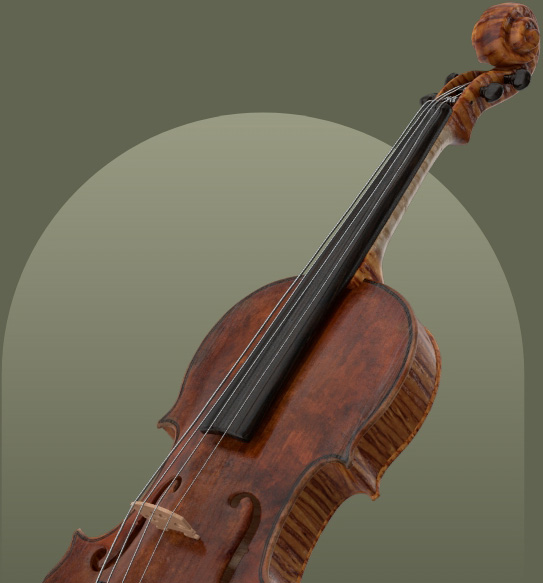
Alessandro D’ Espine
1782–1855
Alessandro D' Espine (1782-1855) was a significant figure in the 19th-century Turin school of violin making, known for his very fine, classically proportioned instruments derived from Stradivari models, occasionally showing Guarnerian inflections. Born in Plainpalais, Geneva, he was a pupil of Gaetano Guadagnini and later received assistance from J. F. Pressenda. Despite his primary career as a dental surgeon to King Carlo Felice, his rare and highly valued instruments are a testament to his skill, making him an important founder member of the Turin tradition.
Request an expert valuation or learn how our global auctions achieve the highest prices for your instruments.
Maker Overview
Life
Alessandro D' Espine (1782-1855) was born in Plainpalais, Geneva, Switzerland, and died in Pinerolo, near Turin, Italy. He emerged as an important founder member of the later Turin school, with his classically influenced work appearing from 1815. Shortly after his arrival, Turin became a premier center for new Italian instrument making, primarily based on careful interpretations of Stradivari models, a development in which D'Espine played a foundational role, later joined by J. F. Pressenda. From an aristocratic family, D'Espine's primary career, shared with his brother, was as a dental surgeon, a position he held for King Carlo Felice from 1820 to 1831. In 1816, he is mentioned in the notebooks compiled by Count Cozio di Salabue, indicating that he was then a pupil of Gaetano Guadagnini, who, in this early period, was varnishing D'Espine's work. He later received assistance from J. F. Pressenda. D'Espine was absent from Turin between 1832 and 1851, likely due to obligations related to his professional life as a dentist. He returned only briefly to Turin itself, subsequently moving to Pinerolo, approximately 40 km to the south-west, where he passed away. His work is highly celebrated and valued, yet it is the rarest of the admirable 19th-century Turin school, a scarcity that is not surprising given his demanding career as the King's dentist. The connection between these two crafts may not be as unusual as it seems, as the 18th-century English maker William Pryor also advertised his services as a maker of false teeth, with cheaper varieties fashioned from hardwood.
Characteristics
- Workmanship
- His workmanship is described as very fine, characterized by a strong outline and very classically proportioned forms, primarily derived from Stradivari.
- Design
- Some of his instruments exhibit modest Guarnerian inflections in the treatment of the soundholes.
- Edges and Corners
- Instruments feature broad flat edges and rather short corners.
- Materials
- Materials used were generally of first quality.
- Varnish
- The varnish is variable; it can occasionally be thick, dark, and oily, but more often it is thin and close to the wood, appearing in red or red-brown colors.
- Label
- An example of his label reads: Alessandrus d'Espine fecit / Taurini anno Domini 1828.
- Alessandrus d’Espine fecit
Taurini anno Domini 1828John Dilworth
Influence and legacy
- Mentorship: In his early period, Alessandro D'Espine was a pupil of Gaetano Guadagnini, who also varnished D'Espine's work.
- Collaboration: He later received assistance from J. F. Pressenda.
- Stylistic Influence: His work is notably classically influenced, primarily deriving from Stradivari models.
- Reputation: Alessandro D'Espine's work is highly celebrated and valued.
- Historical Significance: He is recognized as an important founder member of the later Turin school.
- Rarity: His instruments are considered the rarest of the admirable 19th-century Turin school.
Further Information
- Birthplace: Plainpalais, Geneva, Switzerland.
- Deathplace: Pinerolo, near Turin, Italy.
- Primary Profession: Dental surgeon to King Carlo Felice from 1820 to 1831.
- Notable Mention: He is mentioned in the notebooks compiled by Count Cozio di Salabue in 1816.
Biographies
The overview above is drawn from the following published accounts. Read them in the original:
John Dilworth+
D’ESPINE, Alessandro Born 1782 Plainpalais, Geneva Switzerland, died 1855 Pinerolo, nr. Turin Italy. An important founder member of the later Turin school, his very classically influenced work appeared from 1815. Joined shortly afterwards by J. F. Pressenda, Turin became established as a premier centre for new Italian work based primarily on careful interpretations of Stradivari models. He belonged to an aristocratic family, and his career, and that of his brother, was firstly as a dental surgeon appointed to King Carlo Felice 1820-1831. In 1816 he is mentioned in the notebooks compiled by Count Cozio di Salabue, and it appears that he was then a pupil of Gaetano Guadagnini who in this early period was varnishing D�Espine�s work for him. He later received assistance from J. F. Pressenda. He was absent from Turin between 1832 and 1851, possibly because of obligations in his professional life as a dentist. He returned only briefly to Turin itself, moving to Pinerolo, some 40 km to the south-west, where he died. His work is highly celebrated and valued, but is the rarest of the admirable 19th century Turin school; it is far rarer than many dealers would admit, and considering his other career as the King�s dentist, this is not surprising. The connection between the two crafts may not be as bizarre as it may seem; the eighteenth century English maker William Pryor also advertised his services as a maker of false teeth, the cheaper sorts being fashioned from hardwood. Workmanship very fine; strong outline, very classically proportioned, derived from Stradivari. Some show modest Guarnerian inflections in the treatment of the soundholes. Broad flat edges and rather short corners. Materials generally of first quality. Varnish variable; can be occasionally thick dark and oily, but more often thin and close to the wood, red or red-brown in colour. Alessandrus d’Espine fecit / Taurini anno Domini 1828 [Kass]
Sell your instrument with Amati
Get started by uploading photos of your instrument for our experts to review.
Sell your instrument with Amati
Get started by uploading photos of your instrument for our experts to review.