Eugenio Degani
Merlara, Montagnana, Venice, 1842–1901
Request an expert valuation or learn how our global auctions achieve the highest prices for your instruments.
Instruments
Auction Price History
Highest auction price
66 results
| Type | Details | Auction house | Sold | Price |
|---|---|---|---|---|
| Violin | Labelled Degani Eugenio (dieci medaglie di merito) fece Venezia - Anno 1892 Lot 245 | Ingles & Hayday | October 2025 | £26,400est. £ 12,000-18,000 |
| Violin | Labelled Imitazione di Giuseppe Guarneri Cremonese fatto da Degani Eugenio Anno 1891 Venezia Lot 276 | Ingles & Hayday | October 2025 | £16,800est. £ 12,000-18,000 |
| Violin | A violin by Eugenio Degani, Venice, 1887 Lot 289 | Amati | March 2025 | £50,560est. £ 20,000-30,000 |
| Violin | Labelled Imitazione di Giuseppe Guarnieri, Fatta da Degani Eugenio, Montagnana (Veneto) Anno 1878 Lot 119 | Tarisio | April 2022 | £21,829est. € 20.000-30.000 |
| Violin | Labelled Imitazione di Giuseppe Guarnieri-Cremonese, fatta da ..., original fingerboard and saddle Lot 130 | Tarisio | October 2021 | £21,313est. € 20.000-30.000 |
| Violin | Labelled Degani Eugenio, (Quattordici medaglie di merito) fece Venezia 1895 Lot 168 | Tarisio | November 2020 | £53,459est. $ 60,000-90,000 |
| Violin | Bearing the maker's label Lot 309 | Vichy | November 2019 | £46,208est. € 20.000-25.000 |
| Violin | Labelled Degani Eugenio (quattordici medaglie di Merito), Fece Venezia - Anno 1897 Lot 220 | Brompton’s | June 2018 | £20,400est. £ 18,000-25,000 |
| Violin | Labelled Degani Eugenio (quattordici medaglie di merito) fece ... Lot 201 | Brompton’s | March 2017 | £28,800est. £ 20,000-30,000 |
| Violin | One-piece back of wild flame, varnish of a reddish brown colour on a golden ground Lot 1483 | Gardiner Houlgate | December 2016 | £9,360est. £ 7,000-10,000 |
| Violin | Labelled Degani Eugenio, (quattordici medaglie di merito), Fece Venezia - Anno 1899 Lot 191 | Tarisio | March 2016 | £23,600est. £ 20,000-30,000 |
| Violin | Labelled Degani Eugenio, (quattordici medaglie di merito), Fece Venezia - Anno 1897 Lot 134 | Tarisio | February 2016 | £33,885est. $ 40,000-60,000 |
| Violin | Labelled Degani Eugenio (dieci medaglie di merito) fece 48, Venezia 1894 Lot 461 | Brompton’s | December 2015 | £20,000est. £ 20,000-30,000 |
| Violin | Labelled Degani Giulio di Eugenio (premiato gran diploma d'onore in Milano), fece in Venezia, Anno ... Lot 103 | Tarisio | June 2015 | £7,800est. £ 5,000-8,000 |
| Viola | Bearing the original label Degani Eugenio, fece in Montagnana (Veneto) anno 1871 Lot 129 | Brompton’s | March 2015 | £7,800est. £ 6,000-8,000 |
| Violin | Bearing the original label Degani Eugenio, dieci medaglie di merito ..., original neck and fingerboard Lot 303 | Brompton’s | March 2015 | £29,520est. £ 12,000-18,000 |
| Violin | Labelled Degani Eugenio, (quattordici medaglie di merito), Fece Venezia - Anno 1897 Lot 286 | Tarisio | October 2014 | £26,264est. $ 35,000-55,000 |
| Violin | Labelled Imitazione di Antonio Stradivario - Cremonese, Fatta da Degani Eugenio, Montagnana ... Lot 254 | Tarisio | May 2014 | £31,317est. $ 18,000-25,000 |
| Violin | Labelled Degani Eugenio quattordici medaglie di merito fece Venezia - anno 1890, scroll possibly later Lot 178 | Brompton’s | March 2014 | £38,400est. £ 18,000-25,000 |
| Violin | Labelled Degani Eugenio, quattordici medaglie di merito Fece Venezia ..., of a light amber brown colour Lot 47 | Bonhams | October 2013 | £33,750est. £ 20,000-30,000 |
| Violin | Labelled by the maker, of a handsome light golden brown colour Lot 66 | Bonhams | October 2013 | £25,000est. £ 20,000-25,000 |
| Violin | Bearing the original label Degani Eugenio fecit Venezia anno 1893, original fingerboard Lot 247 | Brompton’s | June 2013 | £20,400est. £ 18,000-25,000 |
| Violin | Labelled Imitazione di Giuseppe Guarneri, Fatta da Degani Eugenio, Montagnana (Veneto) Anno 1887 Lot 235 | Tarisio | May 2013 | £15,412est. $ 20,000-30,000 |
| Violin | Labelled Degani Eugenio, Premiato Gran Diploma D'Onore in Milano, fece in Venice, Anno 1897 Lot 243 | Tarisio | May 2013 | £42,383est. $ 30,000-50,000 |
| Violin | Property of the Late Alfred Knopf, bearing an original label dated 1896 Lot 139 | Brompton’s | June 2012 | £33,600est. £ 18,000-25,000 |
| Violin | Lot 72 | Bonhams | March 2012 | £34,850 |
| Violin | Labelled Degani Eugenio, Premiato Gran Diploma D'Onore in ..., of a light golden orange brown colour Lot 72 | Bonhams | March 2012 | £34,850est. £ 15,000-20,000 |
| Cello | 73.5 cm Venice, 1895 | — | April 2010 | £29,460 |
| Cello | 75.6 cm Venice, 1885 | — | October 2009 | £20,391 |
| Violin | 36.1 cm Venice, 1889 | — | October 2009 | £14,400 |
| Violin | 36.5 cm Venice, 1886 | — | March 2009 | £15,210 |
| Violin | 35.6 cm Venice 1899 | — | March 2009 | £27,500 |
| Violin | 35.6 cm Venice, 1899 | — | November 2008 | £25,935 |
| Violin | 35.8 cm Venice, 1897 | — | October 2007 | £19,700 |
| Viola | 39.7 cm | — | November 2006 | £14,704 |
| Violin | 35.8 cm Venice, 1897 | — | July 2006 | £21,600 |
| Violin | 36.5 cm Venice, 1893 | — | July 2006 | £13,200 |
| Violin | 36.5 cm Venice, 1894 | — | April 2006 | £26,400 |
| Violin | Venice, 1887 | — | November 2005 | £9,600 |
| Violin | Venice, 1891 | — | May 2005 | £15,600 |
| Violin | Montagnana, 1886 | — | November 2004 | £21,600 |
| Violin | Montagnana, 1887 | — | November 2004 | £15,600 |
| Violin | 1889 | — | July 2003 | £10,200 |
| Violin | 1905 | — | June 2003 | £14,999 |
| Violin | 1899 | — | November 2001 | £13,000 |
| Violin | 1895 | — | November 2001 | £22,325 |
| Violin | 1887 | — | May 2001 | £15,603 |
| Violin | 1898 | — | November 1999 | £18,400 |
| Violin | 1893 | — | June 1999 | £13,800 |
| Violin | 1896 | — | March 1999 | £18,500 |
| Violin | 1898 | — | November 1998 | £19,550 |
| Violin | 1897 | — | November 1998 | £16,675 |
| Cello | 1890 c. | — | May 1997 | £20,000 |
| Violin | 1893 | — | November 1996 | £14,375 |
| Cello | 1891 | — | November 1996 | £36,182 |
| Violin | 1886 | — | November 1996 | £17,250 |
| Violin | 18-- | — | March 1996 | £23,000 |
| Violin | 1896 | — | March 1996 | £20,700 |
| Violin | 1897 | — | March 1994 | £12,075 |
| Violin | 1887 | — | March 1994 | £6,820 |
| Violin | 1892 | — | November 1993 | £11,500 |
| Violin | 1895 | — | June 1992 | £9,350 |
| Violin | 1891 | — | June 1992 | £7,700 |
| Cello | 1894 | — | June 1990 | £14,850 |
| Cello | 1884 | — | November 1989 | £20,900 |
| Viola | 40.3 cm 1899 | — | June 1989 | £9,900 |
No results match those filters.
Maker Overview
Life
Eugenio Degani (1842-1901) was born in Merlara in 1842 and died in Venice, Italy, in 1901. He was the son and pupil of Domenico Degani. was a pupil of his father from the age of 10. At 16, from 1856 to 1866, he trained in organ building with Domenico Malvestio in Montagnana. During the war of 1866, he made guns to sustain himself, utilizing his technical skills. Sources contain conflicting information regarding his early career and movements: John Dilworth states that Degani moved to Montagnana in 1868, where he was making violins from at least 1872, winning a gold medal at the Treviso Esposizione in that year. Lütgendorff, however, indicates that Degani became independent in his birthplace (Merlara) in 1877 as a violin maker. Degani later moved to Venice, with Dilworth citing 1888 and Lütgendorff stating 1887, where he remained until his death. He employed his nephew Giovanni Schwarz, Luigi Chiericato, and Ettore Siega in his workshop. When his son Giulio joined the business in 1898, the firm became known as 'Degani e figlio' or 'Eugenio Degani & Figlio'.
Characteristics
- Workmanship
- Eugenio Degani was a very gifted craftsman whose instruments display individual flourishes and a very high standard of finish.
- Design Elements
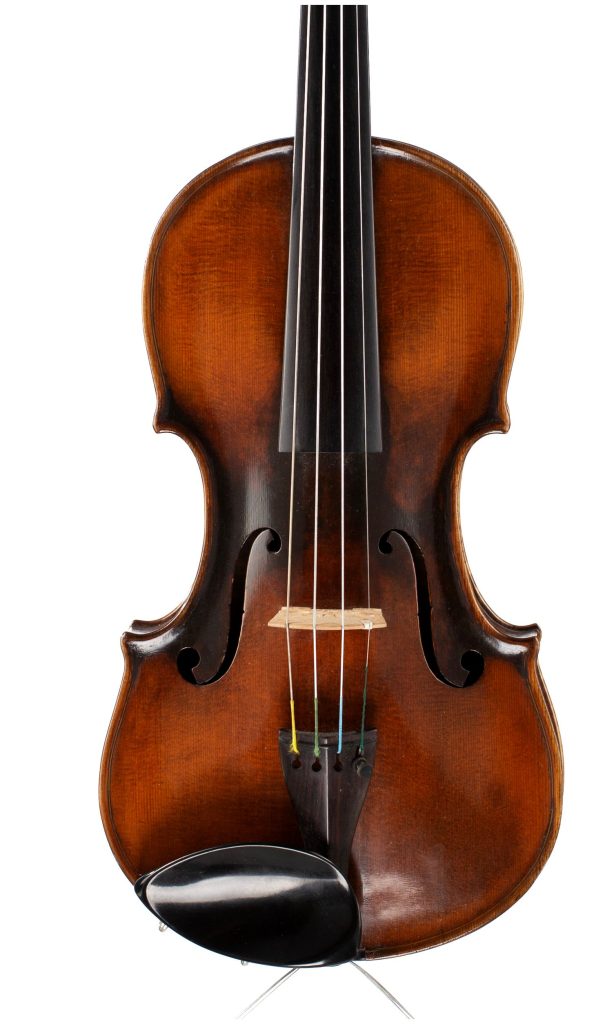
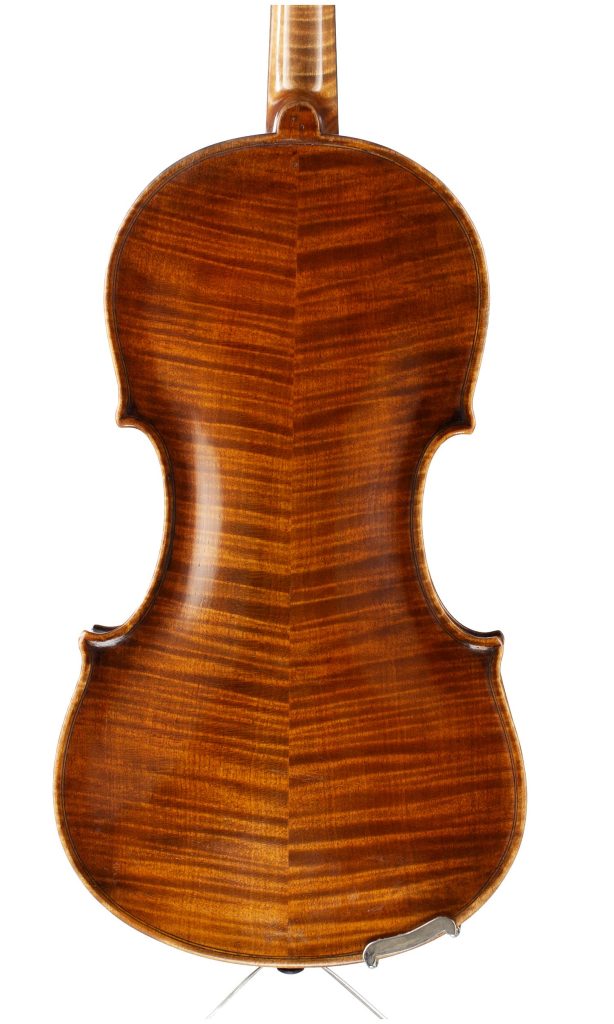
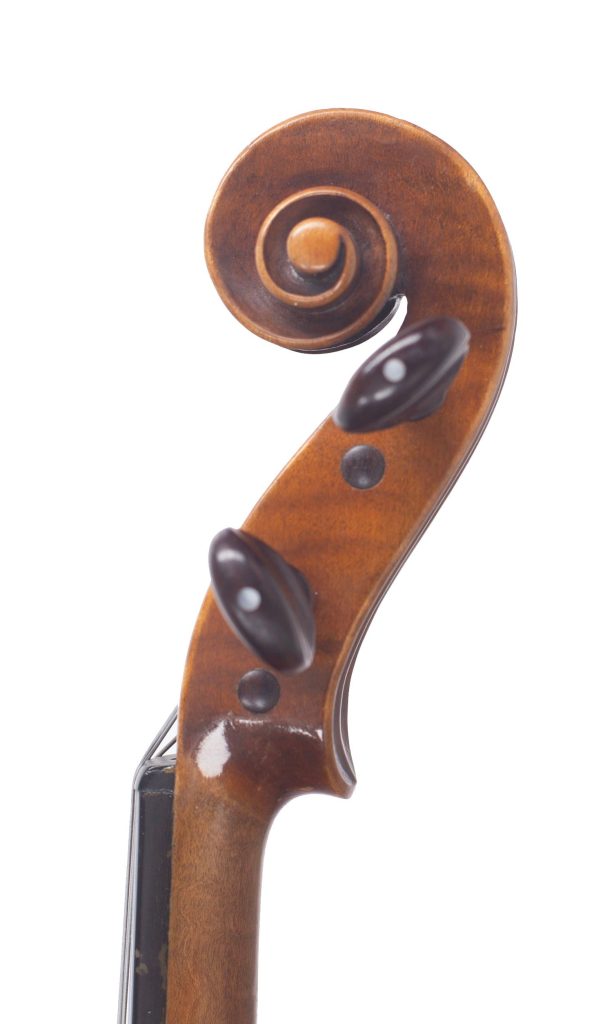
- The edge channel on his instruments is narrow but deeply sunk, rising to a very sharp ridge. The purfling mitres are long, and sometimes the purfling is doubled to five strands of black/white/black/white/black. The pegbox sides are hollowed and brought to a very marked recurve at the lower edge, and the volutes are deeply undercut.
- Models
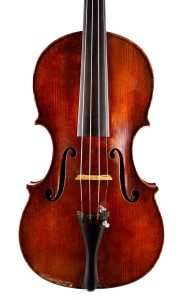
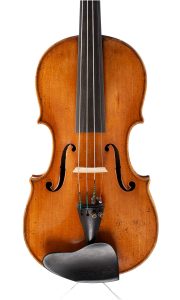
- He often produced instruments of a large overall model, but also created more conventional imitations of Cremonese makers. Willibald Leo Lütgendorff notes that he built according to his own model, featuring five purfling strands (three black and two white) and a specially carved scroll, while also copying old masters.
- Varnish
- His instruments are characterized by a fine orange varnish. Lütgendorff praises his varnish, stating its composition was a secret.
- Degani Eugenio
Venezia – Anno 18..John Dilworth - Eugenio Degani
piu volte premiato
medaglia d’oro
VeneziaJohn Dilworth
Influence and legacy
- Training: Eugenio Degani was the son and pupil of Domenico Degani., he was a pupil of his father from the age of 10. He also received training in organ building from Domenico Malvestio in Montagnana from 1856 to 1866.
- Teaching: Lütgendorff considers him an excellent teacher of his art.
- Awards: Degani won numerous medals throughout his career. These include a gold medal at the Treviso Esposizione in 1872, and further medals at Paris in 1885 and 1900, Bologna in 1888, Turin in 1884, and Palermo in 1892, as documented by John Dilworth. Willibald Leo Lütgendorff states he received more than 15 medals from exhibitions in Treviso, Rovigo, Milan, Arezzo, Naples, Turin, Paris, London, Chicago, Milan, Palermo, and Bologna.
- Family Business: His firm became 'Degani e figlio' or 'Eugenio Degani & Figlio' in 1898 when his son Giulio joined him.
Further Information
- Labels: Instruments by Eugenio Degani bear labels such as "Degani Eugenio / Venezia – Anno 18.." and "Eugenio Degani / piu volte premiato / medaglia d'oro / Venezia", as noted by John Dilworth.
Biographies
The overview above is drawn from the following published accounts. Read them in the original:
John Dilworth+
DEGANI, Eugenio Born 1842 Merlara, died 1901 Venice Italy. Son and pupil of Domenico Degani, above. Moved to Montagnana in 1868, where he was making violins from at least 1872 when he won a gold medal at the Treviso Esposizione, and to Venice in 1888 where he remained until his death. Employed his nephew Giovanni Schwarz, Luigi Chiericato, and Ettore Siega. When his son Giulio joined them in 1898, the business became ‘Degani e figlio’. A very gifted craftsman, his instruments display very individual flourishes and a very high standard of finish. The edge channel is narrow but deeply sunk, and rises to a very sharp ridge. The purfling mitres are long, and sometimes the purfling is doubled to five strands of black/white/black/white/black. The pegbox sides are hollowed and brought to a very marked recurve at the lower edge. The volutes are deeply undercut. Often of large model overall, as well as some more conventional imitations of Cremonese makers. Fine orange varnish. Medals won at Paris 1885 and 1900, Bologna 1888, Turin 1884, and Palermo 1892. Degani Eugenio / Venezia – Anno 18.. Eugenio Degani / piu volte premiato / medaglia d’oro / Venezia [Rosengard]
Willibald Leo Lütgendorff+
Seit seinem 10. Jahre Schüler seines Vaters, ging er, 16 Jahre alt, um sich
im Orgelbau auszubilden, zu dem Orgelbauer Domenico Malvestio in Montagnana,
bei welchem er von 1856—1866 arbeitete. Während des Krieges von 1866
musste er, um sein Leben zu fristen, Flinten machen, wozu ihn seine technischen
Fertigkeiten befähigten. Im Jahre 1877 machte er sich in seinem Geburtsorte
selbstständig und siedelte 1887, nachdem er sich als Geigenmacher bereits einen
Namen gemacht, nach Venedig über. Er baut nach eigenem Modell, versieht
seine Geigen mit fünf Einlagespänen (drei schwarzen und 2 weissen) und
hat auch eine besonders gestochene Schnecke, doch copirt er auch alte Meister.
Sein Lack, dessen Zusammensetzung sein Geheimniss ist, wird sehr gelobt. Er
besitzt mehr als 15 Medaillen von den Ausstellungen in Treviso, Rovigo, Mailand, Arezzo, Neapel, Turin, Paris, London, Chicago, Mailand, Palermo, Bologna etc. etc. und gilt als trefflicher Lehrer seiner Kunst. Seit 1898 lautet seine Firma Eugenio
Degani & Figlio.
Sell your instrument with Amati
Get started by uploading photos of your instrument for our experts to review.
Sell your instrument with Amati
Get started by uploading photos of your instrument for our experts to review.
Pupils
Giuseppe Bartoli Pupil
Giulio Ettore Degani Pupil