John Delany
Dublin, worked 1795–1812
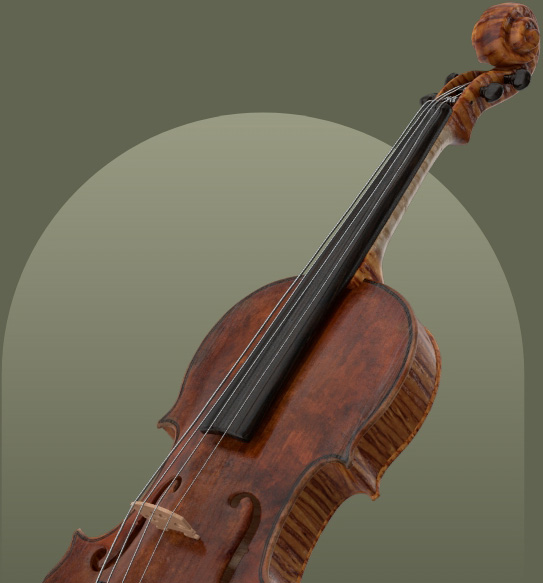
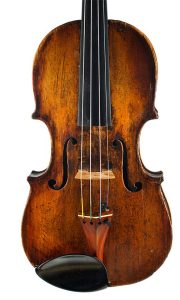
John Delany was a Dublin-based cabinet-maker and part-time violin maker active from approximately 1795 to 1812. While his output was sometimes inconsistent in quality, he was known for producing instruments with a good, clear, and sweet tone, often following Amati or Stainer models. His violins typically featured plain, unpurfled wood, open and somewhat short soundholes, and blunt corners. Delany is particularly remembered for his distinctive and self-aggrandizing labels, which expressed his desire for his memory to be perpetuated through his craft. A violin by Delany is housed in the National Museum, Dublin, and he is noted to have worked from 17 Britain Street, Dublin, in 1808.
Auction Price History
Highest auction price
6 results
| Type | Details | Auction house | Sold | Price |
|---|---|---|---|---|
| Small Violin | Stamped Delaney Dublin on upper back, minor repairs to table and back, minor worm damage Lot 62 | — | May 2019 | £384est. £ 300-500 |
| Small Violin | Stamped Delaney Dublin on upper back, minor repairs to table and back, minor worm damage Lot 59 | — | October 2016 | £300est. £ 600-1,000 |
| Violin | Unlabelled, branded beneath the upper button Delaney, Dublin Lot 186 | — | March 2014 | £1,320est. £ 700-1,000 |
| Violin | 1800 c. | — | April 1987 | £990 |
| Violin | 1800 c. | — | November 1980 | £1,045 |
| Violin | 1800 c. | — | May 1980 | £352 |
No results match those filters.
Maker Overview
Life
John Delany (circa 1795-1812) was an Irish craftsman active in Dublin, Republic of Ireland. Primarily a cabinet-maker, he also worked as a part-time violin maker, with his period of activity noted by John Dilworth as circa 1795-1812. Delany is particularly recognized for his distinctive labels, which, expressed a strong self-confidence and a desire to perpetuate his memory through his instruments.
Characteristics
- Output Quality
- output was rather inconsistent and generally of a fairly low standard.
- Models
- He followed the Amati model, and also produced instruments of a small Amati or Stainer type model. Lütgendorff observed that he imitated the Italians quite well.
- Wood
- Instruments often featured plain wood, with the back cut on the slab, as detailed by William Meredith Morris.
- Purfling
- William Meredith Morris noted that his instruments were typically unpurfled.
- Soundholes
- Characteristically, his violins had open soundholes, which William Meredith Morris further described as rather short and wide.
- Corners
- The corners of his instruments were short, or a little blunt.
- Varnish
- William Meredith Morris described the varnish as originally dark yellow, which often turned nearly black over time.
- Tone
- Despite inconsistencies, William Meredith Morris reported that Delany was very successful in producing a good tone, describing one violin as having a clear and sweet tone.
- Collaborations
- John Dilworth mentions that Delany undertook some work for Perry.
- Made by John Delany
No 17 Britain Street
Dublin 1808John Dilworth - Made by John Delany
in order to perpetuate his memory
in future ages
Dublin 1808
Liberty to all the world, black and whiteJohn Dilworth
Influence and legacy
- Museum Holdings: A violin made by John Delany is preserved in the National Museum, Dublin, as documented by John Dilworth.
- Distinctive Labels: Delany is well-known for his unique labels, which are a significant part of his legacy. Cecie Stainer noted he used two types, one very small and one very large. George Hart and William Meredith Morris provide examples:
- Label Type 1: "MADE BY JOHN DELANY, NO. 17, BRITAIN STREET, DUBLIN, 1808."
- Label Type 2: "MADE BY JOHN DELANY, IN ORDER TO PERPETUATE HIS MEMORY IN FUTURE AGES, DUBLIN, 1808. LIBERTY TO ALL THE WORLD, BLACK AND WHITE." This second label, and Hart, explicitly states his ambition for lasting recognition.
Further Information
- Workshop Location: His workshop was located at No. 17 Britain Street, Dublin, as indicated on his labels from 1808 (Dilworth, Morris, Hart).
Biographies
The overview above is drawn from the following published accounts. Read them in the original:
John Dilworth+
DELANY, John Worked circa. 1795-1812 Dublin Republic of Ireland Cabinet-maker and part-time violin maker. Rather inconsistent output, generally of fairly low standard. Some work done for Perry. Small Amati or Stainer type model, open soundholes, and short corners. Plain wood. One violin in National Museum, Dublin. Made by John Delany / No 17 Britain Street / Dublin 1808. Made by John Delany / in order to perpetuate his memory / in future ages / Dublin 1808 / Liberty to all the world, black and white
George Hart+
Used two kinds of labels, one of them very small— Made by John Delany, No. 17, Britain Street, Dublin. 1808. In the other which is larger, he states that he made Violins that his name might be of immortal memory. Made by John Delany, In order to perpetuate his memory in future ages. Dublin. 1808. Liberty to all the world black and white.
William Meredith Morris+
Followed the Amati model, and was very successful in producing a good tone. I saw one of his violins many years ago in Waterford, which was well made, rather small, and had a clear and sweet tone. The back was cut on the slab of plain wood, and unpurfled. The sound-holes were rather short and wide, and the corners a little blunt. The varnish, which was originally dark yellow no doubt, had turned nearly black. He used two labels : —
(1) MADE BY JOHN DELANY, NO. 17, BRITAIN STREET, DUBLIN, 1808
(2) MADE BY JOHN DELANY, IN ORDER TO PERPETUATE HIS MEMORY IN FUTURE AGES, DUBLIN, 1808. LIBERTY TO ALL THE WORLD, BLACK AND WHITE
Cecie Stainer+
A maker in Dublin in 1808, is best known by his labels, the one very small, the other very large.
Willibald Leo Lütgendorff+
Er ahmte zwar die Italiener recht gut nach, doch scheint er ein allzu starkes
Selbstbewusstsein gehabt zu haben, denn nach seinem Zettel baute er seine
Geigen, um sein Andenken in künftigen Zeiten zu erhalten. In unseren Tagen
hatte er sie wohl »ein Document englischer Kunst« genannt.
Sell your instrument with Amati
Get started by uploading photos of your instrument for our experts to review.
Sell your instrument with Amati
Get started by uploading photos of your instrument for our experts to review.