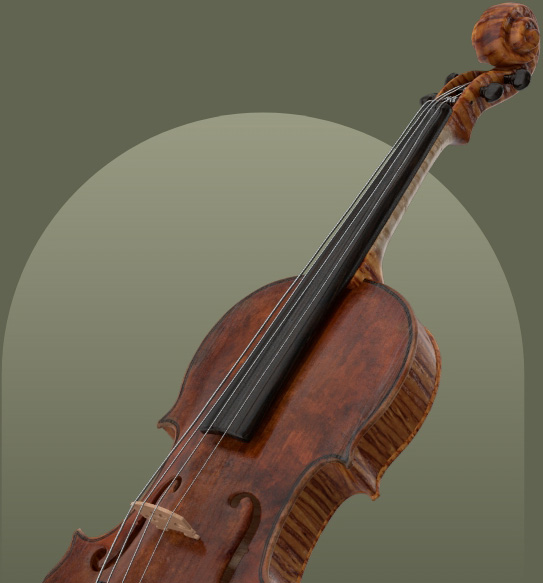
Nicolaus Diehl
Darmstadt, Mainz, 1779–1851
Nicolaus Diehl (1779-1851) was a German luthier, born in Mainz and active in Darmstadt from 1811. The second son of Martin Diehl (I), he trained with his father and his uncle, Jacob Steininger of Frankfurt. He succeeded his father's business and was appointed repairer to the Grand Duke of Hesse. Known as the most refined craftsman in his family, his work evolved from a 'Klotz-like' style to an Italian-influenced model with French precision, particularly noted in his ornately carved cello heads. His contrabasses were considered his finest instruments.
Request an expert valuation or learn how our global auctions achieve the highest prices for your instruments.
Auction Price History
Highest auction price
6 results
| Type | Details | Auction house | Sold | Price |
|---|---|---|---|---|
| Violin | Two-piece back of faint medium fine curl, varnish of a light reddish brown colour on a golden ground Lot 111 | — | October 2018 | £3,120est. £ 2,000-3,000 |
| Viola | Labelled NICOLAUS DIEHL, DARMSTADT, 1840 Lot 366 | — | November 2013 | £2,410est. $ 1,800-2,400 |
| Violin | Bearing the maker's label Lot 29 | — | April 2013 | £4,664est. $ 4,000-6,000 |
| Cello | 73.9 cm Darmstadt, 1826 | — | December 2007 | £2,383 |
| Violin | Darmstadt, 1845 | — | November 2005 | £3,948 |
| Violin | 1825 | — | May 1986 | £1,980 |
No results match those filters.
Maker Overview
Life
Nicolaus Diehl (1779-1851) was born in 1779 in Mainz and died in 1851 in Darmstadt, Germany, as documented by John Dilworth. He was the second son of Martin Diehl (I) and worked alongside his father and his uncle, Jacob Steininger of Frankfurt, who was also his teacher, and Cecie Stainer. Nicolaus Diehl established his workshop in Darmstadt from 1811, succeeding his father's business. He was appointed as the repairer to the Grand Duke of Hesse, or grossherzoglich hessischer Hoflauten- und Geigenmacher.
Characteristics
- Workmanship
- John Dilworth describes Nicolaus Diehl as the most refined workman of his family.
- Model Development
- His early work exhibited a 'Klotz-like' character, but he later developed a more Italian-influenced model that aspired to French levels of precision.
- Cello Characteristics
- This precision is particularly evident in the ornately carved heads of some of his cellos, crafted in the Lafleur manner. These cellos often featured slightly over-large soundholes.
- Varnish
- Sources contain conflicting information regarding his varnish. John Dilworth notes he used well-coloured but thin varnish, while Willibald Leo Lütgendorff states his wood and gold-yellow varnish were usually good.
- Specialization
- Willibald Leo Lütgendorff indicates that while his work was very similar to that of his brother Johann, his contrabasses were considered his best instruments.
- Nicolaus Diehl
Grossherzogl:Hessischer
Hof-Lauten u Geigenmacher
in Darmstadt, 18..John Dilworth
Influence and legacy
- Family Training: Nicolaus Diehl worked with his father, Martin Diehl (I).
- Mentorship: He also worked with and was a pupil of his uncle, Jacob Steininger of Frankfurt, and Willibald Leo Lütgendorff.
- Official Appointment: Nicolaus Diehl held the title of repairer to the Grand Duke of Hesse, or grossherzoglich hessischer Hoflauten- und Geigenmacher, in Darmstadt.
- Family Reputation: He was regarded as the most refined workman within the Diehl family.
Further Information
- Workshop Location: Nicolaus Diehl's workshop was established in Darmstadt from 1811.
- Label Inscription: An example of his label reads: "Nicolaus Diehl / Grossherzogl:Hessischer / Hof-Lauten u Geigenmacher / in Darmstadt, 18.."
Biographies
The overview above is drawn from the following published accounts. Read them in the original:
John Dilworth+
DIEHL, Nicolaus Born 1779 Mainz, died 1851 Darmstadt Germany. Second son of Martin Diehl (I), above. Worked with his father and his uncle Jacob Steininger. Established in Darmstadt from 1811. Repairer to the Grand Duke of Hesse. The most refined workman of the family. Although early work is still a little Klotz-like, he developed a more Italian influenced model which even aspires to French levels of precision. This is especially reflected in the heads of some cellos which are ornately carved in the Lafleur manner. These cellos often seem to have slightly over-large soundholes. Well-coloured but thin varnish. Nicolaus Diehl / Grossherzogl:Hessischer / Hof-Lauten u Geigenmacher / in Darmstadt, 18..
George Hart+
Son of Martin, worked with his uncle Jacob Steininger of Frankfort. He succeeded to the business of his father. Died 1851.
Cecie Stainer+
b. 1779 ; d. 1851. Son of Martin Diehl, to whose business he succeeded. First worked with his uncle, Jacob Steininger, of Frankfort.
Willibald Leo Lütgendorff+
Sohn von Martin D. und dessen Nachfolger, Schüler seines Oheims Jak. Staininger in Frankfurt a. M. Um das Jahr 1811 verlegte er seine Werkstatt nach Darmstadt, wo er grossherzoglich hessischer Hoflauten- und Geigenmacher wurde. In der Arbeit steht er seinem Bruder Johann sehr nahe, am besten gelangen ihm jedoch Contrabässe ; sein Holz und sein gold-gelber Lack sind gewöhnlich gut.
Sell your instrument with Amati
Get started by uploading photos of your instrument for our experts to review.
Sell your instrument with Amati
Get started by uploading photos of your instrument for our experts to review.