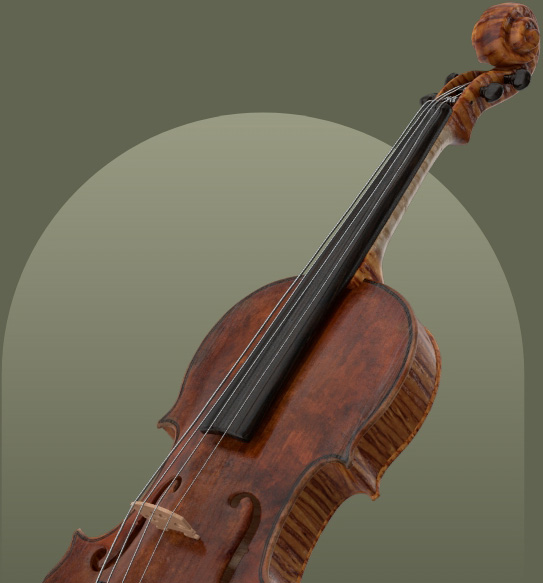
Richard (II) Duke
London, worked 1764–1792
Richard (II) Duke, active from circa 1764 to 1792 in London, was the son and pupil of the elder Richard Duke. Despite his training, he was considered an inferior craftsman, producing cheaper quality instruments often based on the Stainer model with painted purfling. He experienced estrangement from his family business and eventually resorted to selling roughly worked violins, having brought the Duke name into disrepute due to his lack of talent.
Request an expert valuation or learn how our global auctions achieve the highest prices for your instruments.
Auction Price History
Highest auction price
50 results
| Type | Details | Auction house | Sold | Price |
|---|---|---|---|---|
| Violin | various table brusing Lot 133 | Gardiner Houlgate | October 2025 | £2,684est. £ 2,500-3,500 |
| Violin | Branded Duke London on the button, head probably Viennese of the same period Lot 30 | Ingles & Hayday | March 2019 | £10,800est. £ 5,000-7,000 |
| Violin | Labelled Richard Duke, Kolborn, London anno ..., branded to the button Duke, London Lot 152 | Tarisio | November 2017 | £3,683est. $ 4,000-6,000 |
| Viola | Unlabelled, stamped on the back Duke Lot 102 | Brompton’s | October 2017 | £4,560est. £ 2,000-3,000 |
| Violin | Unlabelled, branded on upper back DUKE Lot 117 | Brompton’s | June 2017 | £3,599est. £ 3,000-5,000 |
| Violin | Labelled Richd. Duke in Holborn, London fecit 1779, branded Duke, London on the back near the button Lot 17 | Ingles & Hayday | March 2016 | £2,640est. £ 2,500-3,500 |
| Violin | Labelled Jacobus Stainer ..., branded beneath the upper button Duke London Lot 53 | Brompton’s | October 2014 | £7,200est. £ 6,000-8,000 |
| Violin | After Stainer, branded Duke London Lot 252 | Brompton’s | October 2014 | £4,800est. £ 4,000-6,000 |
| Violin | Labelled Made by Richard Duke, London, 1792, signed and dated in his own writing inside Lot 7 | Sotheby's | March 2012 | £6,875est. £ 4,000-6,000 |
| Cello | 73.8 cm London, 1780 c. | — | May 2011 | £3,196 |
| Violin | 35.3 cm 1800 c. Attributed to | — | March 2010 | £2,880 |
| Violin | 35.0 cm Richard Duke, 1790 c. Workshop of | — | February 2010 | £1,078 |
| Violin | 35.9 cm London, 1770 c. Attributed to | — | March 2009 | £3,120 |
| Viola | 38.0 cm 1810 c. Attributed to | — | March 2009 | £2,520 |
| Violin | 35.3 cm London, 1780 c. | — | June 2008 | £815 |
| Viola | 39.5 cm 1770 c. | — | May 2008 | £2,409 |
| Violin | 35.7 cm London, 1770 c. | — | March 2008 | £6,875 |
| Cello | 75.0 cm London, 1790 c. | — | July 2007 | £7,440 |
| Violin | 35.8 cm London, 1770 c. | — | November 2006 | £1,800 |
| Violin | 35.4 cm London, 1770 c. | — | April 2006 | £4,560 |
| Violin | London, 1770 c. | — | October 2005 | £2,293 |
| Cello | London, 1776 | — | May 2005 | £12,000 |
| Violin | London, 1770 c. | — | June 2004 | £2,674 |
| Violin | 1770 c. | — | November 2003 | £1,763 |
| Violin | 1770 | — | September 2003 | £3,407 |
| Violin | 1780 | — | March 2003 | £3,600 |
| Violin | 1780 | — | November 2001 | £2,200 |
| Violin | 1760 | — | September 2001 | £4,340 |
| Violin | 1770 | — | June 2001 | £7,800 |
| Violin | 1770 | — | February 2001 | £2,165 |
| Viola | 37.6 cm 1782 | — | November 2000 | £1,610 |
| Violin | 1770 | — | June 2000 | £1,725 |
| Violin | 1780 | — | June 2000 | £1,150 |
| Violin | 1780 | — | March 1999 | £4,000 |
| Violin | 1775-99 | — | June 1997 | £4,025 |
| Violin | 1770 c. | — | November 1996 | £6,900 |
| Violin | 1770 | — | March 1996 | £3,220 |
| Viola | 37.8 cm 1770 c. | — | March 1996 | £2,070 |
| Violin | 1777 | — | November 1995 | £4,370 |
| Violin | 1790 c. | — | June 1995 | £1,610 |
| Violin | 1780 | — | June 1995 | £1,035 |
| Violin | 1780 | — | March 1995 | £2,300 |
| Violin | 1770 c. | — | November 1994 | £2,070 |
| Cello | 38.7 cm 1768 | — | November 1993 | £1,380 |
| Violin | 18-- | — | October 1993 | £2,530 |
| Cello | 38.7 cm 1768 | — | July 1992 | £660 |
| Viola | 37.8 cm 1770 c. | — | June 1990 | £2,420 |
| Viola | 37.9 cm 1770 c. | — | March 1990 | £3,300 |
| Viola | 39.5 cm 1780 c. | — | June 1988 | £1,870 |
| Viola | 41.3 cm 1790 c. | — | November 1987 | £682 |
No results match those filters.
Maker Overview
Life
Richard (II) Duke (circa. 1764-1792) worked in London, UK, and was the son and pupil of Richard Duke (I). According to The Brompton's Book of Violin & Bow Makers by John Dilworth, his earliest authenticated work gives his address as 'near the Eagle in Eagle Street'. By 1773, he used the same address as his father in Holborn, but by 1777, he had moved to Great Ormond Street. John Dilworth also notes that the terms of Richard (I)'s will indicate an estrangement between father and son, resulting in Richard (II) not benefiting from the family business. Willibald Leo Lütgendorff, in Die Geigen- und Lautenmacher vom Mittelalter bis zur Gegenwart, states that Richard (II) had little talent and eventually fell into such decline that he had to make a living as a peddler with his roughly worked violins.
Characteristics
- Workmanship
- Instruments produced by Richard (II) Duke were considered inferior to his father's in British Violin Makers. Willibald Leo Lütgendorff describes his violins as 'roh gearbeiteten Geigen' (roughly worked violins), indicating his lack of talent.
- Models
- He supplied cheaper quality trade work on the old Stainer model, featuring painted purfling and a very full arch.
- Labeling
- William Meredith Morris states that he usually left his instruments unlabelled.
- Duke, Junr.
London 1771John Dilworth
Influence and legacy
- Mentorship: Richard (II) Duke was the son and pupil of Richard Duke (I), a fact corroborated by John Dilworth, William Meredith Morris, and Cecie Stainer in A Dictionary of Violin Makers.
Further Information
- Addresses: His early address was 'near the Eagle in Eagle Street', later moving to his father's address in Holborn in 1773, and by 1777, he was located in Great Ormond Street, as detailed by John Dilworth.
- Branding: He branded his instruments similarly to his father, often near the button on the back, sometimes adding 'London' below, as mentioned by Cecie Stainer. John Dilworth notes an example of his branding as 'Duke, Junr. / London 1771'.
- Sales: Some of his instruments were sold by J. & J. Simpson, according to John Dilworth.
Biographies
The overview above is drawn from the following published accounts. Read them in the original:
John Dilworth+
DUKE, Richard (II) Worked circa. 1764-1792 London UK. Son and pupil of Richard Duke (I), above. Address given in earliest authenticated work says that he was established ‘near the Eagle in Eagle Street’. In 1773 he used the same address as his father in Holborn, but by 1777 he was in Great Ormond Street. It is clear from the terms of Richard (I)’s will that father and son became estranged and Richard (II) did not benefit from the family business. He subsequently supplied cheaper quality trade work on the old Stainer model with painted purfling and very full arch. Some of these were sold by J. & J. Simpson. Duke, Junr. / London 1771
William Meredith Morris+
Son and pupil of the preceding. The few instruments of his make which remain show that he was inferior to his father as a workman. He branded his violins similarly to his father, and usually left them unlabelled.
Cecie Stainer+
Son of Richard Duke, sen., with whom he apparently learnt his trade. He was not so successful, however. Both father and son generally branded their instruments on the back, near the button, with their surname, sometimes adding ” London” below.
Willibald Leo Lütgendorff+
Seiner Arbeit nach zweifellos ein Schüler seines Vaters. Er verwendete
auch den gleichen Brandstempel, hat aber den Namen Duke sehr in Misscredit
gebracht, denn er hatte wenig Talent und kam schliesslich so herunter, dass er
mit seinen roh gearbeiteten Geigen als Hausirer sein Leben fristen musste.
Sell your instrument with Amati
Get started by uploading photos of your instrument for our experts to review.
Sell your instrument with Amati
Get started by uploading photos of your instrument for our experts to review.