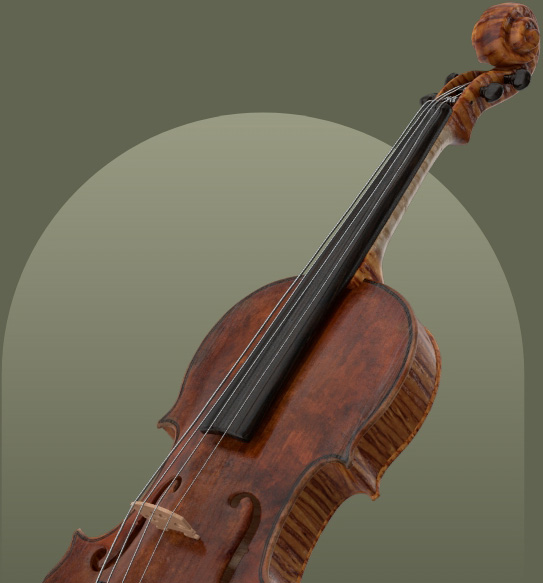
William (II) Forster
Brampton, London, 1739–1808
William (II) Forster (1739-1808), known as ‘Old Forster’, was a highly influential English luthier and the most significant maker of his family. Born in Brampton, Cumbria, he moved to London around 1759, eventually establishing his own successful workshop at 348 The Strand. A versatile craftsman, he initially copied Stainer models before transitioning to Amati patterns around 1772, producing instruments of very fine workmanship, particularly his sought-after violoncellos. He developed a distinctive varnish, sometimes using fossil amber, and his instruments were highly regarded, earning him a Royal Warrant from the Prince of Wales and patronage from King George III. Forster also ventured into music publishing, notably contracting with Haydn. His detailed output records and preserved diary offer valuable insights into 18th-century English lutherie.
Auction Price History
Highest auction price
71 results
| Type | Details | Auction house | Sold | Price |
|---|---|---|---|---|
| Viola | Labelled William Forster Violin, Violoncello, Tenor and Bow-maker to their Royal Highnesses the ... Lot 29 | Tarisio | March 2026 | £19,200est. Estimate £ 7,000-10,000 |
| Viola | Peter Voigt collection, two-piece back, varnish of a reddish brown colour on a golden ground Lot 130 | Gardiner Houlgate | October 2025 | £6,100est. £ 5,000-8,000 |
| Violin | Labelled William Forster Violin, Violoncello, Tenor & Bow-maker to their Royal Highnesses the ... Lot 86 | Tarisio | September 2025 | £14,679est. € 15.000-22.000 |
| Viola | Labelled Forster London 1775, Amatus copy Lot 19 | Tarisio | May 2024 | £10,146est. € 10.000-15.000 |
| Violin | Labelled David Dechler fecit in Roma. Anno 1724 Lot 143 | Ingles & H. | March 2024 | £7,200est. £ 5,000-8,000 |
| Violin | A violin by William Forster II (Old Forster), London, circa 1780 Lot 61 | Amati | January 2023 | £4,424est. £ 4,000-8,000 |
| Small Cello | Labelled William Forster Junr, Violin, Violoncello, Tenor & Bow maker, also Music Seller, to their ... Lot 130 | Ingles & Hayday | March 2017 | £78,000est. £ 50,000-70,000 |
| Small Cello | Later varnish Lot 247 | Brompton’s | December 2016 | £10,200est. £ 10,000-15,000 |
| Violin | Labelled with signature William Forster, Violin, Violoncello, Tenor & Bow Maker, to their ..., scroll later Lot 90 | Ingles & Hayday | October 2016 | £3,300est. £ 3,000-5,000 |
| Viola | Labelled William Forster Violin maker ... bow maker ... London Lot 111 | Brompton’s | October 2013 | £6,840est. £ 6,000-10,000 |
| Cello | Labelled William Forster, London, signed to the lower rib and dated 1810 Lot 128 | Tarisio | November 2012 | £22,470est. $ 30,000-50,000 |
| Small Cello | Labelled William Forster ..., branded to the uncut lower rib 1803 and HAH (the Reverend H. A. Hole) Lot 129 | Tarisio | November 2012 | £28,088est. $ 40,000-60,000 |
| Cello | Labelled William Forster, Violin, Violoncello and Bow Maker to their Royal Highnesses The Prince of ... Lot 130 | Brompton’s | March 2012 | £33,600est. £ 30,000-40,000 |
| Violin | 35.3 cm London, 1780 c. | — | November 2011 | £12,029 |
| Violin | Lot 74 | Bonhams | October 2011 | £2,625 |
| Violin | 35.4 cm London, 1790 c. Attributed to | — | October 2011 | £2,625 |
| Viola | 39.7 cm London, 1800 c. Attributed to | — | October 2010 | £5,400 |
| Cello | 73.5 cm London, 1789 (sold with "W.E. Hill" bow) | — | September 2010 | £28,800 |
| Viola | 39.5 cm London, 1783 | — | April 2010 | £14,926 |
| Viola | 59.5 cm London, 1790 c. | — | March 2010 | £4,800 |
| Violin | 35.3 cm London, 1780 c. | — | March 2010 | £10,000 |
| Violin | 35.6 cm London, 1785 c. | — | October 2009 | £6,367 |
| Cello | 73.4 cm London, 1790 c. | — | October 2009 | £24,000 |
| Violin | 35.3 cm London, 1776 | — | March 2009 | £2,500 |
| Violin | 35.8 cm London, 1790 c. | — | March 2009 | £4,628 |
| Cello | 73.5 cm London, 1780 c. | — | November 2008 | £56,316 |
| Violin | 35.3 cm London, 1785 c. | — | March 2008 | £5,000 |
| Cello | 73.7 cm 1780 c. | — | May 2007 | £27,447 |
| Violin | 35.3 cm London, 1780 c. | — | May 2007 | £6,625 |
| Violin | 35.3 cm London, 1780 c. | — | October 2006 | £4,291 |
| Cello | 73.8 cm London, 1795 c. | — | May 2006 | £24,527 |
| Violin | 35.3 cm London, 1780 c. | — | May 2006 | £6,745 |
| Cello | 73.7 cm London, 1807 | — | February 2006 | £9,600 |
| Violin | London, 1780 c. | — | May 2005 | £4,359 |
| Cello | London, 1775 c. | — | May 2005 | £33,581 |
| Cello | 1790 c. | — | September 2004 | £3,107 |
| Cello | London | — | May 2004 | £7,077 |
| Cello | 1814 | — | November 2003 | £10,800 |
| Viola | 39.4 cm 1784 | — | July 2003 | £7,200 |
| Violin Bow | I/I 63 g. | — | November 2002 | £2,151 |
| Violin | 1780 | — | June 2002 | £6,816 |
| Cello | 1778 | — | November 2001 | £32,900 |
| Viola | 39.5 cm 1777 | — | June 2001 | £9,000 |
| Cello | 1790 | — | February 2001 | £6,325 |
| Cello | 1795 | — | November 2000 | £11,500 |
| Violin | 1780 | — | November 2000 | £1,206 |
| Viola | 39.3 cm 1775 | — | October 2000 | £6,846 |
| Cello Bow | I/I 73 g. | — | November 1999 | £1,495 |
| Cello | 1793 | — | October 1999 | £15,818 |
| Violin | 1775 | — | November 1998 | £4,370 |
| Cello | 1780 | — | November 1998 | £18,400 |
| Viola | 39.7 cm 1777 | — | November 1998 | £7,620 |
| Cello | 1790 | — | October 1998 | £17,250 |
| Cello | 1790 c. | — | November 1996 | £20,700 |
| Violin | 1775 | — | November 1996 | £1,955 |
| Viola | 38.3 cm 1790 | — | August 1996 | £2,070 |
| Cello | 1780 | — | June 1996 | £17,250 |
| Violin | 1770 c. | — | December 1995 | £2,875 |
| Cello | 1790 | — | December 1995 | £22,421 |
| Viola | 39.5 cm 1775 | — | October 1995 | £6,900 |
| Viola | 39.4 cm 1775 | — | June 1995 | £11,500 |
| Cello | 1782 | — | December 1994 | £29,487 |
| Violin | 1774 | — | November 1994 | £3,450 |
| Viola | 38.1 cm 1790 | — | October 1994 | £1,955 |
| Violin | 1780 c. | — | March 1993 | £5,280 |
| Viola | 39.4 cm 1778 | — | March 1992 | £5,500 |
| Violin | 1790 c. | — | November 1991 | £2,420 |
| Violin | 1770 c. | — | June 1991 | £2,750 |
| Viola | 39.7 cm 1791 | — | June 1989 | £3,850 |
| Viola | 39.8 cm 1790 c. | — | September 1983 | £2,420 |
| Viola | 38.1 cm | — | February 1982 | £535 |
No results match those filters.
Maker Overview
Life
William (II) Forster (1739-1808), known as 'Old Forster', was born in May 1739 in Brampton, Cumbria, and died on December 14, 1808, in London, UK. He was the son and pupil of William Forster (I), learning both gun-making and violin-making from his father. Around 1759, he moved to London, initially to Commercial Road, and found employment in a music shop run by Beck on Tower Hill, where he remained for about two years making fiddles. Shortly thereafter, he established his own independent business at Duke's Court, St. Martin's Lane. By 1762, he was located at 33 St. Martin's Lane and soon received a Royal Warrant from the Prince of Wales. In 1781, he contracted with Haydn to publish his works in England. By 1785, he settled at 348 Exeter Exchange, The Strand, where he was assisted by his son, William (III). His commercial success is evidenced by the issue of a copper token stamped 'Wm Forster, Violin, Tenor, and Violoncello Maker, No. 348, Strand' featuring the Prince of Wales' feathers, with the melody of 'God save the King', a Crown, and the date 1795 on the reverse. was a 'Jack of all trades' and master of more than one, having been a spinning-wheel maker, gun-stock maker, cattle driver, publisher, and fiddler before rising to the rank of instrument maker to the Court.
Characteristics
- Instrument Types
- William (II) Forster produced violins, violoncellos, tenors (violas), and double basses (Dilworth, Morris, Stainer).
- Models
- He initially followed the Stainer model from 1762 to 1772, after which he exclusively adopted Amati patterns, specifically those of Antonio and Girolamo Amati, and Nicola Amati (Dilworth, Morris, Stainer, Hart). His Stainer copies are noted as very good, though Morris suggests they do not compare to instruments by Duke in terms of finish and tone. His Amati copies, however, are considered much better, being solid and well-finished, and represent his best workmanship (Morris).
- Varnish
- Forster employed various varnishes. Early instruments featured spirit varnish, while better classes used a richer dark red varnish, and his best instruments were finished with a rich orange-red oil varnish (Dilworth). Morris notes a dark, golden amber varnish on a beautiful Amati copy. Stainer mentions "amber-coloured" and dark red-coloured cellos, noting the latter were often better stocked with wood. Towards the end of his life, he is said to have used fossil amber as the basis for his varnish, assisted by a chemist named Delaporte (Morris, Hart).
- Grades of Instruments
- , he produced three grades: those with painted purfling and spirit varnish; a better class with purfling and a richer dark red varnish; and the best with a rich orange-red oil varnish.
- Workmanship Details
- His scrolls are described as exaggerated forms of the Stainer model, featuring a strongly tapered and slightly weak pegbox, well-turned but with a large boss and strong chamfer. The purfling is generally brought right to the end of the long corners in an extended mitre (Dilworth).
- Cellos
- His violoncellos are particularly sought-after, with many made on a distinctive shortened Amati model (Dilworth). He varied his cello models considerably, sometimes widening the waist, flattening the upper bouts, or narrowing the width and lengthening the body (Morris). Their tone is described as excellent (Morris).
- Double Basses
- He made only four double basses, three of which were for the private band of King George III (Morris, Stainer, Hart).
- Violas
- Many of his violas are noted as having a very short body length, making them somewhat inadequate for modern orchestral use (Dilworth).
- Signing
- Instruments are signed and numbered in ink beneath the endpin (Dilworth).
- Assistants
- He was assisted in instrument production by Thomas Powell and John Carter, among others (Dilworth).
- Specific Dimensions
- Morris provides dimensions for a beautiful Amati copy violin: Length of body 13 13/16ins, Width across upper bouts 6 11/32ins, Width across middle bouts 4 5/16ins, Width across lower bouts 7 27/32ins, Width of C's 3 3/16ins, Length of F's 2 7/8ins, Depth of ribs at bottom 1 1/4ins, Depth of ribs at top 1 3/16ins.
- William Forster Violin Maker
in St. Martin’s Lane, London
1762John Dilworth
Influence and legacy
- Training: William (II) Forster was the son and pupil of William Forster (I), learning violin-making and gun-making from him (Dilworth, Lütgendorff, Hart).
- Mentorship: He was assisted in the manufacture of his varnish during the latter part of his life by a chemist named Delaporte (Morris, Hart).
- Market Influence: The influence of Banks from 1760 to 1790 led British players to recognize the superior merits of Amati instruments, prompting Forster to shift his modeling away from Stainer (Morris).
- Royal Patronage: He received a Royal Warrant from the Prince of Wales (Dilworth). Three of his four double basses were made for the private band of King George III (Morris, Stainer, Hart).
- Publishing: In 1781, he contracted with Haydn to publish his works in England (Dilworth).
- Esteem: His violoncellos were supplied to many celebrated soloists of the time (Dilworth) and were the favorite equipment of Robert Lindley (Hart). Lütgendorff notes that English collectors and musicians consider his work equal to Stainer's, and his violas and cellos achieve high prices.
- Commercial Success: His commercial success is indicated by the issue of a copper token stamped with his name, address, and featuring the Prince of Wales' feathers, with the melody of ‘God save the King’ on the reverse, dated 1795 (Dilworth).
- Historical Documentation: His preserved diary is considered a valuable document for the history of violin making (Lütgendorff).
- Market Value: While the value of his productions depreciated with the influx of Italian instruments, they were rapidly rising again by the time Hart wrote his book, with cellos commanding an average catalogue price of £23 between 1890 and 1900 (Morris, Hart).
Further Information
- Workshop Locations: After moving to London around 1759, he worked on Commercial Road, then established himself at Duke’s Court, St. Martin’s Lane. By 1762, he was at 33 St. Martin’s Lane, and from 1785, he settled at 348 Exeter Exchange, The Strand (Dilworth, Morris).
- Labels: Examples of his labels include: "WILLIAM FORSTER, VIOLIN MAKER, IN ST MARTIN'S LANE, LONDON, 17-" and "WILLIAM FORSTER, VIOLIN, VIOLONCELLO, TENOR, AND BOW MAKER N.B. — The above instruments are made in the best manner and finished with the original varnish ; and a copy of every Capital instrument in England may be had." (Morris, Stainer). Another label from 1762 reads: "William Forster / Violin, Violoncello, Tenor, and Bow-maker / Also Music Seller. / To their Royal Highnesses the / Prince of Wales and Duke of Cumberland / Opposite the Church. St. Martin's Lane, London / N.B. / The above instruments are made in the best manner / and finished with the original varnish / and a copy of every Capital Instrument in England / may be had." (Dilworth).
- Output Records: Most of his output is recorded in Sandys & Forster (Dilworth).
- Versatility: Morris notes that his "many-sidedness" and the "indiscrimination of his countrymen" prevented him from achieving the highest artistic fame, despite his capabilities.
Biographies
The overview above is drawn from the following published accounts. Read them in the original:
John Dilworth+
FORSTER, William (II) Born 1739 Brampton, Cumbria, died 1808 London UK. Known as ‘Old Forster’. Son and pupil of William Forster (I), above. Moved to London c.1759 to Commercial Road. Employed in a music shop run by Beck on Tower Hill (the Hill Archive lists a cittern with Beck’s signature dated 1763). Shortly after established independently at Duke’s Court, St. Martin’s Lane. In 1762 was at 33 St. Martin’s Lane and soon received the Royal Warrant from the Prince of Wales. In 1781 contracted with Haydn to publish his works in England. In 1785 settled at 348 Exeter Exchange, The Strand assisted by his son William (III). Commercial success is perhaps indicated by the issue of a copper token stamped: ‘Wm Forster, Violin, Tenor, and Violoncello Maker, No. 348, Strand’ and featuring the Prince of Wales’ feathers; on the reverse the melody of ‘God save the King’, a Crown, and the date 1795. Produced three grades of instrument: those with painted purfling and spirit varnish, a better class with purfling and a richer dark red varnish, and the best with a rich orange-red oil varnish. These were made with the help of Thomas Powell and John Carter (amongst others) on Stainer or Amati models, generally of very fine workmanship. Most of his output is recorded in Sandys & Forster (see under Simon Andrew Forster, above). Scrolls are exaggerated forms of the Stainer model with a strongly tapered and slightly weak pegbox, the scroll well-turned but with a large boss and strong chamfer. The purfling is generally brought right to the end of the long corners in an extended mitre. Cellos are particularly sought-after, many made on a distinctive shortened Amati model, and supplied to many celebrated soloists of the time. Double basses also highly regarded, but many violas of very short body length are a little inadequate for modern orchestral use. Instruments are signed and numbered in ink beneath the endpin. William Forster Violin Maker / in St. Martin’s Lane, London / 1762 William Forster / Violin, Violoncello, Tenor, and Bow-maker / Also Music Seller. / To their Royal Highnesses the / Prince of Wales and Duke of Cumberland / Opposite the Church. St. Martin’s Lane, London / N.B. / The above instruments are made in the best manner / and finished with the original varnish / and a copy of every Capital Instrument in England / may be had. [BVMA]
George Hart+
Son of William Forster… Worked with his father at Brampton in Cumberland, making spinning-wheels and Violins—two singularly diverse occupations. It was, however, to the latter industry he gave the most attention, and he soon became the great maker of his neighbourhood. He afterwards added another string to his bow, viz., that of playing country-dances at the village festivities. Thus armed with three occupations, he must have been well employed. He seems to have early discovered that his abilities required a larger field in which to show themselves to advantage, and accordingly took the usual .course in such circumstances— came to the Metropolis, in which he settled about the year 1759. He soon obtained employment at a musical instrument seller’s on Tower Hill, and gave up then and for ever the making of spinning-wheels, while by throwing all his soul into the manufacture of Violins he soon gave his master’s patrons the highest satisfaction. He ultimately commenced business on his own behalf in the neighbourhood of Duke’s Court, St. Martin’s Lane, where his abilities attracted considerable attention, and secured him the patronage of the dilettanti in the musical world. For several years he followed the path trodden by the makers of the period, and copied Stainer. His instruments of this date are very excellent both in workmanship and material, but are not equal to those of the Amati pattern, which he commenced to make about the year 1770. These are beautiful works, and have a great charm from their being so varied. Some are copies of Antonio and Girolamo Amati, variously modelled; others are copies of Niccolo Amati. The wood and varnish also varies very much, but the high standard of goodness is well maintained throughout. His varnish was, during the last twenty years of his life, very fine in quality, and in the manufacture of it he is said to have been assisted by a friend who was an excellent chemist. He made only four Double-Basses, three of which were executed for the private band of George III. Forster’s instruments were the favourite equipment of Robert Lindley, and their value in his day was far higher than at the present moment. When Lindley died, attention was turned to Italian Violoncellos, and a vast number having been brought to England, the value of Forster’s productions was very considerably depreciated; now, however, that the cultivation of stringed instrument music has been so much extended, they are rapidly rising again to their former level, Italian instruments being a luxury not obtainable by every one, and age having so benefited the tone of Forster’s Violoncellos as to render them excellent substitutes.
William Meredith Morris+
He is known as “Old Forster,” and is the greatest maker of the family. He was born May 1739, and died Dec. 14, 1808. “Old Forster” may be described as the British type of which Vuillaume was the French antitype, although they were not separated by a great span of years. He was the exact counterpart of the great Frenchman — shrewd, versatile, and worldly-wise. When French players wanted a Stradivari or a Guarneri fiddle, Vuillaume met their demands and sold them those new-old instruments which set the Seine on fire. Similarly, when the British public wanted Stainer copies, or Amati copies, or any other copies, Forster was equal to the occasion, and supplied them with their requirements. The only difference between the two men, apparently, was that the Britisher possessed in addition to the artistic sense another and sometimes inconvenient sense called “conscience.” In all other respects Forster and Vuillaume were similar. Had Forster lived amongst wiser people, that would demand Stradivari copies, his instruments would rank beside those of Vuillaume. Forster was a “Jack of all trades” and master of more than one. By turns a spinning-wheel maker, gun-stock maker, cattle driver, publisher, fiddler — he could manage to eke out an existence at any one of them. As a luthier he rose from being a humble Cumberland repairer to the rank of instrument maker to the Court. He ought to have been the greatest maker of all England, and would have been but for his many-sidedness and the indiscrimination of his countrymen. His artistic work at Brampton was confined to the repairing of old instruments, and the making of an occasional fiddle on the Stainer model. In 1759 he came to London, and after meeting with some reverses, entered the shop of one Beck, of Tower Hill, where he remained for about two years making fiddles. In 1762 he set up at Duke’s Court, whence he removed to St. Martin’s Lane. From this place he again removed to 348 Strand, where he remained for the rest of his days. He followed three models : (a) Stainer, (b) A. & H. Amati, (c) N. Amati.
He appears to have followed Stainer exclusively from 1762 to 1772, but at the latter date he put aside that model never to take it up again. From 1760 to 1790 the influence of Banks was felt far and near, and British players were awakening to the superior merits of Amati. Forster was still a young man of only thirty-three, and had the better and longer half of his life before him. When he turned his back on the German he was in possession of his full strength and able to swim fast with the flowing tide. It was not so with Duke, who had less than a third of his life to live when the star of Amati appeared on the horizon. Now was Forster’s chance.
” There is a tide in the affairs of men, Which, taken at the flood, leads on to fortune.”
Forster might have reached the broad sea of artistic fame had he not paused by the way. He dallied with the form of A. & H. Amati, and gave up much time to musical enterprise, which, although profitable both to him and to the public, kept him from looking steadily on. ” Beware of the man of one book ” is an adage which, slightly modified, is applicable in many ways. If Forster had been a man of one ideal, posterity would have rewarded him by conferring upon him the title which has been given to Banks. As matters stand he must rest content with perhaps a third place on the list. His Stainer copies are very good, but do not compare for finish and tone with, e.g., the instruments of Duke. The Amati copies are much better, being solid and well finished. When copying A. & H. Amati he was at his best as regards workmanship, and the result shows what he was capable of when at his best. But the tone of these copies is rather small and glassy. One beautiful specimen I have seen and tried : it was made of fine wood, with maple of narrow, regular, and well-defined curl, very pretty to look at, and varnished in dark, golden amber. Its principal dimensions were : —
Length of body … 13 13/16ins,
Width across upper bouts . . . 6 11/32ins,
Width across middle bouts . . . 4 5/16ins,
Width across lower bouts … 7 27/32ns,
Width of C’s … 3 3/16ins,
Length of F’s … 2 7/8ins
Depth of ribs at bottom … 1 1/4ins,
Depth of ribs at top … 1 3/16ins,
His N. Amati copies are very faithful to the original, but are never likely to lend themselves to the wiles of the forger. The same remark applies to the tenors. The violoncellos stand on an altogether higher platform. Here, delicacy of detail is not so absolutely necessary as in the smaller work, and solidity and rugged grandeur show to better advantage. His larger work is of moderately full proportions, not usually so large as the larger-sized violoncellos of Banks. But he varied his model a great deal, sometimes widening the waist, sometimes flattening the upper bouts, and sometimes narrowing the width all over and lengthening the body. The tone of the violoncellos is excellent, and was greatly appreciated in England previous to the advent of Italian instruments. It will be appreciated still more when we think it worth our while to coax the old veterans out of the sullen silence into which they have been obliged to retire. The world is tolerably free of fraudulent Forster ‘cellos. I have not seen any, but have heard of one or two. No doubt there are many genuine “Forsters” still in existence, but quite a host of them disappeared during the latter half of the nineteenth century. The average catalogue price for the violoncellos from 1890 to 1900 is £23. They will command a higher figure in the near future. Those varnished dark amber were preferred in the eighteenth century, but the red ones are more in favour to-day. The amber ones which I have seen were not so well stocked with wood as the red ones. Probably the greater thickness of the latter placed them at a slight disadvantage when new, which is the very reason why they are the better sort to-day. I do not know that it was a rule with Forster to make uniformly in this manner, and to indicate the difference in thickness by a difference in the colour of the varnish. I only point out that so far as my observation goes it was his invariable practice. He is said to have used fossil amber for the basis of his varnish towards the end of his life, in the solution of which he was assisted by Delaporte, a chemist. There is a close resemblance between the said varnish and that manufactured until recently by the Messrs. Caffyn of London. Forster made only four double-basses, three of which were for the private band of George III. Labels : —
(1) WILLIAM FORSTER, VIOLIN MAKER, IN ST MARTIN’S LANE, LONDON, 17-
(2) WILLIAM FORSTER, VIOLIN, VIOLONCELLO, TENOR, AND BOW MAKER N.B. — The above instruments are made in the best manner and finished with the original varnish ; and a copy of every capital instrument in England may be had.
Cecie Stainer+
Son of William Forster (1713-1801), b. May, 1739. at Brampton, Cumberland ; d. Dec, 14, 1808. Having worked for some time under his father, he went to London about 1759. Was first a gun-stock maker, only occasionally making violins and selling them to the dealers. About 1785 he started his business at 348, Strand. In 1762 he was making on the Stainer pattern, using brown varnish. These instruments are not equal to the later ones made on the Amati pattern. This he followed from 1772 till the end of his life, copying sometimes from Ant. and Gir. Amati, sometimes from Nicola Amati.
His violins and altos, though of fair workmanship, have not such a fine tone as his violoncellos. The latter were much liked in England, especially the ” amber-coloured ” ones (the dark red-coloured ones were really equally good). For a time they were neglected owing to the large number of Italian violoncellos sent to England, but they still sell at high prices. He only made four double-basses, three of which were for the private band of George III.
another, ” William Forster, violin, violoncello, tenor, and bow maker. N.B. The above instruments are made in the best manner and finished with the original varnish ; and a copy of every Capital instrument in England may be had.”
Willibald Leo Lütgendorff+
Sohn von William I. F., dessen Schüler er sowohl als Büchsenmacher, wie als
Geigenmacher und Musiker war. Mit etwa 20 Jahren kam er nach London
und arbeitete zunächst gelegentlich für Händler, bis er sich soviel erspart hatte,
um seine eigene Werkstatt zu eröffnen. Er ist ein vorzüglicher Meister gewesen
und unstreitig der bedeutendste aus seiner Familie. Er ahmte von 1762—1772
Stainer und dann die Amati nach, besass einen trefflichen Lack, und wenn er
auch den edlen Ton seiner Vorbilder nicht erreichte, so übertraf er sie doch sehr
oft in der Klangfülle. Die englischen Sammler und Musiker achten seine Arbeit der Stainerschen gleich, und namentlich seine Violen und Violoncelli erreichen hohe Preise. — Sein noch erhaltenes Tagebuch ist ein werthvolles Dokument zur Geschichte des Geigenbaus.
Sell your instrument with Amati
Get started by uploading photos of your instrument for our experts to review.
Sell your instrument with Amati
Get started by uploading photos of your instrument for our experts to review.