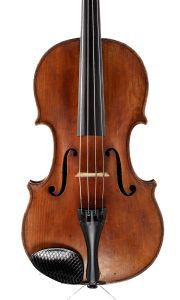
John Furber
London, b. 1780
John Furber (Born 1780, died after 1857) was a significant English violin maker, the third son and pupil of Matthew Furber, sen., and also a pupil of John Betts. He worked in various London locations, including Turnmill Street and St John's Row, and was highly regarded as a repairer. Furber was known for producing numerous high-quality violins, often following the Amati model and creating copies of Stradivari instruments, many of which were sold under the Betts label.
Request an expert valuation or learn how our global auctions achieve the highest prices for your instruments.
Auction Price History
Highest auction price
25 results
| Type | Details | Auction house | Sold | Price |
|---|---|---|---|---|
| Violin | A violin by John Furber, England, 1817 over 100 years old Lot 193 | Amati | November 2021 | £3,160est. £ 2,500-4,000 |
| Violin | A violin by John Furber, London, circa 1830 Lot 102 | Amati | January 2021 | £3,034est. £ 1,000-1,500 |
| Viola | Labelled John Furber, Maker, 13 John's Row, top of Brick Lane, Old Street, St ... Lot 39 | Brompton’s | June 2017 | £2,400est. £ 2,000-4,000 |
| Violin | 35.6 cm London, 1800 c. | — | November 2008 | £1,151 |
| Violin | 35.7 cm London, 1830 c. | — | October 2008 | £2,125 |
| Violin | 35.3 cm London, 1820 | — | June 2008 | £1,913 |
| Violin | 35.8 cm London, early 19th C. | — | March 2008 | £1,875 |
| Violin | 35.7 cm 1820 c. Attributed to | — | March 2008 | £1,200 |
| Violin | London, 1830 c. | — | March 2004 | £2,270 |
| Cello | 1814 | — | November 2001 | £3,262 |
| Cello | 1812 | — | July 2000 | £300 |
| Violin | 1817 | — | March 1999 | £2,070 |
| Violin | 1800 c. | — | June 1998 | £1,035 |
| Violin | 1810 | — | June 1998 | £1,035 |
| Violin | 1820 | — | March 1997 | £2,070 |
| Violin | 1817 | — | February 1997 | £2,070 |
| Viola | 38.7 cm 1820 c. | — | October 1993 | £2,530 |
| Viola | 41.9 cm 18-- | — | April 1993 | £5,175 |
| Violin | 1836 | — | September 1992 | £935 |
| Violin | 1800 c. | — | April 1992 | £1,045 |
| Cello | 1830 c. | — | June 1991 | £6,380 |
| Cello | 1820 | — | February 1990 | £506 |
| Cello | 1810 c. | — | April 1985 | £3,520 |
| Violin | 1812 | — | April 1985 | £410 |
| Cello | 1810 c. | — | November 1981 | £1,540 |
No results match those filters.
Maker Overview
Life
John Furber (Born 1780, died after 1857) was the third son of Matthew Furber, sen., and a pupil of his father and John Betts. John Dilworth notes that he worked in Turnmill Street in 1810 and at 10 St John's Row from 1813. In 1840 he relocated to 26 Wellington Street. Cecie Stainer adds that in 1841, he was living in Cow Cross, Smithfield. Furber was highly esteemed as a repairer and worked for J. E. Betts at the Royal Exchange, producing many instruments that bore Betts' label.
Characteristics
- Significance
- Willibald Leo Lütgendorff considered John Furber the most significant member of his family, building numerous good violins.
- Models
- He used the Amati model as a prototype and was a copyist of Stradivari and Amati, as detailed by John Dilworth. William Meredith Morris noted that he made a large number of instruments on the grand Amati pattern and some copies of the "Betts" Stradivari.
- Workmanship
- William Meredith Morris described his work as "excellent in every respect," noting a specific copy with a "broad 'flame'" wood, "golden red, mellow, tender" varnish, and a "clear and penetrating" tone. However, the scroll was considered "somewhat stiff and over masculine."
- Characteristics
- His Amati copies were often modified, sometimes "deeply grooved and highly arched," but consistently produced a "clear and penetrating" tone.
- Branding
- Some examples are branded "Furber" below the back button.
- Maker
13 St.John’s Row, top of Brick Lane
Old Saint Luke
1813John Dilworth - John Furber, maker
10 St John’s Row, Brick Lane,
Old Street John Furber, Maker
77 Turnmill Street
Clerkenwell
1810John Dilworth
Influence and legacy
- Mentorship: John Furber was a pupil of his father, Matthew Furber, sen and John Betts.
- Market Value: William Meredith Morris observed that John Furber's best violins realized as much as £20 at the time of his writing and predicted they would sell for a higher figure in the future.
Further Information
- Addresses: John Dilworth notes his addresses included Turnmill Street in 1810, 10 St John's Row from 1813, and 26 Wellington Street in 1840. Cecie Stainer adds that he was living in Cow Cross, Smithfield, in 1841.
- Labels: His labels include "JOHN FURBER, MAKER, 13 ST. JOHN'S ROW, TOP OF BRICK LANE, OLD ST., SAINT LUKE, 1839" as cited by William Meredith Morris. Other labels mentioned by John Dilworth include "John Furber. Maker / 13 St.John's Row, top of Brick Lane / Old Saint Luke / 1813" and "John Furber, Maker / 77 Turnmill Street / Clerkenwell / 1810."
Biographies
The overview above is drawn from the following published accounts. Read them in the original:
John Dilworth+
FURBER, John Born 1780, d. after 1857 Clerkenwell, London UK. Brother of Matthew Furber (II), below, working in Turnmill Street 1810 and 10 St John’s Row from 1813. In 1840 he moved to 26 Wellington Street. Credited with most of the instruments sold and labelled by Betts in this period. A considerable and versatile craftsman. Copyist of Stradivari and Amati. Some examples branded below back button: ‘Furber’ John Furber. Maker / 13 St.John’s Row, top of Brick Lane / Old Saint Luke / 1813 John Furber, maker / 10 St John’s Row, Brick Lane, / Old Street John Furber, Maker / 77 Turnmill Street / Clerkenwell / 1810 [BVMA]
William Meredith Morris+
He was the third son of Matthew Furber, sen., and a pupil of his father and John Betts. He made a large number of instruments on the grand Amati pattern, and some copies of the ” Betts ” Stradivari, when that famous masterpiece was in the possession of Betts. His work is excellent in every respect. I quite recently saw one of these copies, and I must say that I considered it a superb example of the copyist’s art. The wood of the back was of a broad ” flame,” with the curl slanting nearly at right angles to the longitudinal axis in the direction of the lower end of the instrument. The varnish was golden red, mellow, tender, and not too thickly laid on. The tone was clear and penetrating, and very fine on the two inner strings. The only part of the work which might be considered to be lacking in depth of feeling was the scroll, which was not quite in the spirit of the master, being somewhat stiff and over masculine. His Amati copies are considerably modified in many instances, and some of them are rather deeply grooved and highly arched, but the tone is almost invariably clear and penetrating. His best violins realise as much as £20 to-day, and they will sell at a still higher figure in years to come. Furber worked for J. Betts at the Royal Exchange, and many of the fine instruments which bear Betts’ label. His own label is:-
JOHN FURBER, MAKER, 13 ST. JOHN’S ROW, TOP OF BRICK LANE, OLD ST., SAINT LUKE, 1839
Cecie Stainer+
Third son of Matthew Furber, sen. Pupil of his father, became an excellent workman and clever repairer. Made numerous violins, following the Amati pattern. He also worked for J. K. Betts at the Royal Exchange.
In 1841 he was living in Cow Cross, Smithfield.
Willibald Leo Lütgendorff+
Dritter Sohn von Matthew F. sen. und dessen Schüler. Er ist der bedeutendste aus der Familie, baute zahlreiche gute Geigen, zu denen ihm das Amatimodell als Vorbild diente. Er arbeitete auch bei J. E. Betts und war als Reparateur hochgeschätzt.
Sell your instrument with Amati
Get started by uploading photos of your instrument for our experts to review.
Sell your instrument with Amati
Get started by uploading photos of your instrument for our experts to review.
Pupils
Henry John Furber Pupil