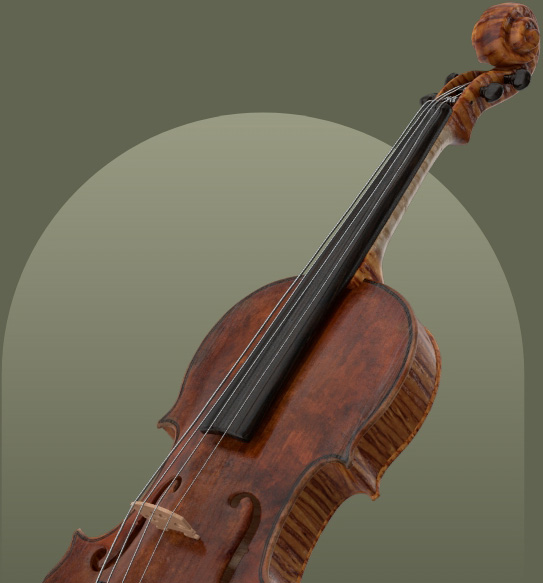
Nicola Gagliano
Auction price history
Highest auction price
£480,000
| Type | Details | Sold | Price |
|---|---|---|---|
| Violin | Labelled Nicolaus Gagliano Filius Alexandri fecit Neap. 1779 | October 2024 | £54,000 |
| Violin | Labelled Nicolaus Gagliano Filius ..., with the collaboration of his son Giuseppe, lower bass rib replaced | May 2024 | £51,830 |
| Violin | Labelled Nicolaus Gagliano filius Alexandri fecit Neap 1765 | March 2024 | £101,596 |
| Violin | October 2014 | £15,000 | |
| Violin | 35.2 cm Naples, 1770 c. | November 2011 | £97,737 |
| Cello | Naples, 1774 | October 2011 | £480,000 |
| Violin | 35.3 cm Naples (original & replacement back) [Ascribed to] | July 2011 | £31,216 |
| Violin | 35.2 cm Naples, Late 18thC. | May 2011 | £30,955 |
| Violin | 35.2 cm Naples, 1735 c. | April 2010 | £69,045 |
| Violin | 35.4 cm Naples, 1750 c. | March 2010 | £55,200 |
| Violin | 35.5 cm Naples, 1776 | October 2009 | £121,250 |
| Violin | 35.2 cm Naples, 1740 c. | April 2009 | £58,588 |
| Violin | 35.4 cm Naples, 1750 c. | March 2009 | £58,500 |
| Violin | 35.5 cm Naples, 1770 c. | October 2008 | £67,250 |
| Violin | 35.4 cm [Attributed to] | March 2008 | £8,750 |
| Violin | 35.5 cm Naples, 1740 c. [Attributed to & possibly by] | October 2007 | £39,980 |
| Violin | 35.4 cm [Attributed to] | October 2007 | £9,375 |
| Violin | 35.4 cm Naples, 1775 c. | April 2007 | £72,779 |
| Violin | 35.3 cm Naples, 1750 c. | November 2006 | £24,059 |
| Violin | 35.5 cm Naples, 1760 c. | November 2006 | £48,000 |
| Violin | 35.4 cm Naples, 1750 c. | May 2006 | £74,257 |
| Violin | Naples, 1730 c. | April 2005 | £37,596 |
| Violin | Naples, 1770 c. | February 2005 | £78,000 |
| Violin | [Ascribed to] | November 2004 | £11,711 |
| Viola | 39.0 cm Naples, 1775 | November 2004 | £40,800 |
| Violin | 1920 c. [Ascribed to] | October 2004 | £5,090 |
| Violin | 1770 c. [Attributed to] | September 2004 | £9,560 |
| Violin | Naples, 1780 c. | July 2004 | £71,700 |
| Violin | 1760 (poor condition) | November 2002 | £19,120 |
| Violin | 1759 (poor condition) | June 2002 | £10,921 |
| Violin | 1783 | November 2001 | £65,000 |
| Violin | 1765 | October 2001 | £42,553 |
| Violin | 1728 | March 2001 | £97,250 |
| Violin | 1739 | November 2000 | £69,500 |
| Violin | 1755 | May 2000 | £28,994 |
| Violin | 1731 | November 1999 | £84,000 |
| Violin | 1782 | November 1999 | £78,500 |
| Violin | 1744 | March 1999 | £87,300 |
| Violin | 1752 | November 1998 | £43,300 |
| Violin | 1760 c. | June 1998 | £49,450 |
| Violin | 1750 c. | June 1998 | £60,900 |
| Violin | 1760 c. | June 1998 | £43,300 |
| Violin | 1740 c. | March 1998 | £52,100 |
| Violin | 1738 | June 1997 | £78,500 |
| Violin | 1731 | November 1995 | £80,500 |
| Violin | 1770 c. | October 1995 | £49,900 |
| Violin | 1761 | June 1995 | £73,000 |
| Violin | 1770 c. | June 1995 | £47,700 |
| Violin | 1750 c. | March 1995 | £47,700 |
| Violin | 1780 c. (scroll later) | November 1994 | £25,300 |
| Violin | 1760 | March 1994 | £60,500 |
| Violin | 1730 | June 1993 | £27,600 |
| Violin | 173- | April 1993 | £8,625 |
| Violin | 1765 | March 1993 | £71,500 |
| Violin | 1750 c. | November 1992 | £24,200 |
| Violin | 1740 c. | June 1992 | £28,600 |
| Violin | 175- | November 1991 | £48,400 |
| Violin | 1756 | November 1990 | £27,500 |
| Violin | 1733 | June 1990 | £38,500 |
| Violin | 1750-75 | March 1990 | £13,750 |
| Violin | 1750 c. | June 1989 | £33,000 |
| Violin | 1735 | June 1988 | £27,500 |
| Violin | 1750 c. | November 1987 | £26,400 |
| Violin | 1770 c. | November 1987 | £22,000 |
| Violin | 1750 c. | April 1987 | £36,300 |
| Violin | 1752 | April 1987 | £14,300 |
| Cello | 1774 | June 1984 | £32,593 |
| Cello | 1782 | June 1982 | £21,600 |
Maker Overview
History
Nicola Gagliano, the eldest son of Alessandro Gagliano, was a prolific violin maker who worked in Naples, Italy. According to John Dilworth in The Brompton’s Book of Violin & Bow Makers, he worked circa 1730 and died in 1787. However, Cecie Stainer in A Dictionary of Violin Makers states he was born about 1675 and died about 1745 in Naples, presenting conflicting information regarding his life dates. John Dilworth also notes he was more prolific than his brother Gennaro. George Hart notes in The Violin that his violins and violoncellos were made with care, showing some originality.
Craft
- Materials: John Dilworth notes he often used maple with very strongly marked grain, a characteristic seen in work by most subsequent members of the Gagliano family. Willibald Leo Lütgendorff, in Die Geigen- und Lautenmacher vom Mittelalter bis zur Gegenwart, states he "verarbeitete sehr schönes Holz" [processed very beautiful wood].
- Methods: Willibald Leo Lütgendorff describes his construction approach: "Die Decke ließ er gewöhnlich sehr stark, den Boden machte er an den Seiten etwas schwacher" [He usually left the top very strong, making the back somewhat weaker at the sides]. Cecie Stainer states he copied the pattern of Stradivari very cleverly, both in outline, in thicknesses, and in arching. John Dilworth highlights that he instigated the typical Gagliano purfling of beech wood with stained paper outer strips, which generally causes a distinctive crazing in the varnish above it. According to Lütgendorff, "Auch die Einlagen sind mit Sorgfalt und Geschmack ausgeführt" [The inlays are also executed with care and taste].
Influence
- Training and Mentorship: Cecie Stainer records that Nicola Gagliano had four sons, all of whom became makers: Ferdinando, Giuseppe, Antonio, and Giovanni.
- Schools/Tradition: Cecie Stainer states his work was superior to that of his father. George Hart notes his instruments were not after the pattern of his father's but similar to earlier works of Stradivari, falling between the "Amatise" and the long form. Willibald Leo Lütgendorff confirms that he "ahmte im Allgemeinen die Stradivari-Modelle nach, meist die der älteren Perioden des Meisters" [generally imitated Stradivari models, mostly those from the master's earlier periods]. John Dilworth also notes his soundholes were very Stradivarian.
Legacy
- Modern Recognition: According to John Dilworth, Nicola Gagliano is generally the most admired and sought-after maker of the Gagliano family.
Further Information
- Technical Characteristics:
- Quality Consistency: John Dilworth notes his work is less consistent in quality compared to his brother Gennaro, but often shows great distinction.
- Archings: John Dilworth describes them as bold and well-proportioned. Cecie Stainer states he copied Stradivari's arching very cleverly.
- Varnish: John Dilworth notes it can vary from a rather thin, plain golden-yellow to brilliant red, laid over a good reflective ground. Cecie Stainer describes it as very transparent and rather deep in colour. George Hart states the varnish is of a deeper colour than Alessandro's and its quality is not inferior. Willibald Leo Lütgendorff describes the varnish as "rothbraun oder braungelb" [reddish-brown or brownish-yellow]. Cecie Stainer specifically mentions his violoncellos often have a fine rich varnish, not often seen on other Gagliano family instruments.
- Scrolls: John Dilworth highlights a distinctive elongated pegbox and small tight spiral. Cecie Stainer states the scroll is generally well-cut. George Hart mentions the scroll is, in some cases, well formed, in others somewhat grotesque.
- Soundholes: John Dilworth specifies they are very Stradivarian and set quite close to the edge.
- Purfling/Inlay: John Dilworth describes typical Gagliano purfling of beech wood with stained paper outer strips. Cecie Stainer mentions an ornamentation of diamond and lozenge-shaped pieces of ebony sometimes found around the purfling. George Hart corroborates this, noting instruments sometimes seen ornamented round the purfling with ebony, diamond, and lozenge shapes. Some instruments, according to Dilworth, also feature added decorative inlay around the edges and ribs, "somewhat after the manner of the decorated Stradivari violins."
- Model: Cecie Stainer states his instruments are smaller and narrower. George Hart notes the model is high.
- Tone: Cecie Stainer describes the tone as very brilliant.
- Labels: John Dilworth provides an example: "Nicolaus Gagliano Filius / Alexandri fecit Neap. 17..". Cecie Stainer gives two examples: "Nicolaus Gagliano filius Alexandri, fecit Neap., 17—," or "Nicolai Gagliano, fecit in Napoli, 1711." She also notes some instruments contain spurious labels of Stradivari. John Dilworth adds that an additional label with religious dedication is often found fixed to the upper rib inner surface. Willibald Leo Lütgendorff mentions that a label with an inscription is found inside at the base of the neck in most Gagliani violins that have not yet been opened.
- Historical Uncertainties: Sources present conflicting information regarding Nicola Gagliano's life dates. John Dilworth states he worked circa 1730 and died in 1787, while Cecie Stainer indicates he was born about 1675 and died about 1745.
Summary
Nicola Gagliano, the eldest son of Alessandro Gagliano, was a prominent Neapolitan violin maker, recognized for his prolific output and significant contributions, despite some inconsistency in quality. While his exact life dates are subject to conflicting historical accounts (circa 1730-1787 or 1675-1745), he is widely considered the most admired and sought-after maker of his family. He skillfully emulated Stradivari models, particularly those from earlier periods, employing bold and well-proportioned archings. His varnish varied greatly, ranging from a thin golden-yellow to brilliant red, and sometimes reddish-brown or brownish-yellow, often laid over a reflective ground. His violoncellos, in particular, are noted for a fine, rich varnish. Gagliano's instruments are characterized by distinctive scrolls with elongated pegboxes and small tight spirals, along with Stradivarian soundholes set close to the edge. He innovated with a typical Gagliano purfling of beech wood with stained paper outer strips and sometimes incorporated decorative inlays of ebony or other materials, echoing Stradivari's ornamental work. He was also a family patriarch, with four sons who followed in his footsteps as makers. He used beautiful, often strongly grained maple and constructed his instruments with care, showing a degree of originality.
Biographies
John Dilworth
GAGLIANO, Nicola (I) Worked circa. 1730- died 1787 Naples Italy. Son of Alessandro Gagliano, above. More prolific than his brother Gennaro, his work is less consistent in quality, but often shows great distinction. Bold and well-proportioned archings. Varnish can vary from plain rather thin golden-yellow to brilliant red, but laid over a good reflective ground. Scrolls have a distinctive elongated pegbox and small tight spiral. Soundholes very Stradivarian, set quite close to the edge. Generally the most admired and sought-after maker of the family, he instigated the typical Gagliano purfling of beech wood with stained paper outer strips, which generally causes a distinctive crazing in the varnish above it. Also often used maple with very strongly marked grain, which is seen in work by most subsequent members of the family. Some instruments with added decorative inlay around the edges and ribs, somewhat after the manner of the decorated Stradivari violins. Additional label with religious dedication often found fixed to upper rib inner surface. Nicolaus Gagliano Filius / Alexandri fecit Neap. 17..
Sell your instrument with Amati
Get started by uploading photos of your instrument for our experts to review.
Sell your instrument with Amati
Get started by uploading photos of your instrument for our experts to review.