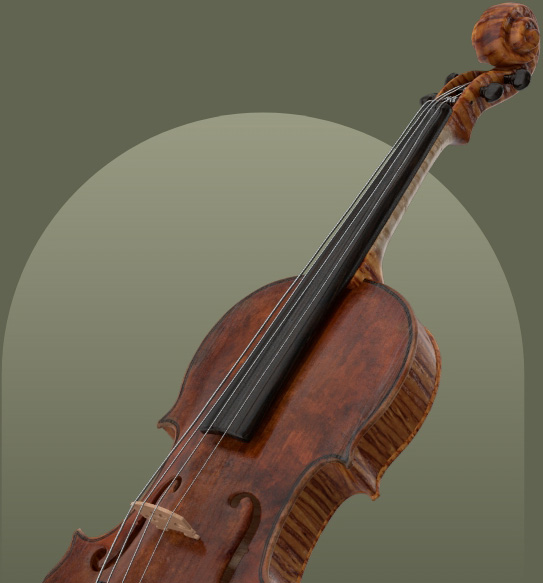
Giulio Cesare Gigli
Rome, d. 1794
GIGLI, Giulio Cesare b. c.1724, died 1794 Rome Italy. Apprenticed to Michael Platner from 1738; named successor to the workshop 1753. Comparatively rare maker, but worthy inheritor of the Tecchler and Platner tradition in Rome in the later 18th century. — John Dilworth
Request an expert valuation or learn how our global auctions achieve the highest prices for your instruments.
Auction Price History
Highest auction price
11 results
| Type | Details | Auction house | Sold | Price |
|---|---|---|---|---|
| Violin | Labelled Julius Caesar Gigli Romanus, fecit Romae anno 1760 Lot 66 | Tarisio | July 2020 | £55,671est. $ 70,000-100,000 |
| Violin | Labelled Laurentius Storioni fecit Cremonae 1799, ribs and scroll later Lot 168 | Ingles & Hayday | March 2016 | £17,400est. £ 16,000-18,000 |
| Violin | Labelled Julius Caefar Gigli Romanus, Fecit Romae Anno 1760 Lot 202 | Tarisio | October 2014 | £59,000est. £ 60,000-90,000 |
| Violin | 35.7 cm 18th C. Attributed to | — | October 2008 | £6,000 |
| Violin | 1774 | — | July 2003 | £45,750 |
| Violin | 1760 | — | June 2000 | £8,625 |
| Cello | 1757 | — | December 1999 | £30,358 |
| Violin | 1759 | — | June 1990 | £1,760 |
| Violin | 1752 | — | June 1988 | £17,600 |
| Viola | 38.1 cm 1779 | — | June 1985 | £4,620 |
| Viola | 38.1 cm 1779 | — | June 1984 | £6,519 |
No results match those filters.
Biographies
The overview above is drawn from the following published accounts. Read them in the original:
John Dilworth+
GIGLI, Giulio Cesare b. c.1724, died 1794 Rome Italy. Apprenticed to Michael Platner from 1738; named successor to the workshop 1753. Comparatively rare maker, but worthy inheritor of the Tecchler and Platner tradition in Rome in the later 18th century. Fine work; his cellos in particular are very desirable, with characteristic bold Roman modelling, built on a large scale. Violins also very beautifully made on an individual model of large form, with prominent corners and some residual Stainer influence in arching and soundholes. Very cleanly carved and concentric scroll. Julius Caesar Gigli Romanus / fecit Romae. anno 1761 [Lebet]
Cecie Stainer+
Worked in Rome about 1730-62.
Willibald Leo Lütgendorff+
Wahrscheinlich ein Sohn oder Enkel des 1640 in Rom vorkommenden
Cimbelmachers Giovanni Giglio. Wenn er im Ganzen auch nicht zu den hervorragenden Meistern gehörte, so machte er doch einige bessere Geigen nach
Amati, die in ihrem rothgelben Lack und ihrer Arbeit für ihn sprechen. Das Museum Kraus in Florenz besitzt eine Taschengeige (Violinetto No. 599) von ihm, die nicht ohne Verdienst ist.
Sell your instrument with Amati
Get started by uploading photos of your instrument for our experts to review.
Sell your instrument with Amati
Get started by uploading photos of your instrument for our experts to review.