Jeffery James Gilbert
Kent, New Romney, Peterborough, 1850–1942
Jeffery James Gilbert (1850-1942) was a highly regarded English violin maker, born in New Romney, Kent. Largely self-taught, he began his studies in 1873, influenced by his amateur maker father. He established his workshop in Peterborough by 1875/1876, later moving to Richmond in 1938. Gilbert developed his own models, showing influence from Stradivari, and was celebrated for his consistently fine workmanship, beautiful wood selection, and distinctive oil varnish, available in various colors including a notable deep red. He connected with prominent connoisseurs like Charles Reade, George Hart, and Horace Petherick, who offered valuable guidance. His instruments, known for their large, clear, and bell-like tone, earned him multiple silver and gold medals at international exhibitions in London and Edinburgh. Sources provide conflicting figures for his total instrument output, ranging from 166 to over 400 instruments.
Request an expert valuation or learn how our global auctions achieve the highest prices for your instruments.
Instruments
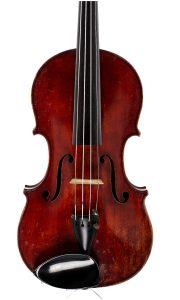
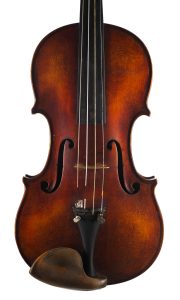
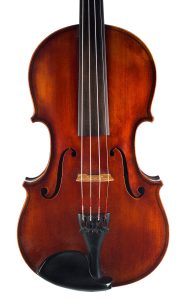

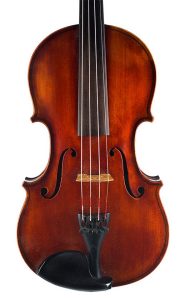
Auction Price History
Highest auction price
62 results
| Type | Details | Auction house | Sold | Price |
|---|---|---|---|---|
| Violin | A violin by Jeffrey J. Gilbert, Peterborough, 1901 Lot 124 | Amati | January 2026 | £1,643est. £ 1,000-2,000 |
| Viola | A viola by J. J. Gilbert, Peterborough, 1920 Lot 21 | Amati | June 2025 | £3,034est. £ 1,500-2,500 |
| Violin | A violin by Jeffery James Gilbert, Peterborough, 1890 Lot 160 | Amati | January 2024 | £3,034est. £ 1,500-2,500 |
| Small Cello | Two-piece back, varnish of a light reddish brown colour on a golden ground Lot 2515 | Gardiner Houlgate | December 2023 | £6,710est. £ 1,200-1,800 |
| Cello | Varnish of a reddish brown colour Lot 2520 | Gardiner Houlgate | June 2023 | £4,392est. £ 1,500-2,500 |
| Violin | Bearing the maker's label Jeffery J Gilbert Peterborough fecit anno MDCCCCI, signed, two-piece back Lot 28 | Tennants | May 2023 | £3,360est. £ 3,000-4,000 |
| Violin | A violin by Jeffrey James Gilbert, New Romney, 1880 Over 100 years old Lot 148 | Amati | June 2022 | £4,740est. £ 1,000-2,000 |
| Violin | A violin by Jeffery Gilbert, Peterborough, 1817 Lot 40 | Amati | October 2019 | £4,108est. £ 500-1,000 |
| Violin | Labelled Jean Baptiste Vuillaume à Paris ..., back by another maker Lot 2454 | Gardiner Houlgate | December 2018 | £432est. £ 400-600 |
| Violin | One-piece back of faint medium curl, varnish of an orange brown colour on a golden ground Lot 26 | Gardiner Houlgate | October 2017 | £2,880est. £ 1,200-1,800 |
| Viola | Labelled Jeffery J. Gilbert. Peterborough. Fecit. Anno MDCCCCVI Lot 233 | Brompton’s | December 2016 | £3,000est. £ 2,500-3,500 |
| Violin | Bearing the original label and numbered 61 Lot 117 | Brompton’s | December 2014 | £1,168est. £ 600-1,000 |
| Violin | Labelled Jeffery J. Gilbert, Peterborough, Fecit. Anno MDCCCCXIX Lot 522 | Gardiner Houlgate | September 2013 | £480est. £ 150-250 |
| Violin | Lot 22 | Bonhams | May 2013 | £2,250 |
| Violin | Lot 248 | Bonhams | May 2013 | £2,125 |
| Violin | Violin, 1883 Lot 22 | Bonhams | May 2013 | £2,250est. £ 1,000-1,500 |
| Violin | Violin, 1885 Lot 248 | Bonhams | May 2013 | £2,125est. £ 1,500-2,000 |
| Violin | After del Gesù, labelled Jeffrey J Gilbert. Peterbrough, Fecit Anno MDCCCCXVIII, signed and dated Lot 304 | Brompton’s | March 2013 | £2,400est. £ 2,000-3,000 |
| Violin | 35.9 cm Peterborough, 1899 | — | July 2011 | £1,469 |
| Violin | 35.8 cm Peterborough, 1929 | — | October 2010 | £2,253 |
| Violin | 35.6 cm Peterborough, 1897 | — | June 2009 | £1,560 |
| Violin | 36 cm | — | December 2007 | £541 |
| Violin | 35.6 cm English, 1933 | — | October 2007 | £1,176 |
| Violin | 35.8 cm Peterborough, 1929 | — | May 2006 | £2,146 |
| Violin | 35.6 cm Peterborough, 1911 | — | February 2006 | £1,680 |
| Viola | 40.4 cm Peterborough, 1911 | — | November 2005 | £1,560 |
| Violin | Peterborough, 1916 | — | November 2005 | £3,941 |
| Violin | Peterborough, 1933 | — | May 2005 | £1,080 |
| Violin | Petersborough, 1905 | — | November 2004 | £1,208 |
| Violin | New Romney, 1884 | — | March 2004 | £358 |
| Violin | 1899 | — | March 2003 | £1,410 |
| Violin | 1900 | — | November 2002 | £1,035 |
| Violin | 1905 | — | March 2002 | £1,400 |
| Violin | 1893 | — | March 2001 | £1,762 |
| Violin | 1933 | — | December 2000 | £1,265 |
| Violin | 1933 | — | December 2000 | £1,035 |
| Violin | 1920 | — | September 2000 | £437 |
| Cello | 1902 | — | July 1997 | £3,800 |
| Violin | 1900 c. | — | June 1996 | £1,380 |
| Viola | 42.1 cm 1910 | — | November 1995 | £1,840 |
| Violin | 1921 | — | November 1995 | £1,495 |
| Violin | 1922 | — | October 1995 | £1,955 |
| Violin | 1905 | — | October 1995 | £1,265 |
| Violin | 1917 | — | June 1995 | £2,530 |
| Viola | 41.0 cm 1906 | — | May 1995 | £2,645 |
| Violin | 1903 | — | June 1994 | £2,300 |
| Cello | 19-- | — | June 1994 | £2,750 |
| Viola | 39.7 cm 1893 | — | March 1994 | £920 |
| Violin | 1906 | — | November 1993 | £880 |
| Viola | 40.8 cm 1905 | — | April 1993 | £1,840 |
| Violin | 1889 | — | April 1993 | £920 |
| Viola | 38.4 cm 1884 | — | March 1993 | £1,265 |
| Violin | 1915 | — | March 1993 | £1,725 |
| Viola | 40.5 cm 1912 | — | April 1991 | £1,980 |
| Violin | 1898 | — | April 1991 | £1,210 |
| Viola | 39.7 cm 1919 | — | March 1990 | £2,420 |
| Cello | 1928 | — | June 1989 | £3,300 |
| Cello | 1922 | — | March 1989 | £3,850 |
| Viola | 43.2 cm 1899 | — | September 1987 | £1,650 |
| Viola | 40.6 cm 1911 | — | June 1987 | £550 |
| Cello | 1926 | — | September 1986 | £1,430 |
| Viola | 40.6 cm 18-- | — | May 1986 | £626 |
No results match those filters.
Maker Overview
Life
Jeffery James Gilbert (1850-1942) was born on August 16, 1850, in New Romney, Kent, England, to Jeffery and Eleanor Langley Gilbert. He was a direct descendant of an old Kentish family, which included notable members such as Sir Jeffery Gilbert, an accomplished exchequer baron. He received private tuition until approximately twelve years of age, followed by several years at Crockley Green Grammar School under the mastership of Mr. Thomas Dalby.
Originally intended for another career, Gilbert's father, an enthusiastic amateur musician and maker born in 1814, provided him with his initial instruction in violin making. Despite his father's attempts to discourage him and the lack of opportunities in his isolated hometown, Gilbert began his studies in 1873 in New Romney. Sources contain conflicting information regarding his relocation to Peterborough; John Dilworth states he was established in New Priestgate, Peterborough, by 1875, while William Meredith Morris notes his marriage to Miss Lily White in St. John's Church, Peterborough, in 1876. Willibald Leo Lütgendorff, however, indicates he continued his studies in New Romney until 1887, the year he moved to Peterborough. He later moved to Richmond, Surrey, in 1938, where he died in 1942.
Jeffery James Gilbert and Lily White had six children: Jeffery Francis White, Charles Clement, Catharine Eleanor, Leslie Baker, Kate Julia, and Frederick William. Gilbert's primary aim throughout his career was quality over quantity, meticulously studying each instrument during its construction.
Characteristics
- Workmanship
- Gilbert's work is praised for its commendable perfection, encompassing the beauty of the wood, form, and tone. John Dilworth notes his consistently fine workmanship, though scrolls were often a little heavy in design.
- Models
- He developed his own models, which were influenced to some extent by Stradivari. His models varied over time and were original, avoiding both vagaries and slavish copies. He worked from two distinct violin models, a viola model, a viola alta model, and an original cello model.
- Measurements (Violin Model A)
- Length of body: 14 inches; Width across upper bouts: 6 1/2 inches; Width across middle bouts: 4 3/8 inches; Width across lower bouts: 8 inches; Width of ribs at bottom: 1 1/4 inches, gradually diminishing at top to 1 3/16 inches.
- Measurements (Violin Model B)
- Length of body: 14 inches; Width across upper bouts: 6 5/8 inches; Width across middle bouts: 4 1/2 inches; Width across lower bouts: 8 1/8 inches; Ribs same as Model A.
- Measurements (Viola Model)
- Length: 16 inches; Width across upper bouts: 7 5/8 inches; Width across middle bouts: 5 1/8 inches; Width across lower bouts: 9 inches; Depth of ribs at bottom: 1 1/2 inches; Depth of ribs at top: 1 3/8 inches.
- Measurements (Viola Alta Model)
- Length: 17 inches; Width across upper bouts: 8 1/8 inches; Width across middle bouts: 5 3/8 inches; Width across lower bouts: 9 1/2 inches; Depth of ribs 1/16 inch more all over than in the viola.
- Measurements (Cello Model)
- Length: 29 3/4 inches; Width across upper bouts: 13 3/4 inches; Width across middle bouts: 9 3/4 inches; Width across lower bouts: 17 1/2 inches; Depth of ribs: 4 9/16 inches.
- Sound-holes
- The sound-holes for both violin models were 3 1/16 inches long. For both violas and viola altas, they were 3 5/8 inches long. For the cello, they were 5 11/16 inches long. Their outline was nearly identical to those of Stradivari, but not in inclination. The notch was noted as an artistic detail, and the hollowing out of the lower lip (or wing) was in the best Stradivarian style.
- Scroll
- The violin scroll was in the best Italian style, with a width from boss-edge to boss-edge of 1 9/16 inches. The depth of the peg-box at its deepest part was 15/16 inch, diminishing to 11/16 inch at the throat. The scollop was nicely rounded, and the curves of the volute were delicately scooped at the base.
- Edges and Purfling
- Edges were fairly full, emphasizing the extreme outline of the fiddle. The margin was exactly 1/8 inch wide, and the purfling, inlaid beautifully, was 1/16 inch wide.
- Wood
- The wood used was always acoustically perfect and handsome, mostly cut sur maille, though some specimens had whole tables.
- Varnish
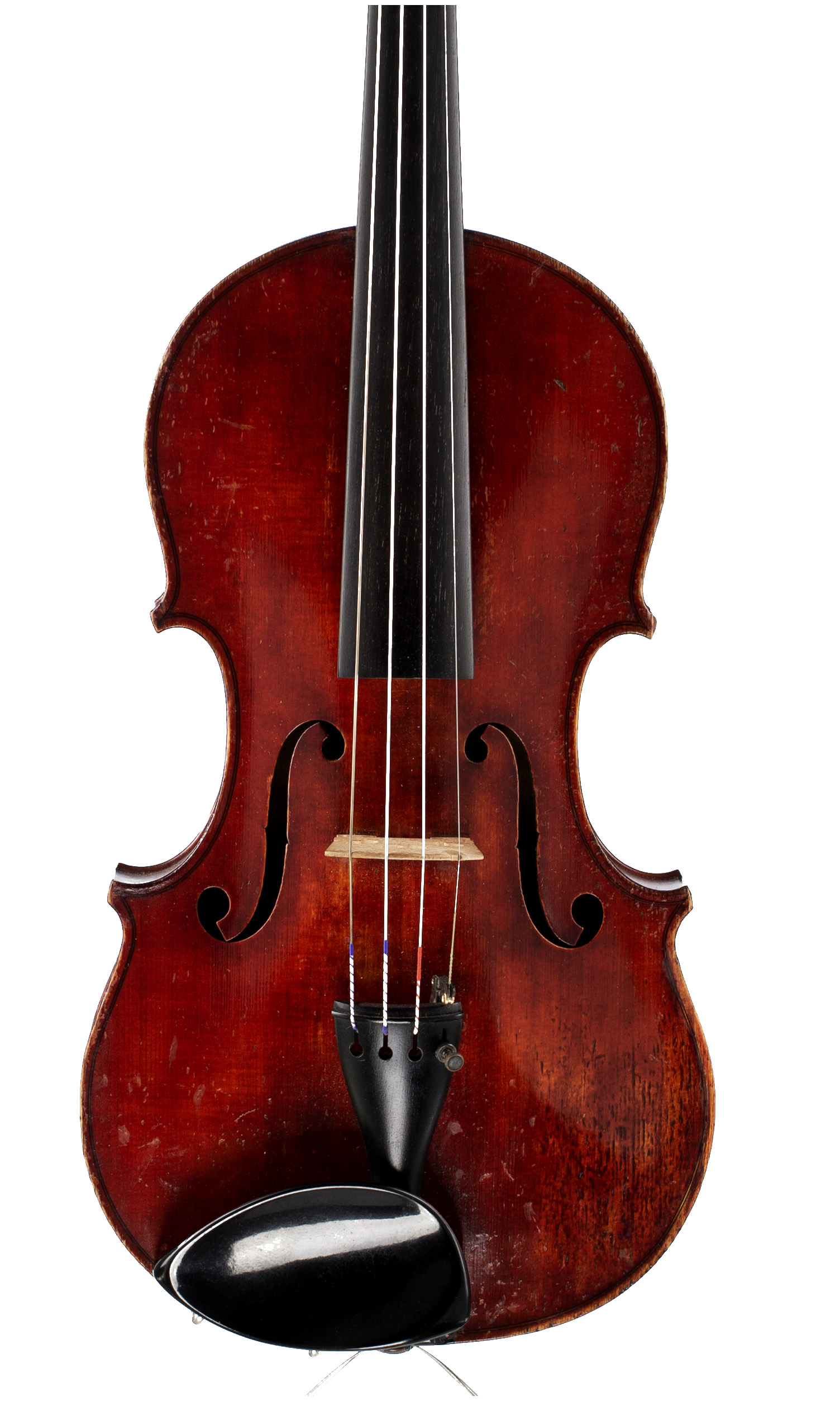
- His varnish, the result of many years of experimentation, was luscious, brilliant, transparent, and possessed a beautiful luminosity. It was an oil varnish, not made with linseed or other heavy oils. Colors included gold-yellow (light and dark), brown, deep red, amber, dark amber, light brown, and very dark brown. The deep rich red varnish was considered of surpassing beauty and excellence.
- Tone
- The tone was described as large, clear, and bell-like, expected to develop qualities combining the sweetness of Amati and the power of Guarneri with age and careful use.
- Output
- Sources contain conflicting information regarding the total number of instruments produced. Willibald Leo Lütgendorff states he made around 200 instruments. William Meredith Morris, writing around 1900, reported 166 instruments, comprising six cellos, thirty violas and viola altas, and the remainder violins. John Dilworth states he produced more than 350 violins, 40 violas, and 12 cellos.
- Labeling
- All instruments were numbered consecutively upon completion, both on the base of the neck (under the finger-board) and inside on the face of the top block. In addition to a printed label, instruments also bore the artist's autograph on the back. An example label reads: "Jeffery J. Gilbert, Peterborough / Fecit anno MDCCCCIV" or "Jeffery J. Gilbert. Peterborough Fecit. Anno mdcccxcix."
- Pricing (circa 1900)
- Violins were priced at 25 guineas, violas at 25 guineas, and cellos from 45 guineas.
- Jeffrey J. Gilbert, Peterborough
Fecit anno MDCCCCIVJohn Dilworth
Influence and legacy
- Early Instruction: He received his initial instruction in violin making from his father, who was an enthusiastic amateur maker.
- Mentorship and Advice: Gilbert connected with several connoisseurs and artists who provided valuable advice. These included Charles Reade, George Hart, Horace Petherick, Dr. John Day, and George Withers.
- Varnish Studies: Charles Reade took a particular interest in Gilbert's varnish studies, offering encouragement and discussing the "mysteries" of old Cremona varnish.
- Awards: Jeffery James Gilbert received several prestigious awards for his instruments:
- International Exhibition, Crystal Palace (1884): Silver Medal (highest award).
- International Inventions Exhibition, London (1885): Silver Medal.
- International Exhibition, Edinburgh (1890): Gold Medal.
Further Information
- Workshop Locations: Gilbert commenced his studies in New Romney in 1873. He was established in Peterborough by 1875 or 1876, and continued working there until at least 1900. He moved to Richmond, Surrey, in 1938.
- Violin Model A Measurements: Length of body: 14 inches; Width across upper bouts: 6 1/2 inches; Width across middle bouts: 4 3/8 inches; Width across lower bouts: 8 inches; Width of ribs at bottom: 1 1/4 inches, gradually diminishing at top to 1 3/16 inches.
- Violin Model B Measurements: Length of body: 14 inches; Width across upper bouts: 6 5/8 inches; Width across middle bouts: 4 1/2 inches; Width across lower bouts: 8 1/8 inches; Ribs same as Model A.
- Viola Model Measurements: Length: 16 inches; Width across upper bouts: 7 5/8 inches; Width across middle bouts: 5 1/8 inches; Width across lower bouts: 9 inches; Depth of ribs at bottom: 1 1/2 inches; Depth of ribs at top: 1 3/8 inches.
- Viola Alta Model Measurements: Length: 17 inches; Width across upper bouts: 8 1/8 inches; Width across middle bouts: 5 3/8 inches; Width across lower bouts: 9 1/2 inches; Depth of ribs 1/16 inch more all over than in the viola.
- Cello Model Measurements: Length: 29 3/4 inches; Width across upper bouts: 13 3/4 inches; Width across middle bouts: 9 3/4 inches; Width across lower bouts: 17 1/2 inches; Depth of ribs: 4 9/16 inches.
- Sound-hole Lengths: Violins: 3 1/16 inches; Violas and Viola Altas: 3 5/8 inches; Cellos: 5 11/16 inches.
- Scroll Dimensions: Width from boss-edge to boss-edge: 1 9/16 inches; Depth of peg-box at deepest part: 15/16 inch, diminishing to 11/16 inch at the throat.
- Label Details: Printed on cartridge paper from an engraved block. Example facsimile: "Jeffery J. Gilbert. Peterborough Fecit. Anno mdcccxcix."
Biographies
The overview above is drawn from the following published accounts. Read them in the original:
John Dilworth+
GILBERT, Jeffrey James Born 1850 New Romney, Kent, Worked from 1870, died 1942 Richmond, Surrey UK. Son of Jeffrey Gilbert, above. Largely self-taught. Established in New Priestgate, Peterborough 1875. Medals at Crystal Palace, London 1884, the Inventors’ Exhibition 1885, and Edinburgh 1890. Moved to Richmond in 1938. Produced more than 350 violins, 40 violas, and 12 cellos. Various models, but consistently fine workmanship, although scrolls often a little heavy in the design. Different varnishes used throughout his career. Signed internally. Printed label: Jeffrey J. Gilbert, Peterborough / Fecit anno MDCCCCIV
William Meredith Morris+
He is the son of Jeffery and Eleanor Langley Gilbert, and was born in New Romney on Aug. 16, 1850. He is the direct representative of an old Kentish family, one of the most notable members of which, in recent times, was Sir Jeffery Gilbert, whom the learned in the law described as ” the accomplished exchequer baron.” He received private tuition till he was about twelve years of age, after which he spent some years at the Crockley Green Grammar School, which was then under the mastership of Mr. Thomas Dalby. Mr. Gilbert is one of the leading makers of modern times, and his workmanship, varnish, and tone give him a place amongst the very select few of the innermost circle of present day makers.
Although he has always been of an artistic and musical turn of mind, he was more than twenty years of age before he had any kindly feelings for the violin in particular. Having once caught the infection he was soon in the firm grip of the fiddle ” disease.” His father in his own early days was an enthusiastic amateur player and maker, and from him he seems to have inherited the practical side of his character. He commenced his early studies quite unaided, as his father did all he could to discourage the budding “Stradivari,” intending him for another career ; and, living as he was in a small isolated town, there were no opportunities of gaining any knowledge whatever upon the subject.
The purely mechanical part of the work never presented any great difficulty to his hand and eye, but he was not long in recognising the fact that it required something more than an expert use of carving tools to create a masterpiece in tone, and especially was the difficulty of an approximate reproduction of the fine old varnishes realised by him. About this time he made the acquaintance of several connoisseurs in London, notably that of the late Charles Reade, the late George Hart, Mr. Horace Petherick, Dr. John Day, and George Withers, all of whom took a kindly interest in his work, and from time to time gave him useful hints. Mr. Reade was especially interested in his varnish studies, and on the eve of his last departure for the Continent, a short time before his death, had a long chat with him on the ” mysteries ” of old Cremona. It was at this final parting that Reade spoke to him the cheery words, ” Go on, Mr. Gilbert, do not get discouraged, I am sure you will succeed in the end.” This was in allusion to the varnish problem.
In 1876, Mr. Gilbert was married to Miss Lily White, in St. John’s Church, Peterborough. He has six children, named Jeffery Francis White, Charles Clement, Catharine Eleanor, Leslie Baker, Kate Julia, and Frederick William.
Up to date, Mr. Gilbert has made 166 instruments, comprising six ‘cellos, thirty violas and viola altas, and the remainder violins. His aim has always been quality, and not quantity, and he carefully studies each instrument during its construction.
His models have varied from time to time, and are original, without being vagaries on the one hand or slavish copies on the other.
The measurements of the two violin models, of distinctly different outline, from which he is at present working, are as follows : —
(a) Length of body … 14 ins,Width across upper bouts . . . 6 1/2ins,Width across middle bouts . . . 4 3/8ins,Width across lower bouts … 8 ins,Width of ribs at bottom … 1 1/4ins,[Ribs] Gradually diminishing at top to … 1 3/16ins,
(b) Length of body … 14ins,Width across upper bouts . . . 6 5/8ins,Width across middle bouts . . . 4 1/2ins,Width across lower bouts … 8 1/8ins,Ribs same as above.
The sound-holes are the same in both models and are 3 1/16ins
The measurements of the viola model are : — Length … 16ins,Width across upper bouts . . . 7 5/8ins,Width across middle bouts . . . 5 1/8ins,Width across lower bouts … 9ins,Depth of ribs at bottom … 1 1/2ins,Depth of ribs at top … 1 3/8ins,
and those of the viola alta : — Length … 17ins,Width across upper bouts . . . 8 1/8ins,Width across middle bouts . . . 5 3/8ins,Width across lower bouts … 9 1/2ins,Depth of ribs 1/16 in. more all over than in those of viola. The length of sound-holes is identical in both violas and viola altas, and is 3 5/8 in.
His ‘cello model is also an original one, and the measurements are : — Length … 29 3/4ins,Width across upper bouts . . . 13 3/4ins,Width across middle bouts . . . 9 3/4ins,Width across lower bouts … 17 1/2ins,Depth of ribs … 4 9/16ins,Length of sound-holes … 5 11/16ins,
The outline of Mr. Gilbert’s instruments is very beautiful, and the curves are as graceful as it is possible for curves to be. The violin scroll is in the best Italian style. The width from boss-edge to boss-edge is 1 9/16in. The depth of the peg-box at the deepest part is 15/16in., diminishing to 11/16 at the throat.
The scollop is nicely rounded, and projects sufficiently to produce piquancy of expression. The curves of the volute are most delicately scooped at the base, and the flutes at the back of the box give the correct balance in lines of subdued boldness. The button is nearly semi-circular, strong, and in keeping with the contour. The edges are fairly full, not exactly rounded nor yet raised, but turned in a manner that emphasises the extreme outline of the fiddle. The margin was exactly 1/8 in. wide in the specimens examined by me, and the purfling, which was inlaid beautifully, 1/16in. wide. The sound-holes are a masterly conception. In outline they are all but identical with those of Strad ; but not in inclination. The notch is a most interesting detail — I have never seen it made so artistically by any other luthier, whether classical or post-classical. The hollowing out of the lower lip (or wing) is also a noticeable feature, and is in the best Stradivarian style.
The varnish is luscious, brilliant, and transparent. Colours : amber, dark amber, light brown, very dark brown, light red, and deep rich red. In the last-mentioned colour the varnish is of surpassing beauty and excellence. It is beautiful in all the colours, but in describing the deep red, ” beautiful ” and such-like adjectives are not quite good enough. The varnish is, of course, an oil one — not ” linseed or any other heavy oil, which destroy all that is good in colour, delicacy, and brilliancy ” — so Mr. Gilbert informs me. The wood is always acoustically perfect and very handsome. It is mostly cut sur maille though I have seen one specimen in which both tables were whole.
The tone is large, clear, and bell-like, and with age and careful use will develop, no doubt, qualities that may be considered in their sum total as a just combination of the sweetness of Amati and the power of Guarneri.
All the work is personal, and the instruments are numbered consecutively as they are finished, both upon the base of the neck (under the finger-board) and inside on the face of the top block. They have also in addition to the label the artist’s autograph on the back.
The prices are : — Violins … 25 guineas. Violas … 25 guineas.’Cellos from … 45 guineas.
Mr. Gilbert’s instruments have gained the following awards: — “International Exhibition,” Crystal Palace, 1884, Silver Medal (highest award) ; ” International Inventions Exhibition,” London, 1885, Silver Medal; “International Exhibition,” Edinburgh, 1890, Gold Medal.
Facsimile label : —
Jeffery J. Gilbert. PeterboroughFecit. Anno mdcccxcix.
The label is printed on cartridge paper from an engraved block.
Willibald Leo Lütgendorff+
Einer alten, angesehenen kentischen Familie entstammend und ursprünglich
für einen andern Beruf bestimmt, hatte er im Geigenbau keinen eigentlichen
Lehrer. Wohl war sein Vater (geb. 1814) ein begeisterter Musikfreund, der als
Dilettant einige gute Violoncelli machte, und von ihm erhielt er die ersten
Unterweisungen. Nachdem er sich einmal mit dem Geigenbau beschäftigt hatte,
verlegte er sich mit Feuereifer auf das Studium dieser Kunst und trat mit
den besten Kennern und Künstlern in Verbindung, so mit Charles Reade,
George Hart, Horace Petherick, Dr. John Day und George Withers, von denen
er werthvolle Rathschläge erhielt. Er begann seine Studien 1873 in New Romney
und setzte sie dort bis 1887 fort, in welch letzterem Jahre er nach Peterborough
übersiedelte. Er bildete sich ein eigenes Modell, das bis zu einem gewissen
Grade von Stradivari beeinflusst erscheint und das er, ohne sich selbst stets
sklavisch nachzuahmen, im Laufe der Zeit immer mehr vervollkommnet hat.
Seine Arbeit ist von lobenswerther Vollendung sowohl in Bezug auf die Schönheit
des Holzes und der Form, als auch in Bezug auf den Ton. Sein Lack, der von
hübscher Leuchtkraft ist, zeigt entweder goldgelbe (hell und dunkel), braune
oder tiefrothe Farbe und ist das schliessliche Ergebniss vieljähriger Versuche. Er
hat an 200 Instrumente gemacht, die alle ein individuelles, künstlerisches Gepräge
haben und von manchen Autoritäten selbst den Italienischen als nahekommend
an die Seite gestellt werden. Er besitzt viele Auszeichnungen; eine ausführliche
Biographie von ihm veröffentlichte Rev. W. Meredith Morris in No. 121 (Mai 1900) der Zeitschrift »The Strad«
Sell your instrument with Amati
Get started by uploading photos of your instrument for our experts to review.
Sell your instrument with Amati
Get started by uploading photos of your instrument for our experts to review.