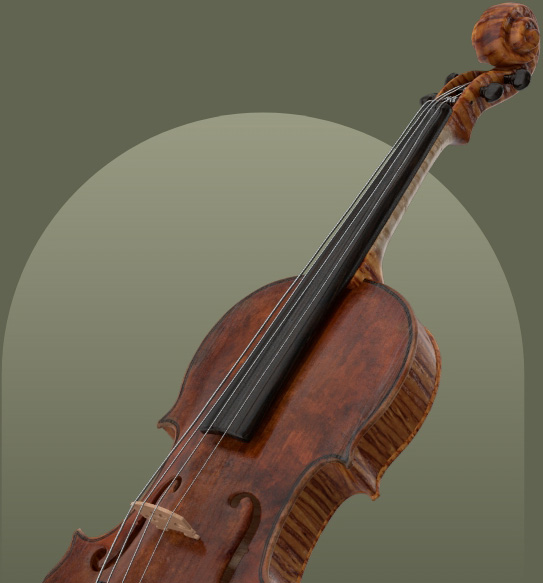
Antonio Gragnani
Livorno, worked 1765–1794
Antonio Gragnani was an Italian luthier active in Livorno, with conflicting dates of operation ranging from 1741 to 1794. Described as a stylish and idiosyncratic maker, he likely trained in Florence. His craftsmanship was noted for its high order, often employing an Amati-like model, distinctive swan-necked pegboxes, and sometimes unique materials like whalebone for purfling. While some sources praise his golden amber-yellow varnish and excellent tone, others describe his materials and varnish as inferior. He typically branded his instruments with his initials "A.G." and his work has been subject to many copies due to its recognizable nature. An example of his five-stringed viol was exhibited in London in 1872.
Auction Price History
Highest auction price
63 results
| Type | Details | Auction house | Sold | Price |
|---|---|---|---|---|
| Violin | Labelled Antonius Gragnani fecit Liburni Anno 1784, branded to the button and lower rib A. G. Lot 202 | Tarisio | November 2025 | £54,317est. $ 50,000-80,000 |
| Violin | Labelled Antonius Gragnani fecit Liburni Anno 1781, branded to the button and to the lower ribs A. G. Lot 100 | Tarisio | September 2025 | £82,420est. € 80.000-120.000 |
| Violin | Labelled Antonius Gragnani fecit Liburni Anno 1767, branded AG on the table under the fingerboard Lot 170 | Ingles & H. | October 2024 | £108,000est. £ 60,000-80,000 |
| Violin | Labelled Antonius Gragnani fecit Liburni Anno 1784, branded A*G on the button and by the endpin Lot 58 | Ingles & Hayday | October 2023 | £120,000est. £ 70,000-100,000 |
| Violin | Branded A.G on the button and under the fingerboard Lot 83 | Ingles & Hayday | March 2023 | £156,000est. £ 60,000-80,000 |
| Violin | Labelled Antonius Gragnani fecit Liburni Anno 1776, branded A.G. by the endpin and on the table Lot 333 | Ingles & Hayday | March 2023 | £108,000est. £ 60,000-80,000 |
| Violin | Original neck Lot 75 | Vichy | June 2022 | £99,320est. € 50.000-60.000 |
| Violin | Labelled Antonius Gragnani fecit Liburni Anno 1784, branded A.G. on the button and by the endpin Lot 22 | Ingles & Hayday | June 2021 | £144,000est. £ 80,000-100,000 |
| Violin | Labelled Antonius Gragnani fecit Liburni Anno 1780, branded to the button and lower rib A. G. Lot 156 | Tarisio | October 2020 | £112,100est. £ 80,000-120,000 |
| Violin | Labelled Antonius Gragnani Fecit / Liburni ANNO 1781, branded AG on button and bottom rib Lot 222 | Freeman's | May 2019 | £67,926est. $ 80,000-100,000 |
| Violin | Labelled Antonius Gragnani fecit, Liburni Anno 1793, branded A.G twice on the table Lot 24 | Ingles & Hayday | March 2019 | £36,000est. £ 30,000-50,000 |
| Violin | Labelled Antonius Gragnani fecit Liburni Anno 1786, further labelled In te Domine Speravi, branded A.G Lot 145 | Ingles & Hayday | March 2019 | £120,000est. £ 70,000-90,000 |
| Violin | Labelled Antonius Gragnani fecit, Liburni Anno 1790, dimensions slightly reduced from a small viola Lot 257 | Tarisio | November 2018 | £53,893est. $ 60,000-90,000 |
| Violin | Labelled Antonius Gragnani fecit, Liburni anno 1773, branded to the button and the lower rib A. G. Lot 141 | Tarisio | May 2018 | £42,025est. $ 30,000-50,000 |
| Violin | Labelled Antonius Gragnani fecit Liburni Anno 1774, branded to the button and lower rib AG. Lot 200 | Tarisio | February 2017 | £163,585est. $ 60,000-90,000 |
| Violin | Labelled Antonius Gragnani fecit, Liburni, Anno 1784, branded to the button and to the lower rib A. G. Lot 179 | Tarisio | June 2016 | £23,600est. £ 20,000-30,000 |
| Violin | Branded A.G on the button and by the tailpin Lot 96 | Ingles & Hayday | March 2016 | £36,000est. £ 30,000-40,000 |
| Violin | Labelled Antonius Gragnani fecit Liburni Anno 1782, branded to the button and to the lower rib AG Lot 179 | Tarisio | November 2015 | £102,000est. £ 60,000-90,000 |
| Viola | Labelled Antonius Gragnani fecit, Liburni, Anno 1786, branded to the button and the lower rib A.G. Lot 93 | Tarisio | May 2015 | £28,114est. $ 50,000-80,000 |
| Violin | Labelled Antonius Gragnani fecit Liburni Anno 1784, branded A.G. on the button and by the tailpin Lot 110 | Ingles & Hayday | May 2014 | £13,200est. £ 12,000-16,000 |
| Violin | Labelled Antonius Gragnani fecit Liburni Anno 1771 Lot 22 | Ingles & Hayday | May 2013 | £36,000est. £ 30,000-50,000 |
| Violin | Labelled Antonius Gragnani fecit Liburni Anno ... Lot 227 | Brompton’s | December 2012 | £36,000est. £ 30,000-50,000 |
| Violin | Labelled Antonius Gragnani, fecit Liburni, anno 1745, bearing a brand ... Paris and inscribed 15.03.85 Lot 361 | Tarisio | November 2012 | £41,195est. $ 50,000-80,000 |
| Violin | Labelled Antonius Gragnani fecit Liburni Anno 1779 and branded externally A.G. by the endpin Lot 12 | Sotheby's | October 2012 | £58,850est. £ 25,000-35,000 |
| Violin | Labelled Antonius Gragnani fecit Liburni ..., of a light orange brown colour Lot 298 | Bonhams | October 2012 | £18,750 |
| Violin | 35.5 cm Livorno, 1784 | — | November 2011 | £17,292 |
| Violin | 36.1 cm Livorno, 1779 | — | October 2011 | £58,850 |
| Violin | 35.2 cm Late 18th C. Attributed to & possibly by | — | October 2010 | £24,409 |
| Violin | 34.9 cm Livourne, 1784 | — | December 2009 | £36,994 |
| Violin | 35.2 cm Livorno, 1776 c. Attributed to | — | October 2009 | £4,800 |
| Cello | 75.6 cm (head later) Attributed to | — | June 2009 | £6,035 |
| Violin | 35.0 cm Livorno, 1775 c. Workshop | — | October 2008 | £11,129 |
| Violin | 35.3 cm Livorno, 1770 Attributed to | — | March 2008 | £8,398 |
| Violin | 35.3 cm Attributed to | — | July 2007 | £6,167 |
| Violin | 35.1 cm Late 18th C. Attributed to | — | July 2006 | £4,800 |
| Violin | 35.3 cm Attributed to | — | July 2006 | £6,868 |
| Violin | 36.2 cm Livorno, 1778 "ex-Caressa" | — | May 2006 | £39,200 |
| Viola | 40.2 cm Livorno, 1780 c. | — | November 2005 | £24,000 |
| Violin | Livorno, 1780 c. | — | May 2005 | £43,200 |
| Violin | Italy, 18th C Attributed to | — | February 2005 | £15,600 |
| Violin | Livorna, 1780 c. | — | May 2004 | £11,936 |
| Violin | Livorno, 1776 | — | May 2004 | £30,560 |
| Violin | 1780 | — | March 2003 | £44,050 |
| Violin | 1785 | — | November 2001 | £8,972 |
| Violin | 1780 | — | March 2000 | £27,600 |
| Violin | 1780 | — | November 1999 | £18,400 |
| Violin | 1784 | — | May 1994 | £23,742 |
| Violin | 1770 c. | — | March 1992 | £23,100 |
| Violin | 1783 | — | November 1990 | £17,600 |
| Violin | 1772 | — | November 1989 | £13,750 |
| Violin | 1773 | — | March 1989 | £17,600 |
| Violin | 1771 | — | June 1988 | £9,350 |
| Violin | 1780 c. | — | March 1988 | £9,300 |
| Violin | 1770 c. | — | November 1987 | £15,400 |
| Violin | 1778 | — | March 1986 | £12,100 |
| Violin | 1784 | — | November 1985 | £17,600 |
| Violin | 1768 | — | November 1985 | £9,350 |
| Violin | 1760 | — | November 1983 | £11,550 |
| Viola | 38.4 cm 1788 | — | November 1983 | £4,400 |
| Violin | 1779 | — | April 1983 | £9,350 |
| Violin | 1770 | — | November 1981 | £5,500 |
| Cello | 1781 | — | March 1981 | £3,550 |
| Cello | 1781 | — | July 1980 | £8,250 |
No results match those filters.
Maker Overview
Life
Antonio Gragnani worked in Livorno, Italy., he worked circa 1765-1794, while Cecie Stainer indicates his activity was about 1741-1780. Sources contain conflicting information regarding his working dates. Dilworth describes him as a very stylish and idiosyncratic maker who likely learned his craft in Florence.
Characteristics
- Workmanship
- John Dilworth notes his craftsmanship and finish were of the highest order. He employed an Amati-like model with a finely sculpted arch of medium height, or sometimes a slightly pinched higher form. His soundholes were slightly elongated but elegant.
- Materials
- Uniquely among Italian makers, Gragnani sometimes used whalebone for the purfling. Cecie Stainer, however, describes his work as a little rough, stating he used inferior wood and poor varnish, though she notes the tone was sympathetic, sweet, and clear. George Hart also mentions he used ordinary wood, but that the tone was often of good quality.
- Head Design
- The head of his instruments is described by Dilworth as very striking, featuring a long swan-necked pegbox that was wider at the back than at the top edge, often with quite concave sides. The volute itself was horizontally oval, but very finely worked with a delicate chamfer.
- Varnish
- Dilworth states his varnish was golden amber-yellow over a slightly grey ground, reminiscent of the best Carcassi work. In contrast, Stainer describes his varnish as poor, and Hart notes it was somewhat hard.
- Branding
- He usually branded his instruments with his initials, "A.G.", on the back button and above the endpin. Stainer also confirms he generally branded his instruments with "A. G", and Hart notes he usually branded his initials below the tail-prin.
- Antonius Gragnani fecit
Liburni Anno 1783John Dilworth
Influence and legacy
- Training: John Dilworth suggests that Antonio Gragnani probably learned his craft in Florence.
- Exhibitions: A five-stringed viol by Gragnani, bearing the label " Antonius Gragnani, fecit anno 1741.", was exhibited at the South Kensington Museum, London, in 1872.
- Copyists: John Dilworth notes that many copyists have attempted to duplicate Gragnani's work, possibly due to its distinctive and recognisable nature, leading to some inferior or anachronistic work being attributed to him with his label and brand.
Further Information
- Labels: Known labels include "Antonius Gragnani fecit / Liburni Anno 1783" as cited by John Dilworth. Cecie Stainer mentions labels such as " Antonius Gragnani, fecit anno 1741." and " Antonius Gragnani fecit Liburni. anno 1780", with a similar one dated 1752.
Biographies
The overview above is drawn from the following published accounts. Read them in the original:
John Dilworth+
GRAGNANI, Antonio Worked circa. 1765-1794 Livorno Italy. Very stylish and idiosyncratic maker who probably learned his craft in Florence. Craftsmanship and finish of the highest order. Amati-like model with finely sculpted arch of medium height, or slightly pinched higher form. Slightly elongated but elegant soundholes. Sometimes used whalebone for the purfling, unique amongst Italian makers. Head very striking, with long swan-necked pegbox, wider at the back than at the top edge and often quite concave sides, the volute itself is horizontally oval, but very finely worked with a delicate chamfer. Varnish is golden amber-yellow over a slightly grey ground, very reminiscent of the best Carcassi work. Usually branded ‘A.G.’ on the back button and above the endpin. Despite this, many copyists have attempted to duplicate the work, possibly because it is so distinctive and recognisable, and some inferior or anachronistic work has been given his label and brand. Antonius Gragnani fecit / Liburni Anno 1783
George Hart+
Usually branded his initials below the tail-prin. Varnish somewhat hard; ordinary wood. The tone is often of good quality.
Cecie Stainer+
A maker in Leghorn about 1741-80. His work is a little rough ; he used inferior wood and the varnish is poor, but the tone is sympathetic, sweet, and clear. He generally branded his instruments with his initials, “A. G ”
A five-stringed viol exhibited at South Kensington Museum, London, in 1872, had the label: ” Antonius Gragnani, fecit anno 1741.” In an inferior violin was the label : ” Antonius Gragnani fecit Liburni. anno 1780″; a similar one was dated 1752.
Sell your instrument with Amati
Get started by uploading photos of your instrument for our experts to review.
Sell your instrument with Amati
Get started by uploading photos of your instrument for our experts to review.