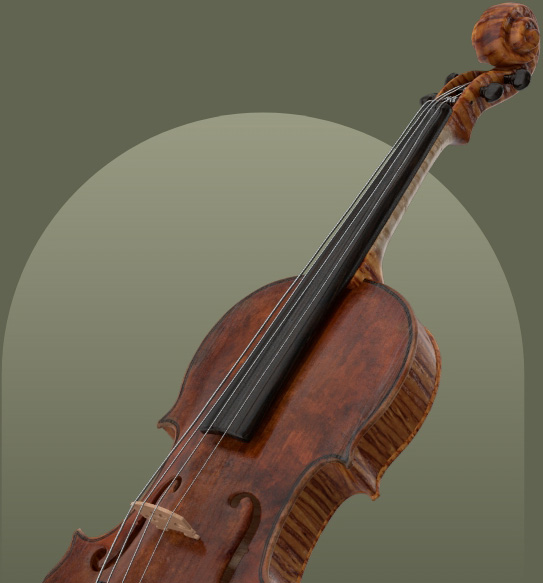
Martin Hoffmann
Leipzig, worked 1678–1719
Martin Hoffmann (circa 1678-1725) was an esteemed luthier from Leipzig, Germany, known for making lutes, viols, violins, and cellos. He is particularly noted for his role in producing the Viola pomposa, an instrument whose invention is attributed to J. S. Bach. While sources describe his instruments as having good tone and a distinctive golden-yellow varnish, there is conflicting information regarding the elegance and distinction of his overall design patterns.
Request an expert valuation or learn how our global auctions achieve the highest prices for your instruments.
Maker Overview
Life
Martin Hoffmann (circa 1678-1725) was a highly esteemed master luthier from Leipzig, Germany. He obtained his citizenship as a violin maker in 1678 and worked in Leipzig from about 1685 until his death in 1725. A significant number of his works, including both lutes and violin-family instruments, have survived. Hoffmann is also credited with beginning the production of the Viola pomposa in 1720, a small five-string violoncello tuned C, G, D, A, E. The invention of this instrument is ascribed to J. S. Bach, though it was not widely adopted and appears to have been a reproduction of an older violoncello form.
Characteristics
- Models and Design
- utilized his own model for violins, characterized by very pointed corners and a weak edge. His cellos, in particular, retained specific details of the older viol form.
- Varnish
- John Dilworth notes that Hoffmann's instruments, while often based on an Amati-derived model, were distinguished by a decent golden-yellow varnish.
- Construction Characteristics
- Cecie Stainer describes his instruments as having an "inelegant pattern," citing the cut of the sound-holes, sharp corners, and weak edges, which she suggests led to their neglect despite possessing a good tone.
- Viola pomposa Characteristics
- A specimen of the Viola pomposa exhibited in Paris in 1878 was described as being on a good model, very much arched, with the head ending in a scroll, and well-cut sound-holes.
- Conflicting Information
- Sources contain conflicting information regarding the overall distinction and elegance of Martin Hoffmann's instrument designs. While Lütgendorff refers to him as a "highly esteemed master," Dilworth suggests his models were "of no distinction apart from a decent golden-yellow varnish," and Stainer notes an "inelegant pattern."
- Martin Hoffmann
in Leipzig, 1688John Dilworth
Influence and legacy
- Exhibitions: A specimen of Martin Hoffmann's Viola pomposa was exhibited in Paris in 1878.
Further Information
- Working Period and Location: Martin Hoffmann worked in Leipzig, Germany, from approximately 1678 to 1725.
- Labeling: An example of his labeling includes "Martin Hoffmann / in Leipzig, 1688."
- Historical References: Further details about Hoffmann can be found in Baron's Laute (page 95), Walther's Musik-Lexikon 1732 (page 316), and De Wits Zeitschrift 1894.
Biographies
The overview above is drawn from the following published accounts. Read them in the original:
John Dilworth+
HOFFMANN, Martin Worked circa. 1678-1719 Leipzig Germany. Amati derived model but of no distinction apart from a decent golden-yellow varnish. Martin Hoffmann / in Leipzig, 1688
George Hart+
Maker of Lutes and Viols.
Cecie Stainer+
d. in Leipzig, 1725. A maker of good lutes and viols, who worked in Leipzig from about 1685. He also made violins and violoncellos of good tone, although the inelegant pattern (the cut of the sound-holes, the sharp corners and weak edges) has caused them to be neglected. In 1720 he began to make the ” Viola pomposa,” a small violoncello with five strings tuned C, G, D, A, E, the invention of which is ascribed to J. S. Bach. It was never much used and seems to have been merely the reproduction of an obsolete form of violoncello. A specimen was exhibited in Paris, 1878; it was on a good model, very much arched, the head ending in a scroll, and the sound-holes well cut.
Willibald Leo Lütgendorff+
Er stammte aus Leipzig und erlangte als Geigenmacher im Jahre 1678 das
Bürgerrecht. Sehr geschätzter Meister, von dem sich ziemlich viele Arbeiten,
sowohl Lauten- als Geigeninstrumente, erhalten haben. Bei den letzteren verwendete
er ein eigenes Modell mit sehr spitzen Ecken und schwachem Rand.
Seine Celli zeigen noch in Einzelhheiten die alte Gambenform. Vgl. Baron,
Laute S. 95, Walther’s Musik-Lexikon 1732 S. 316. De Wits Zeitschr. 1894
Sell your instrument with Amati
Get started by uploading photos of your instrument for our experts to review.
Sell your instrument with Amati
Get started by uploading photos of your instrument for our experts to review.