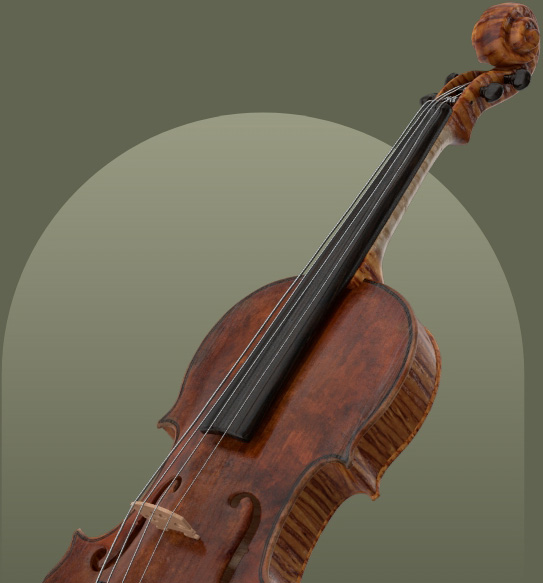
Matthijs Hofmans
Antwerp, Luby, worked 1660–1720
Matthijs Hofmans was a highly regarded violin maker active in Antwerp, Belgium, with a documented working period spanning from approximately 1660 to 1740. He is recognized for crafting beautiful instruments, primarily violins, violas, pochettes, and a theorbo, often following the esteemed patterns of Amati and Guarneri del Gesù. His work is characterized by fine craftsmanship and a distinctive warm dark red or golden amber varnish. Hofmans' instruments are represented in significant collections and museums, including the Musical Instruments Museum in Brussels, and have been featured in historical auctions and exhibitions.
Auction Price History
Highest auction price
16 results
| Type | Details | Auction house | Sold | Price |
|---|---|---|---|---|
| Pochette | Ebony neck and carved head finial, table slightly lifting from the back in places Lot 127 | Gardiner Houlgate | October 2025 | £4,392est. £ 4,000-6,000 |
| Violin | Labelled Amati Lot 271 | Vichy | June 2023 | £16,495est. € 15.000-18.000 |
| Violin | Labelled Amati Lot 260 | Vichy | June 2023 | £14,845est. € 12.000-15.000 |
| Violin | probably revarnished Lot 18 | Vichy | June 2021 | £18,813est. € 4.000-5.000 |
| Violin | Bearing the maker's label Lot 220 | Vichy | December 2018 | £22,448est. € 10.000-15.000 |
| Violin | Labelled Matteo Goffriler fece in Venezia ..., table under edged, wood let into back Lot 224 | Brompton’s | October 2016 | £18,000est. £ 15,000-20,000 |
| Violin | Bearing a facsimile label, Matthius Hofmans, fecit Antwerp, 1690 Lot 280 | Tarisio | October 2013 | £13,548est. $ 18,000-25,000 |
| Violin | Unlabelled Lot 77 | Brompton’s | October 2012 | £16,800est. £ 15,000-20,000 |
| Violin | 36.0 cm 1700 c. Probably by | — | October 2009 | £22,500 |
| Violin | 35.4 cm Antwerp, 1680 c. (the scroll later) | — | October 2009 | £5,400 |
| Violin | 35.6 cm Boleslav, 1942 Attributed to | — | May 2008 | £4,490 |
| Violin | 1680 | — | March 2003 | £20,400 |
| Viola | 43.6 cm 1690 | — | July 2000 | £25,800 |
| Violin | 1675-99 | — | November 1993 | £2,760 |
| Cello | 1700 c. | — | November 1990 | £6,600 |
| Violin | 1720 c. | — | November 1986 | £8,250 |
No results match those filters.
Maker Overview
Life
Matthijs Hofmans (circa 1660-1740) was a distinguished violin maker active in Antwerp, Belgium. His working period is generally cited as circa 1660-1720 by John Dilworth, though labels bearing dates as early as 1619 and as late as 1740 have been reported. This wide span has led to speculation, particularly by Dilworth, that there may have been two makers of the same name, possibly a father and son. Cecie Stainer notes his activity between 1680 and 1740. Willibald Leo Lütgendorff identifies him as one of the best Antwerp violin makers, noting that he apparently did not belong to the St. Luke's Guild.
Characteristics
- Models
- Hofmans crafted instruments on the patterns of Italian masters, specifically Amati and Guarneri del Gesù. John Dilworth further specifies his work as being in the Amati style.
- Workmanship
- His instruments are described as "beautiful" by Stainer and "very finely made" by Dilworth. Lütgendorff praises his work and tone as "recht lobenswerth" (quite praiseworthy).
- Varnish
- Stainer describes his varnish as a warm dark red, similar to Italian instruments of the same period. Lütgendorff mentions a red-brown lacquer. Dilworth notes a golden amber varnish, sometimes with a darker red tone, though possibly harder in texture.
- Labels
- Examples of his labels include "Matthys Hofmans tot Antwerpen, 1740" found in a pocket violin (Stainer), and "Matthys Hofmans / van Antwerpen. 1683" and "Matthys Hofmans / tot Antwerpen. 1720" (Dilworth).
- Matthys Hofmans
van Antwerpen. 1683John Dilworth - Matthys Hofmans
tot Antwerpen. 1720John Dilworth
Influence and legacy
- Italian Tradition: Hofmans worked after Italian models, with his designs tracing back to Amati and Guarneri. John Dilworth corroborates this, describing his style as Amati-esque.
- Exhibitions: A kit by Matthijs Hofmans was exhibited at Milan in 1870.
- Notable Collections: Two of his violins were listed in the auction catalog of the Selhof collection in The Hague in 1759 (Lütgendorff). A charming pocket violin was featured in the Samary auction (Lütgendorff). The Snoeck collection in Berlin houses a pentagonal pocket violin attributed to him (Lütgendorff).
- Museum Holdings: A violin by Hofmans is preserved in the Museum of the Brussels Conservatory (No. 233), as documented by Lütgendorff. John Dilworth adds that several instruments, including violins, pochettes, violas, and a theorbo dated 1619, are held in the Musical Instruments Museum, Brussels.
Further Information
- Instrument Types: Matthijs Hofmans produced a variety of stringed instruments, including violins, pocket violins (pochettes), violas, and a theorbo, as detailed by John Dilworth.
- Workshop Location: His workshop was located in Antwerp, Belgium.
Biographies
The overview above is drawn from the following published accounts. Read them in the original:
John Dilworth+
HOFMANS, Matthys Worked circa. 1660-1720 Antwerp Belgium. Labels dated as early as 1619 and as late as 1740 are reported which has led to speculation that there may be two makers of the same name; father and son. Several instruments in the Musical Instruments Museum, Brussels: violins, pochettes, violas, and a theorbo dated 1619. Very finely made in the Amati style with similar golden amber varnish, if a little harder in texture, some with a darker red tone. Matthys Hofmans / van Antwerpen. 1683 Matthys Hofmans / tot Antwerpen. 1720
George Hart+
A Kit of this maker was exhibited at Milan, 1870.
Cecie Stainer+
A maker in Antwerp 1680-1740. He made beautiful instruments on the pattern of Amati and Guarneri del Jesu, he used a warm dark red varnish, similar to that of Italian instruments of the same period. In a little pocket violin was the label: ” Matthys Hofmans tot Antwerpen, 1740.”
Willibald Leo Lütgendorff+
Einer der besten Antwerpener Geigenmacher, über den leider wenig zu erfahren ist, da er anscheinend nicht der Lukasgilde angehört hat. Er arbeitete nach italienischen Vorbildern, seine Modelle gehen auf Amati und Guarneri zurück und sind in Bezug auf Arbeit und Ton recht lobenswerth. Auch sein rothbrauner Lack ist nicht schlecht. Das Versteigerungsverzeichniss der Selhof’schen Sammlung (Haag, 1759) führt zwei Violinen von ihm an. In der Auction Samary war eine hübsche Taschengeige von ihm; eine fünfeckige Taschengeige mit
Negerköpfchen befindet sich aus der Sammlung Snoeck in Berlin und eine
Violine im Museum des Brüsseler Conservatoriums (No. 233).
Sell your instrument with Amati
Get started by uploading photos of your instrument for our experts to review.
Sell your instrument with Amati
Get started by uploading photos of your instrument for our experts to review.