August Moritz Knopf
Request an expert valuation or learn how our global auctions achieve the highest prices for your instruments.

Auction Price History
Highest auction price
7 results
| Type | Details | Auction house | Sold | Price |
|---|---|---|---|---|
| Violin Bow | Silver mounted, round stick, ebony frog with pearl eye, silver button Lot 76 | — | October 2025 | £1,320est. £ 1,200-1,800 |
| Violin Bow | Silver mounted, octagonal stick, ebony frog with pearl eye, silver and ebony button Lot 252 | — | October 2023 | £2,303est. £ 2,500-3,500 |
| Violin Bow | Silver mounted, round stick inscribed 1.8.59 Lot 1378 | — | June 2021 | £3,997est. $ 2,000-3,000 |
| Violin Bow | A nickel-mounted violin bow by August Moritz Knopf, circa 1890 Lot 69 | Amati | March 2021 | £885est. £ 800-1,200 |
| Violin Bow | Silver mounted, octagonal stick unstamped, light lapping Lot 53 | — | June 2019 | £660est. £ 600-900 |
| Violin Bow | Silver mounted, round stick stamped Lowendall's Lot 41 | — | June 2018 | £1,298est. £ 600-900 |
| Violin Bow | Silver mounted, octagonal stick stamped illegibly Lot 43 | — | October 2016 | £2,160est. £ 600-900 |
No results match those filters.
Maker Overview
Life
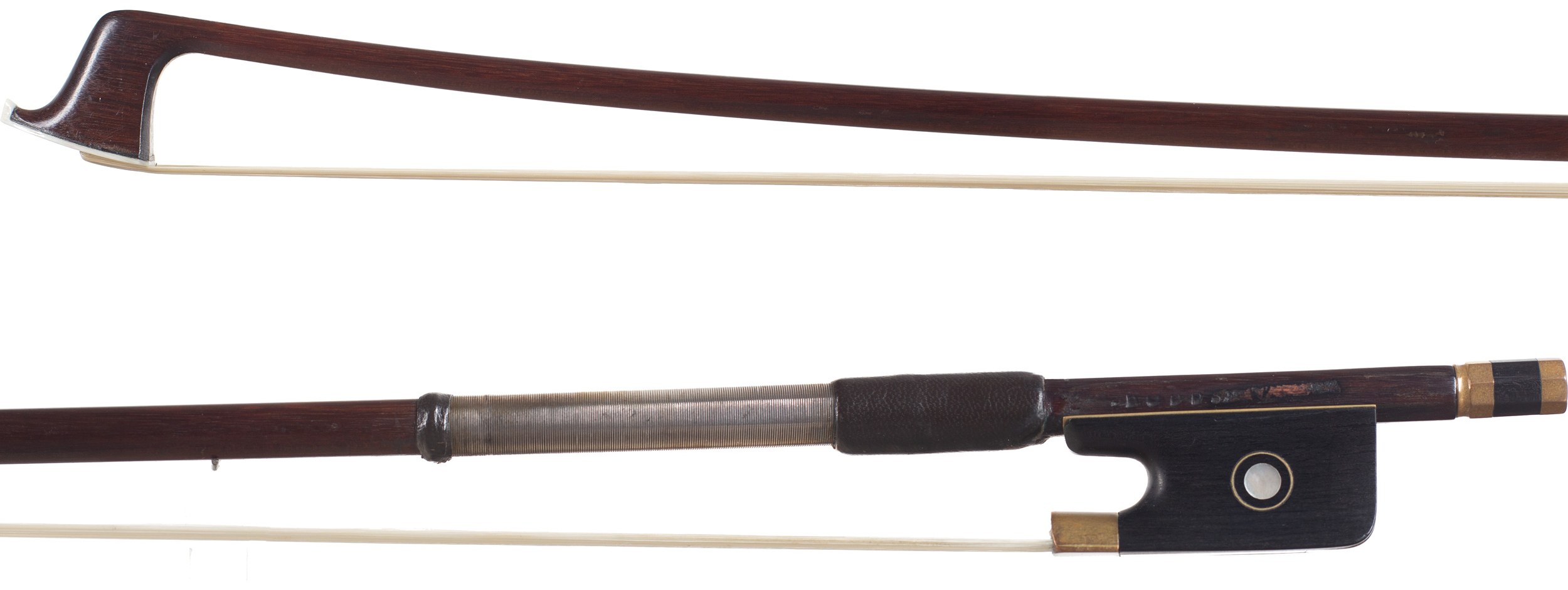
August Moritz Knopf (1857–1899) was a German bow maker associated with the celebrated Knopf family of Markneukirchen, Saxony, one of the most important bow-making dynasties of the nineteenth century. He belonged to a branch of the family descending from Johann Georg Knopf Jr. and is regarded as a significant representative of the later Knopf tradition.
Knopf trained under O. B. Heinel and subsequently worked for several prominent German firms, including Winterling in Hamburg, A. Goetz and E. Gaesel in Markneukirchen, A. Zoephel in Magdeburg, and J. H. Zimmermann in Leipzig. He was registered as a bow maker in Dresden between 1886 and 1888 and is also believed to have been connected with the Löwenthal workshop in Berlin.
Although bows bearing his personal stamp are not known, a number of bows stamped Löwenthal exhibit characteristics associated with Knopf family workmanship and have been linked to his activity. His work reflects the refined Markneukirchen tradition combined with influences absorbed through employment in major commercial workshops in Germany and Russia.
August Moritz Knopf had a relatively short career, but he is recognised as a genuine member of the Knopf bow-making dynasty. Bows attributed to him or to his workshop circle are appreciated for their quality, craftsmanship, and historical importance within the German bow-making tradition of the late nineteenth century.
Sell your instrument with Amati
Get started by uploading photos of your instrument for our experts to review.
Sell your instrument with Amati
Get started by uploading photos of your instrument for our experts to review.