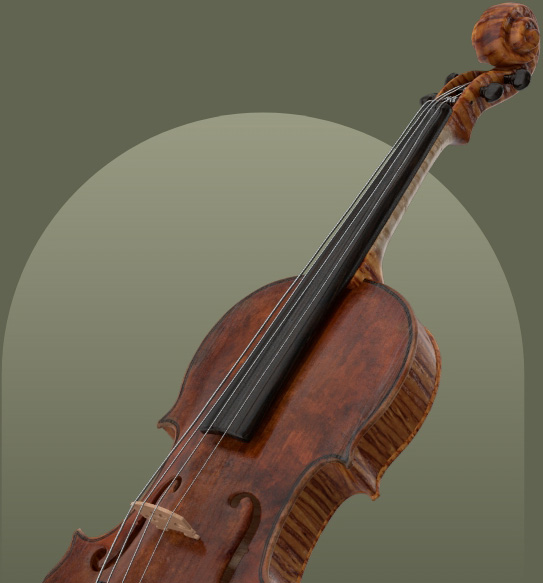
Johann Kulik
Auction price history
Highest auction price
£11,800
| Type | Details | Sold | Price |
|---|---|---|---|
| Violin | Labelled Genau nach Antonius Stradiuarius gemacht, von Johann Kuljk, Prag 1866 | March 2025 | £11,800 |
| Viola | Labelled Jan Kuljk, holowitel hudebnjch nástrogu., W Praze 1862 | October 2024 | £5,919 |
| Violin | Labelled Genau nach Andreas Guarnerius, Alunmus, Nikolai Amati, gemacht von Johann Kulik, Prag ... | May 2024 | £11,308 |
| Violin | 35.8 cm Prague, 1860 | April 2010 | £2,839 |
| Violin | Prague, 1847 | November 2005 | £2,053 |
| Violin | 1862 | November 2000 | £5,760 |
| Violin | 1848 | May 2000 | £4,256 |
| Violin | 1835 | November 1999 | £2,185 |
| Violin | 1867 | November 1997 | £5,104 |
| Violin | 1866 | March 1991 | £4,620 |
| Violin | 1840 c. | November 1987 | £506 |
| Violin | 1867 | June 1984 | £1,026 |
Maker Overview
History
Johann Kulik (1800-1872) was born in 1800 and died in 1872 in Prague, Czech Republic. According to Willibald Leo Lütgendorff's Die Geigen- und Lautenmacher vom Mittelalter bis zur Gegenwart, he was the son of a master miller and the sole student of Schembera. After working with Martin Stoss in Vienna from 1820, where he perfected his art, Kulik established himself independently in Prague in 1824. He married Maria Anna Vyhnàlek in his first marriage and Maria Št?stný in his second. He resided successively in Miš??ská ul., Lužická ul., and on Kleinseitner Platz, until he was able to purchase the small house No. 62 in Palackého t?ida (Karolinenthal) in 1853.
Craft
- Models: Initially, Johann Kulik utilized models from various Italian masters. In 1850, he acquired a fine violin by Andreas Guarneri, which he subsequently copied almost exclusively. John Dilworth's The Brompton's Book of Violin & Bow Makers notes him as a highly regarded maker of refined Cremonese models.
- Workmanship: Lütgendorff describes his work as flawless, using good wood, and his scrolls as more beautifully carved than those of most other Prague masters. Dilworth also highlights his particularly well-carved scrolls.
- Varnish: The varnish is described by Lütgendorff as having a beautiful color, mostly golden-brown or red, though it was spirit varnish. Dilworth confirms the use of fine spirit varnish in appropriate shades.
- Tone: Lütgendorff observed that the tone of his instruments was sometimes a little sharp.
- Violoncellos: His violoncellos were often 'hard-speaking' and were constructed according to a new model calculated by the engineer Leopold Savoi, characterized by a small pattern and very high ribs. Dilworth also mentions these eccentric small pattern instruments with deep ribs made to Savoi's suggestions.
- Labels: Kulik used various labels, including some in the Bohemian language in his later years. Examples include "Genau nach Antonius Stradivarius gemacht / von Johann Kulik,1852" and "Joh. Kulik. Geigenmacher in Prag. A. 18.."
Influence
- Mentorship: Johann Kulik was the only student of Schembera.
- Training: He worked with Martin Stoss in Vienna from 1820, where he further developed his craft.
Legacy
- Collections: A violoncello crafted by Johann Kulik in 1839 is preserved in the princely Lobkowitz collection at Raudnitz Castle.
Further Information
- Locations: Johann Kulik worked and resided in Prague, Czech Republic. His addresses included Miš??ská ul., Lužická ul., and Kleinseitner Platz, before he purchased a house at No. 62 in Palackého t?ida (Karolinenthal) in 1853.
Biographies
John Dilworth
KULIK, Johann Born 1800, died 1872 Prague Czech Republic Highly regarded maker of refined Cremonese models. Fine spirit varnish in appropriate shades. Particularly well-carved scrolls. Some eccentric small pattern instruments with deep ribs made to the suggestions of Leopold Savoi. Genau nach Antonius Stradivarius gemacht / von Johann Kulik,1852 Joh. Kulik. Geigenmacher in Prag. A. 18..
Sell your instrument with Amati
Get started by uploading photos of your instrument for our experts to review.
Sell your instrument with Amati
Get started by uploading photos of your instrument for our experts to review.