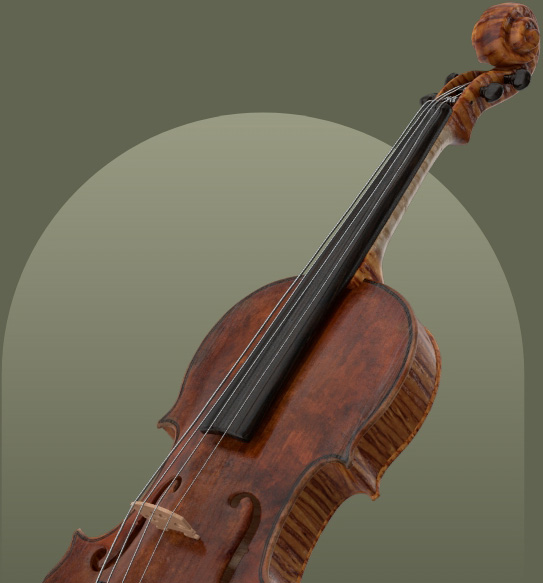
Jean Baptiste (I) Lefebvre
Amsterdam, Lannoy, c.1700–1775
Jean Baptiste (I) Lefebvre (circa 1700-1775) was a French luthier active in Amsterdam from around 1726, known for instruments crafted in both traditional Dutch and Mirecourt styles. His work, often featuring an Amatisé model, small scrolls, and yellow or golden-brown varnish, was considered superior to contemporary French craftsmanship, leading to speculation that he trained in Italy. His workshop in Kalverstraat continued for many years, and his instruments are found in notable collections such as the Sammlung Snoeck and Sammlung Scheurleer.
Request an expert valuation or learn how our global auctions achieve the highest prices for your instruments.
Auction Price History
Highest auction price
9 results
| Type | Details | Auction house | Sold | Price |
|---|---|---|---|---|
| Viola | Labelled J. B. Le Febvre fecit in Amsterdam 176..., head later Lot 39 | Tarisio | February 2019 | £24,420est. $ 4,000-6,000 |
| Viola | Labelled J.B. Le Febvre fecit in Amsterdam 1768 Lot 57 | Ingles & Hayday | October 2016 | £15,600est. £ 14,000-18,000 |
| Violin | Lot 190 | Bonhams | May 2015 | £4,750 |
| Violin | Of a light golden amber colour, later head Lot 190 | Bonhams | May 2015 | £4,750est. £ 4,000-5,000 |
| Violin | Labelled J.B. Le Febvre fecit in Amsterdam 176... Lot 16 | Sotheby's | March 2012 | £8,125est. £ 7,000-10,000 |
| Violin | Lot 190 | Bonhams | October 2011 | £4,750 |
| Violin | 35.5 cm Amsterdam ,1760-1770 c. | — | June 2006 | £3,400 |
| Violin | 1755 c. | — | March 2002 | £7,800 |
| Cello | 17-- | — | November 1983 | £3,740 |
No results match those filters.
Maker Overview
Life
Jean Baptiste (I) Lefebvre (circa 1700-1775) was born around 1700 in Lannoy, near Lille, France, and died in 1775 in Amsterdam, Netherlands in The Brompton’s Book of Violin & Bow Makers. He was active in Amsterdam from approximately 1726.Cecie Stainer, in A Dictionary of Violin Makers, states that he worked in Amsterdam from about 1735 to 1770. Willibald Leo Lütgendorff, in Die Geigen- und Lautenmacher vom Mittelalter bis zur Gegenwart, identifies him as a Frenchman who established himself in Amsterdam.
Characteristics
- Styles
- His work exhibited two distinct styles: one in a traditional Dutch manner and others more commonly in the Mirecourt tradition.
- Dutch Style Characteristics
- The traditional Dutch style featured an Amatisé model with long corners and whalebone purfling.
- Mirecourt Style Characteristics
- Instruments in the Mirecourt tradition were low-arched and short-cornered, finished with yellow and golden-brown varnish.
- General Characteristics
- He generally incorporated small scrolls and short soundholes.
- Quality
- His work is described as good by Willibald Leo Lütgendorff, and Cecie Stainer notes its superiority in merit to contemporary French work.
- Varnish
- He used good yellow varnish, sometimes yellow and golden-brown.
- Output
- Willibald Leo Lütgendorff mentions he was quite diligent and made "Geigen aller Art" (all kinds of violins).
- Specific Instrument
- A violoncello is noted for its small size, yellow varnish, and carefully finished work.
Influence and legacy
- Training Hypothesis: It is supposed that he gained experience in Italy before going to Amsterdam, as his work is considered superior to that made in France at the time.
- Family Assistance: He was assisted by his son, Jean Baptiste Lefèbvre (II).
- Workshop Continuity: The workshop in Kalverstraat continued under the direction of various luthiers until 1857, and the business was taken into the 20th century by the Ko brothers and Johannes Peereboom, as detailed by John Dilworth.
- Preserved Instruments: A violoncello from 1770 is in the Sammlung Snoeck (No. 585) in Berlin, and another from 1772, along with a violin from 1786, are in the Sammlung Scheurleer.
Biographies
The overview above is drawn from the following published accounts. Read them in the original:
John Dilworth+
LEFÈBVRE, Jean Baptiste (I) Born circa. 1700 Lannoy, nr. Lille France, died 1775 Amsterdam Netherlands. Active in Amsterdam from c.1726. Work in two distinct styles: one in traditional Dutch manner: Amatisé model with long corners and whalebone purfling; others more commonly in the Mirecourt tradition: low-arched and short-cornered, with yellow and golden-brown varnish. Small scrolls and short soundholes generally. Assisted by his son, Jean Baptiste Lefèbvre (II). The workshop in Kalverstraat continued under the direction of various luthiers until 1857 and the business was taken into the the 20th century by the Ko brothers and Johannes Peereboom. J. B. LeFèbvre fecit in Amsterdam. 1770. [NGV]
Cecie Stainer+
Was a Frenchman who worked in Amsterdam about 1735-70- He followed the Amati pattern, using good yellow varnish ; it is supposed that he gained experience in Italy before going to Amsterdam, as his work is superior in merit to that made in France at that date.
In a violoncello of small size, with yellow varnish and of carefully finished work, is the label: “J. B. Le Febvre fecit in Amsterdam, 1770.”
Willibald Leo Lütgendorff+
Ein Franzose, der sich in Amsterdam ansässig gemacht hat. Seine Modelle
erinnern manchmal an die Amatischule; seine Arbeit ist gut, sein Lack von
gelber Farbe. Da seine Geigen besser sind als die der gleichzeitigen Franzosen,
will man annehmen, dass er, bevor er nach Amsterdam kam, in Italien gearbeitet
habe. Er war ziemlich fleissig und machte Geigen aller Art. Ein Violoncello
von ihm a. d. Jahre 1770 befindet sich in Berlin in der Sammlung Snoeck (No. 585), ein solches von 1772 und eine Violine von 1786 in der Sammlung Scheurleer.
Sell your instrument with Amati
Get started by uploading photos of your instrument for our experts to review.
Sell your instrument with Amati
Get started by uploading photos of your instrument for our experts to review.