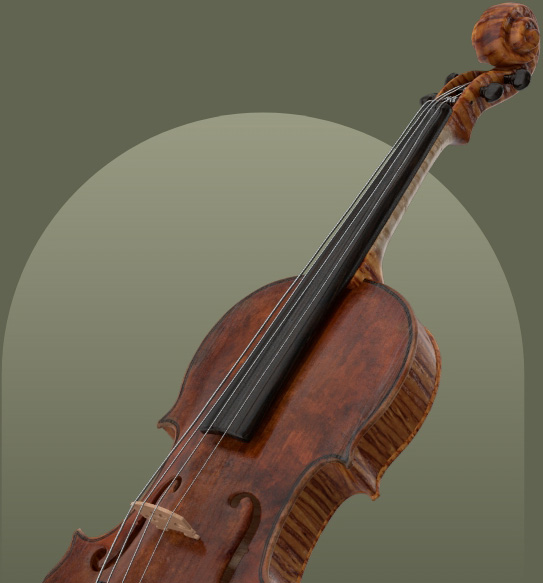
Richard (I) Meares
London, c.1647–1725
Richard (I) Meares (circa 1647-1725) was a significant English viol maker, also producing violins, cellos, violas, and lutes. He was likely an apprentice of Henry Jaye and operated workshops in various London locations, including Half Moon Alley, Bishopsgate, Leadenhall Street, and St Paul's Churchyard. His instruments, particularly his elegant viols, were highly regarded throughout Europe, known for their distinctive English style, dark red-brown varnish, and often featuring tasteful inlays and carvings. He was also involved in music publishing, and his son briefly followed in his footsteps.
Request an expert valuation or learn how our global auctions achieve the highest prices for your instruments.
Maker Overview
Life
Richard (I) Meares (circa 1647-1725) was an important viol maker born around 1647 and died in 1725 in London, UK. He was probably an apprentice of Henry Jaye. He established his workshop on Half Moon Alley, Bishopsgate. In 1699, he moved to Leadenhall Street, Cornhill, operating under the sign of the 'Golden Viol', and by 1706, he relocated to St Paul's Churchyard, where his sign was the 'Golden Viol & Hautboy'. Like many of his contemporaries, Meares was actively involved in music publishing in addition to instrument making.
Characteristics
- Instrument Types
- Richard (I) Meares was known for making lutes, viols, violins, cellos, and violas. His viols are considered exemplary of the elegant English viol, which was highly admired across Europe. A viola da gamba with his label was exhibited in London in 1872.
- Construction & Aesthetics
- His violins are characterized by the early English style of Urquhart, featuring through necks and lacking separate upper blocks. Instruments often display a dark red-brown varnish., his works are distinguished by tasteful inlays and pretty carvings.
- Labels
- Examples of his labels include 'Richard Meares without Bishops / gate Lond 1682', 'Richard Meares / London 1700', 'Ricardos Meares / Londini 1702', 'Richard Meares. 1736. / Instrument Music Fabric in area / Boreali. D.Pauli apud Londinates', and 'Richard Meares / without Bishopsgate / near to Sir Paul Pinders / London. Fecit 1677.'
- Richard Meares without Bishops
gate Lond 1682John Dilworth - Richard Meares
London 1700John Dilworth - Ricardos Meares
Londini 1702John Dilworth - Richard Meares. 1736.
Instrument Music Fabric in area
Boreali. D.Pauli apud Londinates Richard Meares
without Bishopsgate
near to Sir Paul Pinders
London. Fecit 1677.John Dilworth
Influence and legacy
- Training: Richard (I) Meares was probably an apprentice of Henry Jaye.
- Family Continuity: His son, also named Richard Meares, learned the trade and made some violins but later pursued a different profession.
- Reputation & Exhibitions: Richard (I) Meares was held in high esteem during his time. A viola da gamba by him was exhibited in South Kensington in 1872, and collector Dolmetch owned a similar instrument.
Biographies
The overview above is drawn from the following published accounts. Read them in the original:
John Dilworth+
MEARES, Richard (I) Born circa. 1647, died 1725 London UK. Important viol maker. Several violins attributed to him. Probably an apprentice of Henry Jaye. Established on Half Moon Alley, Bishopsgate. In 1699 he moved to Leadenhall Street, Cornhill at the ‘Golden Viol’ and in 1706 to St Paul’s Churchyard, this time under the sign of the ‘Golden Viol & Hautboy’. Meares, like many of his contemporaries, was actively engaged in music publishing as well as instrument making. His viols are exemplary of the elegant English viol which was the most admired and prized throughout Europe. Cellos, violas, and violins are recorded. Violins are very much in the early English style of Urquhart, made with through necks and without separate upper blocks. Dark red-brown varnish. Richard Meares without Bishops / gate Lond 1682 Richard Meares / London 1700 Ricardos Meares / Londini 1702 Richard Meares. 1736. / Instrument Music Fabric in area / Boreali. D.Pauli apud Londinates Richard Meares / without Bishopsgate / near to Sir Paul Pinders / London. Fecit 1677. [BVMA]
George Hart+
Maker of Viols. Richard Meares, without Bishopsgate, near to Sir Paul Finder’s, London. Fecit 1677.
William Meredith Morris+
A maker of lutes and viols.
Cecie Stainer+
A maker of lutes and viols in London in 1677. In 1872 was exhibited in London a viola da gamba with the label: ” Richard Meares, without Bishopsgate, near to Sir Paul Finders, London. Fecit 1677.”
His son, Richard, also learnt the trade but soon abandoned it for other work.
Willibald Leo Lütgendorff+
Seiner Zeit stand er in hohem Ansehen, seine Arbeiten zeichnen sich durch
geschmackvolle Einlagen und hübsche Schnitzereien aus. Im Selhof’schen Versteigerungsverzeichniss finden sich eine Geige, ein Violoncello und eine Viola
da Gamba von ihm. Eine Gamba war auch 1872 in South Kensington ausgestellt,
und ein gleiches Instrument besass der Sammler Dolmetch. Der gleichnamige
Sohn Meares‘ hat auch einige Geigen gemacht, sich aber später einem anderen
Berufe zugewendet.
Sell your instrument with Amati
Get started by uploading photos of your instrument for our experts to review.
Sell your instrument with Amati
Get started by uploading photos of your instrument for our experts to review.